Thursday, July 31, 2008

Meager benefits of the Doha Round for the developing countries

Here is a research done by Sandra Polaski from Carnegie Endowment for International Peace (CEIP) about the winners and losers from the Doha Round under different scenarios. The general equilibrium model showed that total gains from trade to be between $32-55 billion, with rich nations getting $30 billion; middle income countries like China, Brazil and SA getting $20 billion; and poor countries getting $5 billion (about $2 per head).

Global Real Income Gains from Trade Scenarios:

  Agriculture Central Doha Central Doha with “Special Products” Hong Kong Full liberalization
Gain in US$ (billion) 5.4 58.6 57.7 43.4 168.1
Gain over base year GDP 0.02% 0.19% 0.18% 0.14% 0.53%
 
Polaski also argues that a complete agricultural trade liberalization might actually hurt the developing countries. Full elimination of agricultural subsidies could increase food prices, which is not good for net food importers. Developing countries might gain more from liberalization of goods than agriculture.

The biggest winners among industrial nations would be Japan and the European Union, where incomes stand to grow by $6.5 billion and $5.8 billion, respectively. Among developing nations, the chief beneficiary by far would be China, which would gain $10.3 billion in annual income, or more than four times the increase expected for India. In fact, China's expected benefits account for nearly half of those likely to accrue to the developing world. The biggest losers would be Bangladesh, Malawi, Tanzania, and Uganda and the rest of the nations of sub-Saharan Africa (excluding South Africa). The numbers are so small, however, relative to the size of national economies, that the precise figures are less important than the broad picture they paint.

Here is a paper on how India would stand on different trade policy choices. In terms of change in real income, it seems that India would benefit the most from the Doha Round. Surprisingly, India would lose from India-EU FTA.

Here is a previous blog post on why the most recent Doha Round of trade negotiations failed.

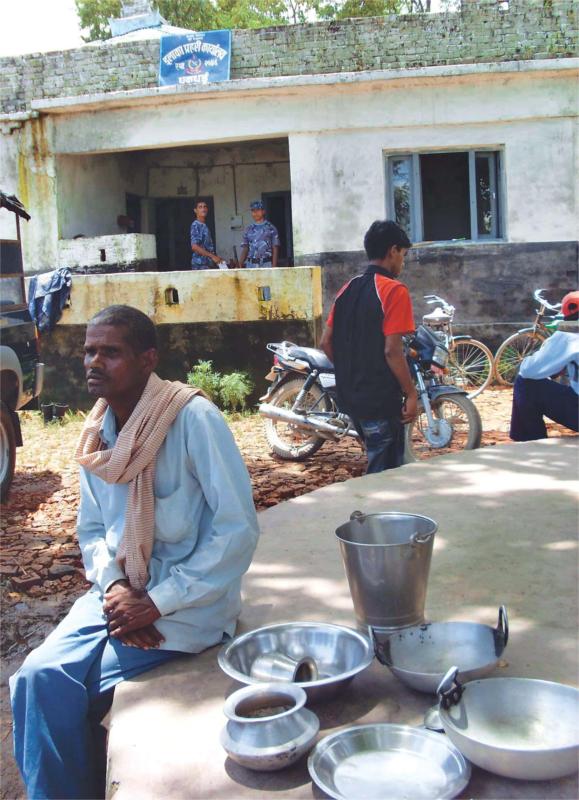
Dalits and discrimination in Nepal

Jay Ram Hirajan, a member of dalit community, waiting in front of a local police station seeking protection and justice. He was threatened of eviction (also black coal painting on his face) from Rupendehi by locals who alleged him of de-purifying utensils belonging to a non-dalit community. Hirajan's pet pig entered houses owned by two locals and touched cooking utensils, which was handed to Hirajan by the locals and ordered him to pay the cost of replacing new ones. He was warned of forced face painting with coal powder and eviction if he did not comply with the local's demand. In the picture, he is seen with the utensils in front of a local police station seeking protection and justice. (Source: Kantipur daily, July 30, 2008)

Social discrimination based on caste system is one of the constraints to mainstreaming marginalized groups into the national economy. These groups have been marginalized for centuries, resulting in a highly unequal social setting where the most poorest and discriminated ones never rises above a certain level, irrespective of the level of economic progress in the country. Somebody tell people to shed off useless conservatism and embrace socially progressive ideas!

Links of Interest

The world cannot grow its way out of this slowdown 

Kenneth Rogoff raises the inflationary alarm: "In policymaker’s zealous attempts to avoid a plain vanilla supply shock recession, they are taking excessive risks with inflation and budget discipline that may ultimately lead to a much greater and more protracted downturn." Well, I would be more worried about a fire engulfing my house right now then a potential fire that would engulf my house! Inflation does posses a risk but it is in the long run, when according to Keynes "we all are dead." That said, I believe that we can manage the dangers of inflation as time passes by being particularly careful with embedded inflation expectations. Mark Thoma weighs in: "Inflation is a concern, but raising interest rates too fast risks throwing the financial sector into a tailspin, and that would bring the economy down with it, and that's a risk I'd rather not take. We need to keep an eye out for signs that inflation is becoming embedded and self-reinforcing, but we need to be even more concerned about a domino effect taking hold in the financial sector. That danger is not yet over." More by Krugman here

Is the WTO no-deal a big deal?

If the real effects of a no-agreement are not likely to be important, is all this noise about the Geneva failure justified? Yes. Perhaps. To the extent that an agreement in the WTO would have strengthened (or at least would have not weakened) the multilateral trading system, the no-agreement may well be a setback. Such a system binds countries to respect a certain set of trading rules, for example preventing possible temptations towards self-sufficiency in the face of difficult domestic and international situations. This is not to deny the importance of domestic policy space. Allowing for moderate policy space is welcome to satisfy particular domestic needs, but a weak multilateral trade regime may allow for an abuse of domestic policy, which may promote protectionism. This is especially the case in a time of adverse international economic environment, as the current one.

Collapse of the WTO trade talks: A pity, and potentially a problem, but not a disaster

Putting a lasso on inflation

There are other ways to approach the challenge of high prices, of course. In its paper, the Asian Development Bank recommended income support to poor families...It's a cheaper and more economically efficient solution than one-size-fits-all subsidies, and it also allows households to prioritize their own purchases. Moreover, once people have the ability to pay global prices for the commodities they need, the problem of guaranteeing supply to the local market simply disappears.

What is Called Development? Exploring the Nexus of Economy

India lags behind Ethiopia in child nourishment

The consequences of a collapse of the Doha negotiation from the perspective of developing nations

Here is Jean-Michel Severnio, CEO of the AFD. More here.

Wednesday, July 30, 2008

Not a big deal: the WTO Doha round failed again

Newspaper editorials are abuzz with anger and frustration against India and China for creating a gridlock, again, in the WTO talks, leading to collapse of the protracted Doha "development" round of trade talks. High on the agenda were the US and the EU farm subsidies and demand posed by the US to developing countries to open up their manufacturing/industrial sector for trade. It is understandable that the US wants the manufacturing to be as free as possible despite its intransigence attitude in reducing farm subsidies --note that the US automakers and manufacturing firms have been struggling to stay put in the market chiefly due to stiff competition from low priced and better fuel economy vehicles from Japan and South Korea. They could not compete in home, so now they want to compete in places where the economy cannot afford to invest in manufacturing plants now. Its like grabbing before anyone grabs it or develops a potential to grab it!

India raised last minute alarm by insisting on inclusion of a provision for it (and the G33) to raise tariff in sectors very vulnerable to international price fluctuation.  Though the new condition was hugely unpopular among the West's negotiators, Indian chief negotiator and commerce minister, Kamal Nath, was also in a dilemma: domestic politics and international trade. He chose the first (remember, the Indians are going to polls in couple of months). He is being cheered in India now! The US, India, and China failed to agree a compromise on a proposal called the Special Safeguard Mechanism (SSMs), which was designed to protect farmers in the developing world against temporary surges in cut-price imports of cotton and rice...Kamal Nath claims that he had the backing of 100 developing countries. He was concerned about the livelihood of poor and subsistence farmers in India, where 70% of the population still depend on agriculture for living, rather than the inflated gains from trade and manufacturing sector deals.

Kamal Nath argues:

It is unfortunate in a development round, this is the last mile we couldn’t run because of an issue of livelihood security.

The Washington Post bemoans and argues that it will make the developing countries more poorer (what a ridiculous argument???) Surprised :

...China's role in the demise of the Doha Round is particularly dismaying, considering China has reaped huge benefits from global trade in the seven years since it joined the organization -- with strong U.S. support. Chinese exports have quadrupled from $300 billion in 2002 to $1.2 trillion in 2007, thanks in large part to free access to the U.S. market. U.S. supporters of Chinese inclusion in the WTO argued that drawing China into a system of multilateral give-and-take would mute its nationalistic tendencies. Evidently, the Chinese see the matter differently. They, and the world, will be poorer because of it.

Similar, but a milder, tone from the NYT:

...A breakdown would certainly be harmful. And the world’s poorest countries would lose the most.

...If the world’s richest nations give in to the temptations of protectionism, the world’s poorest countries will suffer the most. But no one, including the rich nations, will escape the damage to the global economy

Did the collapse of this trade talks mean that we lost a whole lot in terms of tariff and welfare gain? Well, not really. The tariff loss would amount somewhere between $50 billion to $100 billion-- that is equal to or double the amount of foreign aid given to developing countries in a year. It is a very tiny fraction of world GDP (around 0.1%). Worse, the benefits of trade would have gone mainly to the West- not to the poor farmers in developing countries. Ironically, the Doha round is also termed as "development round" in the belief that a success in trade talks would help the poorest people the most. Also, the poor countries already have special access to the markets of the rich world, meaning that a general cut in tariff across the globe would either not affect them or they would lose (the latter one having higher probability of occurrence!)

Here is Rodrik's advice to not cry loud for Doha:

Actually, not much. There was not a whole lot at stake to begin with for poor nations as a whole. (Cotton is a somewhat big deal for West Africa, but pretty much everything else is a mixed bag.) And if the taxpayers and consumers of the U.S. and EU want to reap the considerable benefits of reducing farm supports, they can surely do that on their own without having to be bribed by increased market access abroad.  So don't listen to trade officials and editorialists who will bemoan the huge downside risks.

The Economist says the collapse was expected (and it really was):

The failure of the Geneva talks will not send that into reverse. But with the world economy slowing, it is singularly ill-timed nonetheless. The best that can be said for the collapse of negotiations is that, after all the difficulties and acrimony that have plagued the Doha round for much of its seven-year life, few outside Geneva (and perhaps not many on the lake’s shore) expected a deal. But bad news, even when it is entirely predictable, is bad news all the same.

Bilateral and multilateral trade deals will be popular now (the Doha round is not dead yet...and it should not be!) because countries would be willing to go for free trade in a regional block where they face similar overhead costs and structural problems. For instance, India is really pushing forward for a free trade agreement in the SAARC region (known as SAFTA) and have already been allowing duty free entry of numerous goods into its market.

Here is an assessment from a recent study (The Promise and Perils of Agricultural Trade Liberalization: Lessons from Latin America) by the the Global Development and Environment Institute (GDAE) at Tufts University. It accentuates the need for SSMs:

The government’s responsibility is to provide the tools necessary to enable small farmers to take advantage of high global food prices to enter this virtuous cycle of development.  Governments should retain the ability to use tariffs to protect small holder agriculture when global prices fall; focus poverty alleviation programs on rural areas; accumulate food stocks to cushion citizens from price fluctuations; and act as a guaranteed buyer to small farms in acquiring these stocks.  Developing countries must navigate multilateral and bilateral trade negotiations in a way that allows them to retain the use of tariffs and safeguard measures.

Here is a nice summary of why the the talks stumbled.

The upside of rising global food prices-- Is there any?

An interesting debate is going on about the impact of food prices in positive direction-- actually trying to find out "an upside for humanity in the rise of food prices".

Here is the proposition posed by The Economist :

"There is an upside for humanity in the rise of food prices."

Here is an excerpt from an email I got from Lauryn Nicasio on behalf of the ongoing debate:

Although we can never overlook the grave situation posed by rising food prices, we hope to dissect the issue and view it from fresh perspectives to see if it can have a positive impact. For example, do rising food prices benefit farmers? Can they lead to development of safe, genetically modified foods which in turn can help developing nations with marginal farmlands become self-sustainable? And are the shorter-term pains of creating biofuels worth the longer-term gains of reduced transportation costs? 

Here is the debate hall

Here is Joachim von Braun (I agree with him!)

Here is Homi Kharas

Here is Papa Abdoulaye Seck

I think the answer is "it depends"...some farmers can gain from it but in the long run many more will suffer...we have to look at the net effect, especially from the perspective of farmers in the developing countries. Some initial thoughts:

  1. I think the moderator is asking a wrong/misplaced question, because the impact of global rise in food prices cannot be answered in plain black and white; the options cannot be either 0 or 1.
  2. Switching production from low price food products to high price food products will not be as easy as has been assumed. Especially in the developing countries, farmers are too poor to buy new seeds, local development banks are reluctant to offer a reasonable line of credit for such activities because of moral hazard problems. Development aid for agriculture has fallen from a high of 17% of total aid to just 3% today, with some international donors demanding that fertilizer subsidies be eliminated, making it even more difficult for cash-strapped farmers to compete. Paul Collier puts it in this way: "Unfortunately, peasant farming is generally not well-suited to innovation and investment: the result has been that African agriculture has fallen further and further behind the advancing productivity frontier of the globalized commercial model. Indeed, during the present phase of high prices the FAO is worried that African peasants are likely to reduce their production because they cannot finance the increased cost of fertilizer inputs. While there are partial solutions to this problem through subsidies and credit schemes, large scale commercial agriculture simply does not face this problem: if output prices rise by more than input prices, production will be expanded because credit lines are well-established."
  3. The big producers from the West would definitely benefit as they shift production to high priced corps, which earns them higher marginal revenue. These farmers can offer the technology needed for large scale production.
  4. Obviously, #2>#3 in terms of population...hence, the farmers in the developing countries will lose...(But if #2 is not a problem, then there might be upsides benefiting most of the people-- as of now a highly unlikely case...keep reading for some reasons!)
  5. About technology transfer: Even if higher food prices would trigger development of new technology and innovation in the West, the new technology might not transfer to developing countries as easily as we have been thinking. Have we seen a sea change in technology in the oil sector, even though prices skyrocketed during the 80s? Also, did the oil price rise change consumption patter? (Also, was there a change in consumption pattern after high global food prices during the 80s?)
  6. Moreover, transfer, adoption, and right use of new technology depends on institutional constraints, governance, culture, education, transportation, and communication, among others. How would my parents-- who entirely depend on agriculture for livelihood and live in an area where there is just one single lane, unpaved road--constructed in 2006/07, thanks to donors!--be able to use, in our small farm, a new technology made in the West? Also, would my parents be able to afford it? (Ans: No!)...Moreover, would the new innovation in the West, where farming is done in a large scale, be suitable for farmers in the developing world who hold small, fragmented land? Obviously, the transfer of technology would be too slow, if any. We have not seen high mobility of technology, one of the foundations of successful economies, from the West to Africa in the past couple of decades. Technology transfer argument is easier said than done!Confused
  7. People argue that markets clear itself and we will have an equilibrium price soon? Well, this argument is based on the assumption that there already is a free market in this sector-- which is not true! For instance, the subsidies given by the West and also by the developing countries like India and China to its farmers have been creating a situation where price stabilization towards an equilibrium is just not possible. There will be high degree of volatility and fluctuation, depending on many environmental variables. It should be noted that the subsidies in the US and EU alone in crops used for producing biofuels is driving 60% of the rise in food prices. Will this stop? As of now, it won't-- the protracted WTO talks collapsed just because of some of these thorny issues. See here how Japan alone can distort price of rice in the global market.
  8. Along the veins of the preceding argument, free market-- interpreted in conventional terms-- is not possible in this sector. No country would be willing to put its population under threat of a certain product and shift production pattern. For instance, India, where 70% of the population prefer rice and chapati (made from wheat) two times a day for meal, would not be willing to shift production from rice and wheat to say soybean, just because its price is rising in the international market. The very survival of millions of farmers and households depend on the agriculture sector (rural households spend more than 70% of their household budget on food). This sector is too vulnerable to let it freely flow along with the free market principles. We have already seen how deep we ran in troubled waters (in fact, the depth is still not reached) after the housing market and banking sector was let free flow according to the principles of free market. There is already a backlash-- more regulatory power given to the Fed and government administrations. As one of my Romanian friend used to say, "Free market cannot sustain in very vulnerable sectors because it is not a matter of losing an asset if anything goes wrong--it is a matter of life and death." Free market in sectors where survival is not in line-- like auto industry, airline sector, etc-- is good but not in sectors which have a direct bearing on the survival of poor people...(that said, I do believe in the power of market if things are as they should be!). Governments do not want to let their population fall prey to increased volatility and uncertainty in global food market, which is beset with demand and supply shock--there seems to be no end to it! Collier argues, "The sharp increase in the world price of staple foods is an inconvenience for consumers in the rich world, but for consumers in the poorest countries, especially in Africa, it is a catastrophe."
  9. The final effect would depend on whether households are net buyer or seller (or in a country level, whether countries are net importer or exporter). As of now, poor households are net buyers, which means that higher prices not only put too much strain in their household budget, any upside benefit would only go to the farmers in the West who can invest large sum of money. Also, poor households in the developing countries do not enjoy economies of scale as they own small pieces of land. Unlike them, the farmers in the West own large farmlands, enabling them to reap economies of scale--thus, making sure that their over the long run price of their product is always lower than the price of similar product produced by the poor country farmers.
  10. Any change in consumption and production patterns has to be global to ensure that upsides are fair to all. As Joe Stiglitz argues, Only new patterns of consumption and production – a new economic model – can address that most fundamental resource problem." Note that, we need a completely new economic model. The present model will not solve the problem.
  11. Well, follow The Economist's Debate Hall, which will feature expert views...I will spill some more thoughts in the coming days, especially on the incentive factor... I will also discuss why production in Lanao del Sur, which is one of the most fertile regions for rice production in the Philippines, is not done in the way it should have been to reduce pressure of rice demand in the Filipino economy, one of the most high rice consuming nations...incentives do come in play here???...that discussion is for later date...Sleepy

Here is a good summary of the implications of rising global food prices. A more extended discussion from a variety of sources on this issues here. Also see this.

image image

Tuesday, July 29, 2008

Links of Interest

Africa: Soon to be the next China?

How to Get the Biggest Bang for 10 Billion Bucks (Bjorn Lomborg argues that the same dollar spent on tackling diseases would generate greater economic payoffs than from investment in tackling transitional terrorism or hunger.)

Transitional terrorism: Stopping one catastrophic terrorist event would save the world at least $1 billion. Under these assumptions, this would mean a return of about $9 on each dollar spent.

Diseases: Each dollar spent on ensuring people are healthier and more productive would generate $20 in benefits.

Hunger:The improved nutrition would lead to higher productivity and fewer health problems. Each extra dollar spent would generate economic benefits worth $16.

Rising Income Inequality: Technology, or Trade and Financial Globalization?:

We examine the relationship between trade and financial globalization and the rise in inequality in most countries in recent decades. We find technological progress as having a greater impact than globalization on inequality. The limited overall impact of globalization reflects two offsetting tendencies: whereas trade globalization is associated with a reduction in inequality, financial globalization-and foreign direct investment in particular-is associated with an increase. A key finding is that both globalization and technological changes increase the returns on human capital, underscoring the importance of education and training in both developed and developing countries in addressing rising inequality.

Where are the jobs that take people out of poverty in Brazil?

11microfinance groups agree to publish rates; Nobel winner says don't profit from poor