Friday, March 13, 2020

Economic crisis ensuing medical shock and flow of income

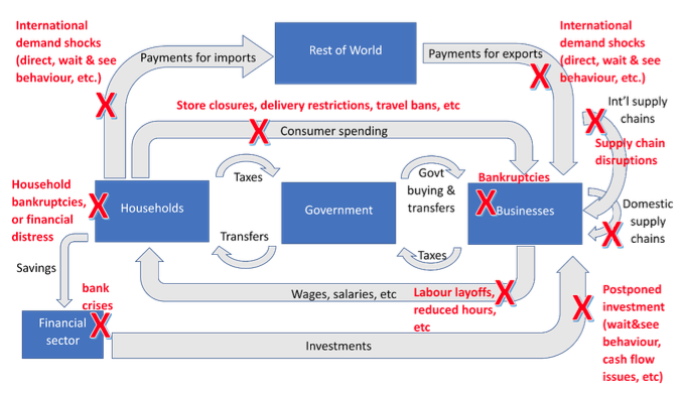
Richard Baldwin has a nice post on VoxEU on the effect of COVID-19 medical shock on economic crisis. He argues that this economic crisis is different because it has hit all the G7 economies and China at the same time and from multiple fronts. Here is his depiction of the famous circular flow of income diagram and how the medical shock is disrupting flow of goods & services and money. 
   
There is a combination of a supply and a demand shock. It is leading to expectations dampening and hysteresis. Bond prices and stock prices are moving in the same direction (not usual) and normally liquid assets are freezing up. Even gold futures have been falling. Risk averse behavior of households and business across investment and saving assets. Gripping uncertainty. 

Thursday, March 12, 2020

कोरोना भाइरसपीडित अर्थतन्त्र

यो विचार फाल्गुण २७, २०७६  गते नयाँ पत्रिका दैनिकमा प्रकाशीत भएको थियो.  English version is here. 


कोरोनाका कारण देखा परेको विश्वव्यापी आर्थिक मन्दीले हाम्रो कमजोर निर्यात क्षेत्रलाई झन् ठूलो धक्का पु-याउनेछ

कोरोना भाइरस प्रकोप (कोभिड-१९) ले क्षेत्रीय र विश्व अर्थ व्यवस्थामा गम्भीर असर पारिराखेको छ । भाइरसको महामारी कहिले रोकिने हो, ठेगान छैन । धेरै देशसँग त यसलाई जाँच्ने उपकरणसमेत अभाव छ । अहिले यस रोगको खोप पत्ता लगाउन वैज्ञानिक लागिपरेका छन् । छोटो समयमै विश्वव्यापी रूपमा फैलिएको यो भाइरसले दशकौँदेखि स्थापित आपूर्ति शृंखलामा अवरोध ल्याएको छ । 

यसले गर्दा विश्व अर्थतन्त्रमा मन्दी आउन सक्ने प्रारम्भिक पूर्वानुमान गरिएको छ । चिनियाँ सामान र पर्यटकको ठूलो महत्व रहेको हाम्रो अर्थतन्त्रमा सोझै नकारात्मक असर पर्ने देखिन्छ । चीनको हुबेई प्रान्तको राजधानी वुहानमा डिसेम्बर २०१९ मा भाइरस पहिचान भएको थियो । यसले चिनियाँ उत्पादन, आपूर्ति संयन्त्र र अर्थ व्यवस्थामाथि त गम्भीर चोट पु-याइसक्यो नै, भाइरसको विश्वव्यापी फैलावटबाट पैदा हुने अनिश्चितता र वैकल्पिक आपूर्ति शृंखलामा अचानक आघात आएपछि विश्वकै अर्थतन्त्र अहिले जोखिममा छ । विश्वव्यापी कारोबार हुने मध्यवर्ती उत्पादनको २० प्रतिशत चीनमा उत्पादन हुन्छ । सन् २००२ मा यो केबल चार प्रतिशत थियो । 

विश्वव्यापी आपूर्ति शृंखलामा कोरोना भाइरस महामारीको प्रभावबारे ‘युएनसिटिएडी’द्वारा गरिएको प्रारम्भिक विश्लेषणअनुसार सबैभन्दा बढी प्रभावित उत्पादनमा सटीक उपकरण, मेसिनरी, मोटरबाहन, सञ्चार उपकरण, विद्युतीय मेसिनरी, रबर र प्लास्टिक, छालाका सामान, धातु, कागज, पेट्रोरसायन र कपडालगायत पर्छन् । युरोपियन युनियन, अमेरिका, जापान, कोरिया र भियतनाम यसबाट सबैभन्दा बढी प्रभावित हुने अर्थतन्त्र हुन् । कच्चा माल र मध्यवर्ती सामान उत्पादनका लागि चीनमा निर्भर अन्य देश पनि प्रभावित छन् ।

यसबाहेक, कोरोना भाइरसको फैलावटका कारण श्रम, पुँजी र व्यापारमा अवरोध आउँदा धेरै देशमा उत्पादन क्षमता कम हुनेछ । ‘यसैगरी, प्रकोप विकसितहुने ट्रेन्डका आधारमा एशियाई विकास बैंकले विश्वव्यापी प्रभाव ७७ अर्ब डलर देखि ३४६ अर्ब डलरको बीचमा हुन सक्ने प्रारम्भिक आनुमन गरेको छ।  र्ती सामानको निर्यातमा दुई प्रतिशतको कटौतीले विश्वव्यापी पचास अरब डलरको उत्पादनमा गिरावट निम्त्याउँछ।

चार मुख्य प्रभाव

महामारीले सन् २००८ को विश्वव्यापी वित्तीय संकट र २०१० मा खाद्यान्नको मुद्रास्र्फीतिको भन्दा बढी नकारात्मक प्रभाव नेपाली अर्थतन्त्रमा पार्ने देखिन्छ । नेपाली अर्थव्यवस्था चार प्रमुख मोर्चामा प्रभावित हुने देखिन्छ । यसले आर्थिक वृद्धि र रोजगारीको अवसरलाई असर गर्नेछ । पहिलो, यात्रा र पर्यटन उद्योग, जुन २०२० मा अपेक्षित वृद्धिका लागि तयारीहुँदै थियो । 

यात्रा प्रतिबन्धले सन् २०२० मा नेपालमा  बीस लाख पर्यटक आगमनको आशा अब सपना मात्रै हुनेछ । पर्यटन पूर्वाधार र सेवाका आधारमा बीस लाख पर्यटक लक्ष्य सुरुमै अवास्तविक लक्ष्य थियो । बीस लाख पर्यटक आउने आशामा नयाँ स्थापना गरिएका, निर्माणाधीन र सञ्चालनमा रहेका होटेल र रेस्टुरेन्टका लगानीकर्तालाई ऋण नवीकरण गर्नुपर्ने समस्याले पिरोल्न थालिसकेको छ । 

चीनबाट सबै उडान निलम्बित छन् नै, अन्य देशबाट आउने पर्यटकमा पनि भारी गिरावट आएको छ । गत साल आएका बाह्र लाख पर्यटकमध्ये चौँध प्रतिशत चीनबाट आएका थिए । चिनियाँ पर्यटककै कारण मुलुकको पर्यटन क्षेत्रमा ‘अफ सिजन’ महिना नै घटेको थियो । वर्षभरि कारोबार चलायमान पारी आर्थिक गतिविधि र रोजगारी वृद्धि गर्न अहम भूमिका खेलेको थियो । भाइरसबाट संक्रमित हुने डरले अहिले पर्यटक आगमन ठप्पजस्तै छ । होटेलको औसत ‘अकुपेन्सी’ पैतालीस प्रतिशतभन्दा तल झरेको छ । 

अघिल्ला वर्षमा यो समयमा पचासी प्रतिशतभन्दा धेरै ‘अकुपेन्सी’ हुने गथ्र्यो । मुलुकमा आउने पाहुनामध्ये सत्तरी प्रतिशत छुट्टी र मनोरन्जनका लागि आउ“छन् भने आठ प्रतिशत पदयात्रा र पर्वतारोहण तथा पन्ध्र प्रतिशत तीर्थयात्रा गर्न आउँछन् । यात्रा र पर्यटन उद्योगमा गम्भीर प्रभावका कारण अन्ततः यस वर्ष सेवा क्षेत्रको वृद्धि अनुमान गरेभन्दा धेरै कम हुनेछ । यात्रा र पर्यटन क्षेत्रको प्रत्यक्ष योगदान (होटेल, ट्राभल एजेन्ट, एयरलाइन्स र यात्री यातायात सेवाद्वारा उत्पन्न आर्थिक गतिविधि) को अनुमानित कुल गार्हस्थ उत्पादनको चार प्रतिशतजति छ । यस क्षेत्रले पनि कुल वैदेशिक मुद्रा आयमा ६ प्रतिशत जति योगदान गर्दै आएको छ ।

दोस्रो, आयोजना कार्यान्वयन र समापनमा अवरोध आउनेछ । विशेषगरी, विमानस्थल, जलविद्युत्, सडक यातायातलगायत क्षेत्रका ठूला पूर्वाधार परियोजना समय र लागत वृद्धिका समस्याले पिरोलिनेछन् । केही चिनियाँ कामदार र प्रबन्धकलाई रोजगारी दिइरहेका चिनियाँ ठेकेदारले बनाइरहेका आयोजनामा समस्या देखिसकेको छ । जस्तैः नारायणघाट–बुटवल सडक सुधार परियोजना, रसुवागढी–स्याफ्रुबेँसी सडक परियोजना र काठमाडौं बाहिरी चक्रपथको विस्तृत परियोजना समीक्षालगायत कार्य प्रभावित भइसकेको सूचीमा पर्छन् । 

बिस्तारै अन्य आयोजनाले पनि कच्चा माल र मेसिनरी आभावका कारण समयमै सम्पन्न गर्न नसक्ने सकस व्यहोर्नेछन् । यसले सार्वजनिक पुँजीगत खर्चमा सोझै असर पार्नेछ । परिणामस्वरूप सिमेन्ट र डन्डी उद्योग उत्पादन कटौती गर्न बाध्य हुनेछन् । सरकारले पुँजीगत खर्च बाचा गरेझै बढाउने आशामा धेरै उद्योगले स्थापित क्षमतामा वृद्धि गरेका छन् । पुँजीगत खर्च सोचेभन्दा कम भयो भने ती उद्योग झन् समस्यामा पर्नेछन् । उदाहरणका लागि सिमेन्ट उद्योगको क्षमता उपयोग चालीस प्रतिशतमा झरेको छ । औद्योगिक र पर्यटन क्षेत्रमा उत्पादन र व्यापार कम भई बैंकको ऋण तिर्न नसक्ने अवस्थामा पुग्ने सम्भावना बढेको छ ।

तेस्रो, विश्वव्यापी आपूर्ति शृंखलामा चीनको केन्द्रीय भूमिका रहेको हुँदा प्रकोपले कच्चा माल र मध्यवर्ती सामानको आपूर्तिमा बाधा पु-याउँछ । नेपालका उद्योग तथा सेवा क्षेत्रले उत्पादन गर्ने मालसामानमा कच्चा माल, मध्यवर्ती वा तयारी सामानमा चीन निर्भरता धेरै छ । मुलुकको कुल व्यापारमा चीनबाट आउने सामानको पन्ध्र प्रतिशत हिस्सा छ । अरू देशमा चिनियाँ कच्चा माल र मध्यवर्ती सामान प्रयोग गरेर बनाइएका सामान पनि नेपाली उद्योगले प्रयोग गर्छन् । चीन निर्यात हुने शीर्ष वस्तुमा हस्तशिल्प, ऊनी कार्पेट, चाउचाउ र तयारी पोसाक पर्छन् । यस्तै, दूरसञ्चार उपकरण, तयारी पोसाक, विद्युतीय सामान, मेसिनरी पार्ट्स र रसायनिक मल चीनबाट आयात हुने शीर्ष वस्तु हुन् । विश्वव्यापी आर्थिक मन्दीले चीनबाहेक हाम्रा वस्तु र सेवाको मागलाई पनि कमजोर बनाउने पक्का छ । यसले हाम्रो कमजोर निर्यात क्षेत्रलाई झन् ठूलो धक्का पुग्नेछ ।

चौथो, ‘माइग्रेसन’ र रेमिट्यान्स प्रवाह प्रभावित हुनेछन् । सरकारले दक्षिण कोरियाजस्तो आकर्षक गन्तव्यमा बहिर्गमन निलम्बित गरिसकेको छ । त्यस्तै, खाडी देशमा वैदेशिक रोजगारीमा कडाइ गरेको छ । यी देशमा आपूर्ति र आर्थिक अवरोधका साथै विश्व आर्थिक मन्दीले लगानी घट्ने सम्भावना छ । यस्तो भयो भने हाम्रो रेमिट्यान्स आयमा ठूलो धक्का लाग्नेछ र बाह्य क्षेत्र झन् कमजोर हुनेछ । रेमिट्यान्सको आडमा धानिएको हाम्रो अर्थतन्त्रमा कत्रो धक्का लाग्छ, अहिल्यै अनुमान गर्न गाह्रो छ । यसका अलावा वित्तीय, मौद्रिक र बाह्य क्षेत्रमा पनि प्रभाव पर्नेछ । जस्तै, आयात कम हुनेबित्तिकै सरकारको राजस्व घट्छ । 

कर राजस्वको पैतालिस प्रतिशत त भन्सार र अन्तर्राष्ट्रिय व्यापारमा असुलिने करबाट संकलन हुन्छ । यस्तो हुँदा वित्तीय घाटा बढ्ने सम्भावना बढ्छ । उद्योगीले लिएको ऋण समयमै तिर्न नसक्दा खराब कर्जाको अनुपात बढ्न जान्छ । रेमिट्यान्स प्रवाहमा कमी आउँदा बैंकमा तरलताको समस्या हुन्छ । उद्योगले ऋण तिर्न नसक्दा खराब ऋणको मात्रा बढेर तरलतामै समस्या आउन सक्छ । 

आर्थिक वृद्धिमा धक्का 

आर्थिक वर्ष ०७६ र ७७ को बजेटको मध्यावधि समीक्षाको क्रममा अर्थमन्त्री डा. युवराज खतिवडाले सरकारले जसरी पनि आठ दशमलव पाँच प्रतिशत आर्थिक वृद्धि लक्ष्यलाई भेट्ने अथवा त्यसैको नजिक रहने ठोकुवा गरेका थिए । उनले सरकारले खर्च गर्छु भनेर विनियोजन गरेको पुँजीगत खर्चको लक्ष्य घटाउँदा पनि आर्थिक वृद्धिको लक्ष्य नघटाउँदा अर्थशास्त्रीहरू कुनचाहिँ आर्थिक मोडेलको आडमा उनले यस्तो ठोकुवा गर्दैछन् भनेर अचम्मित भएका छन् । 

अरू कुनै उल्लेखनीय आर्थिक काम नभए पनि र निजी क्षेत्र अझै चलायमान नभएको अवस्थामा अब झन् अर्थिक वृद्धिदरको लक्ष्यमा यथार्थवादी हुन जरुरी छ । वास्तवमा कोरोना भाइरसको प्रकोपअघि पनि आर्थिक गतिविधि अपेक्षाभन्दा कमजोर नै थियो । यस वर्ष कृषि उत्पादन खासगरी धानको उत्पादन घट्ने पूर्वानुमान सरकारले नै गरेको छ । ढिलो मनसुन, मलको अभाव, गुणस्तरहीन बिउको प्रयोग र फौजी कीराको आक्रमणले कृषि उत्पादनमा नकारात्मक असर पर्नेछ । सार्वजनिक खर्चमा ढिलासुस्तीले औद्योगिक उत्पादनमा असर पारेको छ । विशेषगरी, निर्माण र खानी तथा उत्खनन गतिविधि प्रभावित भएको छ । चालू आर्थिक वर्षको पहिलो ६ महिनामा सरकारले चार खर्ब आठ अर्ब पुँजीगत बजेटको पन्ध्र प्रतिशत मात्र खर्च गर्न सकेको छ । यो अघिल्लो वर्षको भन्दा सुधार होइन । 

यी कारणका साथै भारतीय अर्थतन्त्रमा पनि आर्थिक मन्दी आएका वेला अब यथार्थवादी भएर आर्थिक वृद्धिको लक्ष्य नघटाइ हुन्न । एसियाली विकास बैंक, अन्तर्राष्ट्रिय मुद्राकोष र विश्व बैंकले नेपालको आर्थिक वृद्धि ६ प्रतिशतको सेरोफेरोमा हुने पूर्वानुमान महामारी फैलिनुअघि गरेका थिए । अबको अद्यावधिक पूर्वानुमान पाँच प्रतिशतको सेरोफेरोमा हुने सम्भावना प्रबल छ । छिट्टै कोरोना भाइरसको महामारी नियन्त्रणमा नआई विश्व अर्थतन्त्रमा प्रभाव गहिरिँदै गए अर्को आर्थिक वर्ष पनि आर्थिक वृद्धिमा धक्का लाग्नेछ ।

नीतिगत औजार 

संकुचित वित्तीय अवस्था र बजेट कार्यान्वयनमा कमजोर क्षमताका कारण सरकारले तत्काल आर्थिक वृद्धि बढाउन गर्न सक्ने काम थोरै छ । वित्तीय प्रोत्साहन गर्ने नीतिभन्दा पनि तत्कालका लागि कोरोना भाइरस संक्रमण बढ्न नदिनका लागि सम्बन्धित निकायलाई चाहिएजति बजेट विनियोजन र रकमान्तर प्राथमिकता हुनुपर्छ । बजार अनिश्चितताको फाइदा लिई आपूर्तिकर्ताले कृत्रिम मूल्यवृद्धि गर्दैनन् भन्ने सुनिश्चित गर्न सरकारले बजार अनुगमन तीव्र पार्नुपर्छ । कोरोना भाइरसको असरले माग र आपूर्ति दुवै पक्षमा धक्का दिरहेको छ । घट्दो रेमिट्यान्स र आर्थिक मन्दीका कारण श्रमिकको आय कम हुन्छ भने उपभोग र लगानीमा पनि ह्रास आउँछ ।

विश्वव्यापी आर्थिक मन्दीले हाम्रो वस्तु र सेवाको माग कम गर्नेछ । यस्तो ‘डिमान्ड सक’ निराकरण गर्न वित्तीय प्रोत्साहन नीति चाहिन्छ । वित्तीय नीतिले प्रकोपविरुद्ध अझ राम्रो तयारी गर्न र स्वास्थ्य सेवाका लागि उपलब्ध वित्तीय स्रोतको खोजीमा महत्वपूर्ण भूमिका खेल्न सक्छ । तर, हाम्रो वित्तीय अनुशासन त्यति राम्रो नभएका कारण सरकारले केही गर्न सक्ने अवस्था देखिँदैन । अहिले गर्न सक्ने भनेको स्वास्थ्य क्षेत्रमा सक्दो धेरै आपतकालीन बजेट विनियोजन अथवा रकमान्तर नै हो । 

वाणिज्य मन्त्रालयले बजार अनुगमन गर्न आवश्यक जनशक्ति तथा रकम विनियोजन गर्न सक्छ । सरकारले व्यापारमा मन्दी आएका उद्योगलाई कर प्रोत्साहनका साथै मास्क र औषधि उत्पादनमा प्रत्यक्ष अनुदान दिन सक्छ । निजी अस्पताललाई उपचारका लागि तयार रहन प्रोत्साहित गर्न सक्छ । ‘आइसोलेसन’ को बन्दोबस्त गर्न कर सुविधा वा सहुलियत दिन सक्छ । प्रभावित परियोजनाका लागि समय र लागत बढ्न नदिन सरकारले विशेष व्यवस्था गर्न सक्छ ।

त्यस्तै, हाम्रा उद्योग र सेवा क्षेत्रले प्रयोग गर्ने आयातीत कच्चा माल, मध्यवर्ती सामान वा अन्तिम सामानको आपूर्तिमा समस्या आएर उत्पादन गर्न नसक्दा आपूर्ति सक (सप्लाई सक) आउन सक्छ । क्षमता उपयोग र उत्पादन सीमित पार्न सक्छ । परम्परागत मौद्रिक नीतिका उपकरणले गर्न सक्ने कमै छ । अपरम्परागत मौद्रिक नीतिका औजारले उत्पादन तत्काल नबढाए पनि व्यापार र व्यापारीलाई सहजता प्रदान गर्न सक्छ । उदाहरणका लागि राष्ट्र बैंकले क्रेडिट र ऋणको बोझ कम गर्न सक्ने मौद्रिक औजार ल्याउन सक्छ ।

रोलिङ पुनर्वृत्त सुविधा र ऋणको ब्याज तिर्न केही समयका लागि स्थगित वा माफीजस्ता औजार भूकम्पपछि पनि ल्याइएको थियो । राष्ट्र बैंकले लघु र मझौला उद्यमका लागि किफायती र पहुँचयोग्य कर्जा सुविधा घोषणा गर्न सक्छ । अन्तर्राष्ट्रिय विकास संस्थाद्वारा प्रदान गरिएको आपतकालीन ऋण सुविधा उपयोग गरेर वित्तीय र बाह्य तनावलाई सम्बोधन गर्न सकिन्छ । 

उदाहरणका लागि एसियाली विकास बैंकले नेपाललगायत धेरै देशमा प्राकृतिक प्रकोपपछि थप ऋण र अनुदान स्वीकृत गर्छ । आइएमएफले द्रुत ऋण सुविधा प्रदान गर्छ र अवस्था हेरर ऋण मिनाहा तथा देशको कोटाभन्दा थप धेरै ऋण प्रदान गर्छ । यसैगरी, विश्व बैंकले विकासशील सदस्य देशहरूलाई आवश्यक पर्ने वित्त पोषणका लागि प्रतिक्रिया दिन बाह्र अर्ब डलर प्रतिबद्धता गरिरहेको छ ।
Wednesday, March 11, 2020

Impact of COVID-19 on Nepali economy

It was published in The Kathmandu Post, 09 March 2020.


It makes sense for the government to lower its GDP growth target in light of the impact of the outbreak.

During the mid-year review of the 2019-20 budget, Finance Minister Yuba Raj Khatiwada asserted that the government would meet the 8.5 percent growth target despite acknowledging that actual public spending would fall short of the earmarked budget for this fiscal. However, he did not explain the reasons behind the unchanged growth target in the face of lower capital spending and agricultural output. The recent outbreak of Covid-19—a new disease caused by novel coronavirus that originated in Wuhan, the capital city of Hubei province in China—and its effect on the economy is making the growth target more elusive than ever.

In fact, economic performance was already below expectation before the coronavirus outbreak, which is wreaking havoc on global value chains and threatening the global economic outlook. Agricultural output, especially paddy production, is expected to decrease this year due to a delayed monsoon, shortage of fertilisers, use of substandard seeds and an armyworm invasion. Slow public spending has hit industrial output, especially construction, and mining and quarrying activities. During the first half of this fiscal, the government was able to spend only 15 percent of the Rs408 billion capital budget. These factors coupled with the continuing slowdown in the Indian economy—the largest source of investment commitment and inbound international tourists, and to whose currency the Nepali rupee is pegged—mean that a growth target higher than the provisional growth in 2018-19 is ambitious in the first place.

Four effects

The coronavirus outbreak is severely affecting global as well as regional economic outlooks. This epidemic is bound to affect the Nepali economy much more than the effect of the global financial crisis in 2008 and the food price spikes in 2010. Specifically, the Nepali economy will be impacted on four major fronts, affecting economic growth and employment opportunities.

First, the travel and tourism industry, which was gearing up for an expected tourist surge in 2020, is feeling the brunt of Covid-19. This has put a lid on any chance of achieving the ambitious two-million tourist target in 2020, an ill-conceived numerical target that was not in sync with the state of the tourism infrastructure. Investors who borrowed money from financial institutions to establish new hotels and restaurants or refurbish the existing ones will likely face cash flow problems. The expected business bonanza has almost evaporated with the slump in tourist arrivals. All flights from China are suspended now, and inbound visitors from the country have come to a screeching halt. It was partly because of the surge in Chinese tourists—who accounted for 14 percent of the 1.2 million visitors in 2019—that Nepal's travel and tourism industry did not really have an offseason market. The year-round business supported economic activities and employment.

Note that of the total visitors, 70 percent come for holiday and recreation, 8 percent for trekking and mountaineering, and 15 percent for pilgrimage. The increasing fear of catching Covid-19 as it spreads globally will limit visitors from other countries too. Some researchers are already predicting an outbreak in Kathmandu soon, partly owing to Nepal’s poor ability to manage infectious disease. This is going to specifically affect economic growth through a lower than expected services output. The direct contribution of the travel and tourism sector (economy activity generated by hotels, travel agents, airlines, and passenger transportation services) is estimated to be about 4-5 percent of GDP. The sector also contributes about 6 percent of the total foreign exchange earnings.

Second, setbacks in project execution and completion is likely in several large infrastructure projects in the airport, hydropower and road transport sectors. In the immediate term, it will affect projects led by Chinese contractors that are employing some Chinese workers and managers. They include the Narayanghat-Butwal road improvement project supported by the Asian Development Bank, Rasuwagadhi-Syabrubesi road project and detailed project review of the Kathmandu outer ring road supported by the Chinese government, and hydropower projects such as Khimti-2 and Langtang Khola, among others. It will directly affect public capital spending, which in turn will exacerbate the finances of some companies saddled with excess installed capacity (anticipating accelerated capital spending), but low capacity utilisation (in reality slow capital spending). It includes the cement industry, whose capacity utilisation had already dropped to 40 percent in 2018-19. Accommodating requests for time and cost overruns for the affected projects may be warranted.

Third, the coronavirus outbreak will disrupt supplies of raw materials and intermediate goods because of China’s central role in global value chains. The manufacturing and services sectors in Nepal too will feel the brunt because of reliance on imported goods—be it raw materials, intermediate or final goods. China accounts for about 15 percent of Nepal’s total trade. Nepal’s top exports to China are handicraft, woollen carpets, noodles and readymade garments. Meanwhile, the top imports from China are telecommunication equipment, readymade garments, electrical goods, machinery parts and chemical fertilisers. Nepal’s flagging exports sector will further suffer as a synchronised global economic slowdown will weaken demand for our goods and services beyond China.

Fourth, outmigration for work and remittance inflows will get affected. Outmigration to attractive destinations like South Korea is already suspended. A sharp global economic slowdown due to supplies and economic disruptions will gradually lower investment in migration destinations (such as the Middle East). This will eventually decrease demand for Nepali migrant workers, leading to a deceleration of remittance inflows and potential external sector stress. It happened already when global fuel prices tanked a few years ago.

What next

Unlike in the past, the Nepali economy is not immune to the global outbreak of Covid-19. Unfortunately, there is little the government can do to mitigate the economic impact owing to limited fiscal space and budget execution capacity.

For now, prioritising preparedness and vigilance by deploying resources as well as allocating more funds to the concerned agencies must be the priority. The goal should be to effectively contain the spread within the country in the most cost-effective way, but without compromising quality and standard healthcare procedures. The government will also have to intensify market monitoring to ensure that suppliers and sectoral cartels do not artificially raise prices taking advantage of market uncertainty. It will aggravate cost-push inflation in the face of supply disruption. Perhaps it also makes sense for the government to lower its GDP growth target in light of the impact of the coronavirus, and lower than anticipated capital spending and agricultural output. 

Tuesday, March 3, 2020

Incentives to make India a hub for manufacturing of electronics and components


In one of the biggest incentive schemes to boost domestic manufacturing of mobile phones and their components, the government has worked out a production-linked incentive (PLI) package of nearly Rs 42,000 crore for those making in India, planning to offer a benefit of 4-6% on incremental sales (of goods manufactured locally) for a period of five years.
[...]The electronics hardware manufacturing sector faces the lack of a level-playing field vis-à-vis competing nations… (and) suffers from a disability of 8.5% to 11% on account of lack of adequate infrastructure, domestic supply chain and logistics; high cost of finance; inadequate availability of quality power; limited design capabilities and focus on R&D by the industry; and inadequacies in skill development...
[...]The government plans to offer incentives under the scheme to large contract manufacturers (as defined in the FDI policy circular of 2017) on sale of phones above the invoice value of $200 (a little over Rs 14,000). Those to benefit will include global contract manufacturers such as Foxconn, Flex and Wistron, all of whom are making products in India. However, some companies such as Oppo, Vivo and even Samsung are not too happy as the incentive is for devices with ex-factory price of above $200, and the majority of phones sold by them are below this cost.
[...]The government wants to cut the ballooning bill of electronics imports. It hopes that incentives through the scheme will help create incremental production of Rs 8.2 lakh crore worth of mobile phones and their parts, generate exports of Rs 5.8 lakh crore, while creating 2 lakh fresh jobs and contributing Rs 4,782 crore to the exchequer through direct tax revenue.
[...]The total incentive planned to be given in the first year is around Rs 4,030 crore, in second Rs 6,395 crore, in third Rs 8,760 crore, in fourth Rs 11,790 crore and in fifth Rs 10,820 crore. “With the demand for electronics hardware expected to rise rapidly to approximately $400 billion (approximately Rs 26 lakh crore) by 2025, India cannot afford to bear the rapidly increasing foreign exchange outgo on account of electronics imports...

Monday, March 2, 2020

Coronavirus affects travel, trade and supply chains worldwide

Eswar Prasad writes in NYT that there is little hope for a global economic rebound in 2020.  Excerpts:

The spread of the virus is hurting travel, trade and supply chains worldwide. The Baltic Dry Index, a forward-looking indicator of global trade, has fallen by half and oil prices are down by about a quarter so far this year. U.S. stock markets, after initially taking the epidemic’s fallout in stride, are now experiencing a major sell-off.
[...]Financial markets are prone to large, sentiment-driven swings that sometimes seem out of line with economic fundamentals. But the news of the last few days suggests that, rather than coming under control and being confined to China, the outbreak is spreading and could get far worse. Stock markets in the United States and elsewhere are reflecting this reassessment of the epidemic’s future trajectory and the risks it poses.
The notion of this outbreak being a short-lived negative shock to global demand now looks unrealistic. It is not just spending on restaurants and travel that is suffering, but also investment by businesses while they wait for the uncertainty to be resolved. This will have long-term effects on growth even if the outbreak proves short-lived.
The disruption of supply chains, especially those that pass through Asia, is hurting businesses in multiple dimensions. Countries such as China, South Korea and Japan are critical to the supply chains for products ranging from plastic toys to iPhones to high-tech machinery. In these countries, manufacturers can’t get raw materials delivered reliably, are facing worker shortages and are having difficulty shipping out products. Rejiggering supply chains takes months, if not years. If the coronavirus spreads and causes disruptions to other major economies, it could wreak further havoc on supply chains.
[...]There is no easy way out. The Federal Reserve and other central banks could cut interest rates. This might not do much good, as uncertainty will restrain consumer spending and business investment even if cheap loans were available. Government spending might be more potent. Any assistance that reaches small businesses and allows them to stay afloat or goes directly into the hands of low-income consumers will help. But consumers and businesses are as likely to stash away any extra cash as they are to spend it.

Monday, February 24, 2020

Rethinking advise to emerging markets

In an opinion piece for the Financial Times, IMF's managing director Kristalina Georgieva highlights the Fund's new approach to advising emerging markets given their unique context and diversity of policies pursued by them. Initially, the integrated policy framework will focus on monetary policy, macroprudential policy, exchange rate interventions and capital flow measures. It will be expanded to include fiscal policy. Excerpts from the FT piece.

Our goal is to provide country-specific advice on the appropriate mix of policies needed to preserve growth and financial stability.
Our new “integrated policy framework” will reassess the costs and benefits of four tools — monetary policy, macroprudential policy, exchange rate interventions and capital flow measures — to help stabilise economies exposed to domestic and external shocks. Importantly, the “integrated” aspect of the new framework will capture how these tools interact with each other and with country circumstances.
The IMF’s current framework, grounded in more conventional economic thinking, broadly steers members towards using the exchange rate as a shock absorber. This approach provides a good approximation of how advanced economies adjust to external shocks and exchange rate movements. But it can miss important characteristics of emerging markets that alter their economies’ response to external shocks and may call for a different policy prescription.
New research indicates that while emerging markets are deeply integrated in global trade, their trade is disproportionately invoiced in dollars and consequently flexible exchange rates provide limited insulation. Similarly, while emerging markets are substantially integrated in global capital markets, their foreign debt is denominated extensively in dollars. That can cause exchange rates to become shock amplifiers as they can suddenly increase debt service costs and liabilities.
In fact, the striking diversity of policies pursued among economies could reflect their differing exposure to external shocks. Emerging markets also differ widely in the liquidity of their foreign exchange markets, which could affect the range of tools available to them for stabilisation.

Thursday, February 20, 2020

PPP in infrastructure: How and when to use?

In a recent NBER working paper, Engel, Fischer and Galetovic outline when and how to use public private partnerships (PPPs) in infrastructure. Broadly, they argue that PPPs can be used to increase spending and efficiency gains— better maintenance, reduced bureaucratic costs, and filtering white elephants among others. However, governance of PPPs is important, especially appropriate risk allocation and avoiding opportunistic renegotiations.  

PPPs allow governments to increase spending in infrastructure because: (i) investment via PPPs does not contribute to fiscal deficit and add to public debt in the short run, and (ii) such investment is not subject to regulatory oversight and budgetary controls. 

There are tradeoffs too as government has to forgo future stream of tax/toll revenue from projects that are financed via PPPs, which do not require large upfront investment by the government. PPPs are also used to promote private investment in infrastructure to replace an incompetent public sector. Large infrastructure projects require stronger capabilities to mange contracts and execute projects. 

According to the authors of the working paper, the main reasons for opting for PPPs over public provision are:
  • Narrow focus and dedicated management (contract with employees governed by private law, incentives to manage infrastructure per contract with public authority, SPV to build and manage projects)
  • Bundling (quality of service is contractible and life-cycle approach toward maintenance reduces maintenance and operations costs
  • Fewer construction delays (because of the opportunity to charge user feeds or receive government transfers once project is operations)   
  • Filtering white elephants (private players will not opt for projects where user fees cannot pay for capital and operational expenditures)
  • Avoiding bureaucratic costs (related to rigidities in public spending and corruption)
  • Advantages of private financing (mitigate moral hazard by tightly controlling changes in the project’s design and disbursing funds by banks according to project construction timeline/stages)
  • Better and less expensive maintenance (continuous maintenance is efficient as intermittent maintenance incurs 1.5 to 3 times the cost of continuous maintenance)
For PPPs to succeed, government should have higher capabilities as financing is more complex and there is scope for opportunistic behavior (long-term contract and dealing with government entities). 

Sometimes government has to bail out PPP projects, thus absorbing all the downside risks. There are also cases of contract renegotiation, which opens up avenue for corrupt practices. This can be avoided by using contracts with better risk allocation (concessionaire bears all the exogenous demand risks but renegotiation is allowed in the case of low realization of demand). For instance, Present-Value-of-Revenue (PVR) contracts have built-in renegotiation condition if demand realization is low, in which case contract term is extended but contract itself is not modified. They authors suggest that careful planning, project design, and project management are vital for successful PPPs. 

On the fiscal implications of PPP projects, they argue that PPPs have been used as a means of evading fiscal spending constraints. The use of off-balance sheet expenditure is often termed as “fiscal illusion”. The debt is recorded as financial liability but does not become a part of budget itself over short to medium term. The authors argue that the advantage of PPPs should lie in efficiency gains, not only fiscal accounting gimmickry to increase spending.