
Source: Patan Museum
The picture shows lines of poor people being fed at Tundikhel when the then autocratic Prime Minister Chandra Shamsher, fifth PM from the Rana dynasty, returned from Europe in 1909. The tall structure in the picture is Daharaha.
Source: Patan Museum
The picture shows lines of poor people being fed at Tundikhel when the then autocratic Prime Minister Chandra Shamsher, fifth PM from the Rana dynasty, returned from Europe in 1909. The tall structure in the picture is Daharaha.


An IEA economists says that it is “too good to be believed”. The 2°C below pre-industrial temperature benchmark is widely used these days. But, the pre-industrial temperature itself is, on average, 6°C above ice ages temperature.
The Economist writes, “Despite 20 years of climate negotiation, the world is still on an emissions trajectory that fits pretty easily into the “business as usual” scenarios drawn up by the Intergovernmental Panel on Climate Change (IPCC). According to the IEA, the scenario puts the world on course to warm by 3.5°C by 2100. For comparison, the difference in global mean temperature between the pre-industrial age and the ice ages was about 6°C.”


The IEA also looked at what it might take to hit a two-degree target; the answer, says the agency’s chief economist, Fatih Birol, is “too good to be believed”. Every signatory of the Copenhagen accord would have to hit the top of its range of commitments. That would provide a worldwide rate of decarbonisation (reduction in carbon emitted per unit of GDP) twice as large in the decade to come as in the one just past: 2.8% a year, not 1.4%. Mr Birol notes that the highest annual rate on record is 2.5%, in the wake of the first oil shock.
But for the two-degree scenario 2.8% is just the beginning; from 2020 to 2035 the rate of decarbonisation needs to double again, to 5.5%. Though they are unwilling to say it in public, the sheer improbability of such success has led many climate scientists, campaigners and policymakers to conclude that, in the words of Bob Watson, once the head of the IPCC and now the chief scientist at Britain’s Department for Environment, Food and Rural Affairs, “Two degrees is a wishful dream.”
The fight to limit global warming to easily tolerated levels is thus over. Analysts who have long worked on adaptation to climate change—finding ways to live with scarcer water, higher peak temperatures, higher sea levels and weather patterns at odds with those under which today’s settled patterns of farming developed—are starting to see their day in the uncomfortably hot sun. That such measures cannot protect everyone from all harm that climate change may bring does not mean that they should be ignored. On the contrary, they are sorely needed.

"nothing quite symbolised this State’s loss of sovereignty than the press conference at which the ECB man spoke along with two IMF men and a European Commission official. It was held in the Government press centre beneath the Taoiseach’s office. I am a xenophile and cosmopolitan by nature, but to see foreign technocrats take over the very heart of the apparatus of this State to tell the media how the State will be run into the foreseeable future caused a sickening feeling in the pit of my stomach.
This is not to say that we would be happy to have our country’s affairs managed by the current, disgraced, government. I yield to no-one in my loathing of the men and women who have done this to my country. What has been the intellectual low-point of the last couple of years? Was it the cash-for-clunkers stimulus package (Ireland does not produce any cars)? Or the statement by our Finance Minister that Ireland need not fear a bank run, since Ireland is an island? Or the biggest Irish joke of them all, which underpinned the bank guarantee in the first place: that if we wanted investors to retain confidence in the creditworthiness of the Irish State, we needed to make sure that nobody who invested in our (private sector) banks ever lost a penny?"
Dan O’Brien, the economics editor of the Irish Times, quoted by Kevin O'Rourke. He describes more of the Irish pain brought about by the irresponsible banking sector, who will get a substantial portion of the bailout funds. O’Rourke calls it “black hole that is the Irish banking system”. The Irish citizens are suffering because of its banking system. It got too drunk with lending-Guinness!! Now, the Irish State is having a terrible hangover while the debt-ridden drunkards are preparing to run scot-free again to cause another accident. Rein in them and force them to be sober before it is too late, again!
The latter decision is the one that sank the country. It was the last great act of hubris of the Celtic Bubble, and was immediately denounced by one of the heroes of the crisis, my old UCD colleague Morgan Kelly. On the night the guarantee was announced, Kelly pointed out that while it was the right policy if the Irish banks were facing a liquidity crisis, it was a terrible policy if they were insolvent, which was in fact the case. As they always do when confronted with someone smarter than them, the Dublin establishment circled the wagons, and Kelly was dismissed as an irresponsible young troublemaker of no consequence. He has been proved right, of course, but the establishment is still at it, making the
same fundamental mistake of thinking that a solvency crisis is just a liquidity crisis. Now, however, the establishment is European as well as Irish, and it is the State rather than the banking sector which is insolvent.
More on Iceland versus Ireland here.
The role of SMEs in China’s growth is less well known, compared to the popularity of big manufacturing industries. But, SMEs have played a crucial role in growth in China’s success in light manufacturing success. A WB team visited industrial zones in China and Vietnam to study the success of SMEs there. They argue that facilities provided by the government in industrial zones led to the success of SMEs in China. The Chinese government provided market enabling conditions and encouraged firms to follow market-price signals. It, however, did not provide direct subsidies, thus avoiding inefficiencies and market distortions.
One spectacular example of China's success and the role played by zones is the Weihai Zipper Company in Zhejiang. Starting from virtually nothing, over a span of two decades, it now exports $15 million worth of zippers to about 60 countries. It currently employs 3000 workers with an estimated daily output of 4 million zippers. This company is part of a zipper industrial cluster which counts more than 500 companies (China has more than 75% of the world’s market share in zipper, with the industry employing more than a million workers). Weihai Zipper Company decided to move to an industrial zone because the government offered a great package of cheap and abundant land and a predictable supply of utilities, especially water and energy. The manufacturer said that moving to the industrial zone enabled the scale up of the company by providing more space for plant expansion and for workers’ dorms in the park.
China has more than 1000 industrial zones following a central government policy encouraging the development of such zones. Most cities and counties have followed the models set by the large zones developed by the central and provincial governments. The local governments are motivated to develop industrial zones to get tax revenues and revenues from selling land, as well as nice records of administrative performance. Of course, not all Chinese industrial zones have been successful; the better ones were built on existing or potential industrial strengths, in other words, local comparative advantages. These industrial zones played a critical role in facilitating the growth of Chinese SMEs from family operations catering to the local market to global powerhouses. These zones not only provided Chinese SMEs with good basic infrastructure (e.g. roads, energy, water and sewage), security, streamlined government regulations (e.g. government service centers) and affordable industrial land, they also provided technical training, low cost standardized factory shells allowing Chinese entrepreneurs to "Plug and Play" as well as Chinese workers with free and decent housing accommodations right next to the plants. Hence they played a very critical role in helping Chinese small enterprises to grow into mid-size and large enterprises, avoiding the "Missing Middle" problems that other countries face.
These industrial "Plug and Play" zones considerably reduced the start up investment costs and risks for SMEs at a phase in their development where they are still too risky for bank loans. They also facilitated the development of industrial clusters allowing tremendous economies of scale and scope for Chinese industries (the emergence of clusters was further facilitated by the Chinese government's support for the development of input and output markets). In a nutshell, the Chinese government facilitated SME development through the efficient provision of public goods and market information about sellers and providers but not subsidies. For example, firms pay market prices for the use of utilities. Most importantly, competition between firms is intense. The government does not bail out failing firms. It should also be noted that most of these zones did not preselect particular light industries, letting market forces drive the organic development of specialized clusters.
Now, India is also going on the same lane with this kind of industrial zone.
“Improving infrastructure in the entire country will take a long time, so if you want to promote industry, you need to create more islands of excellence, which these SEZs are.
[…]About 100 zones have opened since 2006, attracting 1.6 trillion rupees in investment, 60 times the level four years earlier. That helped create more than half a million jobs, the Commerce Ministry said. About 478 more SEZs have been approved.
[…]The government-sponsored and private enclaves reduce red tape by offering a single office for environmental, tax and other government clearances. They also offer a way around power and water shortages in a nation that produces 10% less electricity than it needs. Companies operating in the zones get tax breaks for 15 years and don’t have to pay local excise or customs duties.”
Here is how climate change will potentially affect MDGs. It is sourced from South Asia Climate Change Strategy, 2009, pp.105-106.
Eradicate extreme poverty and hunger (Goal 1)
Health-related goals (Goals 4, 5 and 6)
Achieve universal primary education (Goal 2)
Promote gender equality and empower women (Goal 3)
Ensure environmental sustainability (Goal 7)
Global partnerships
The value of world merchandise trade was 18% higher in the third quarter of 2010 than in the same period of 2009, according to the latest WTO quarterly figures. However, this marks a slowdown in comparison with the 26% increase registered in the second quarter of 2010.
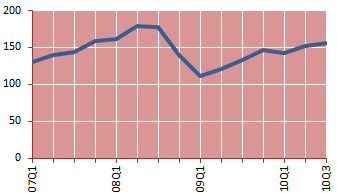 From January to September trade expanded by 23%, continuing the recovery that began in the second quarter of 2009. Despite this positive trend, the value of world trade remains below its peak level from before the present financial crisis. (The chart on the left shows world merchandise exports, Q12005=100).
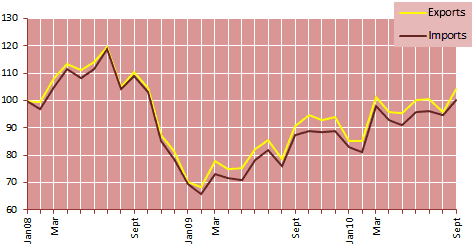
The chart below shows monthly merchandise trade, aggregate of 70 economies, January 2008=100
This paper studies the trade of China in the past 150 years, starting from the first opening of China after the Opium War. The main purpose of the paper is to identify what is (and was) China’s ‘normal’ level of foreign trade, and how these levels changed under different trade regimes, from 1840 to the present. We present new evidence on China’s foreign trade during the treaty port era (1842-1948), drawn from disaggregated trade data collected by the Chinese Maritime Customs Service, that yields important findings for current research. First, although the volume of foreign trade remained limited initially, there was a notable expansion in the diversity of products, with many new goods being imported into China. Second, the regional diffusion of foreign goods through China was greatly facilitated by the expansions of the port system. Third, the importance of Hong Kong as an intermediary in China’s trade has undergone long-term fluctuations suggestive of learning effects. China’s recent wave of liberalization has led by the early 1990s to a trade level comparable to the high of the 1920s. While much of China’s recent growth in world trade is in line with her income growth, there is no doubt that China’s trade openness today, comparable by some measures to Denmark’s, is a stunning reversal relative to the pre-1978 and also the pre-1840 period. The paper emphasizes the roles that history and institutional change have played in this.
Here is the paper written by Wolfgang Keller, Ben Li, and Carol H. Shiue.
Before the twentieth century, China’s top two import destinations were Hong Kong and Great Britain. Meanwhile, its top two export destinations were Great Britain and Hong Kong. Overall, it traded more with Hong Kong, the Europeans, and British India.
| China's Average Trade Shares, 1865-1900 (percent) | |||
| Imports | Exports | ||
| Hong Kong | 41.36 | Great Britain | 31.65 |
| Great Britain | 24.82 | Hong Kong | 26.94 |
| British India | 18.23 | Continental Europe | 11.86 |
| Japan | 5.8 | USA | 11.07 |
| USA | 2.65 | Russia | 5.82 |
| Continental Europe | 2.31 | Japan | 4.93 |
| Other Countries | 4.84 | Other Countries | 7.73 |