Tuesday, November 2, 2010

The Dalai Lama Effect on International Trade

The Chinese government frequently threatens that meetings between its trading partners’ officials and the Dalai Lama will be met with animosity and ultimately harm trade ties with China. We run a gravity model of exports to China from 159 partner countries between 1991 and 2008 to test to which extent bilateral tensions affect trade with autocratic China. In order to account for the potential endogeneity of meetings with the Dalai Lama, the number of Tibet Support Groups and the travel pattern of the Tibetan leader are used as instruments. Our empirical results support the idea that countries officially receiving the Dalai Lama at the highest political level are punished through a reduction of their exports to China. However, this ‘Dalai Lama Effect’ is only observed for the Hu Jintao era and not for earlier periods. Furthermore, we find that this effect is mainly driven by reduced exports of machinery and transport equipment and that it disappears two years after a meeting took place.

Very interesting and surprising! Read the full paper here

Their hypotheses are

  • There is a trade-deteriorating effect caused by foreign officials receiving the Dalai Lama.
  • The detrimental effect of Dalai Lama meetings on trade grows with the rank of the dignitary met.
  • The trade-deteriorating ‘Dalai Lama Effect’ disappears as bilateral relations between China and partner countries recover.

So, China punishes countries if their high level officials meet the Dalai Lama!

Friday, October 29, 2010

Trade and industrial production back to pre-crisis level?

The figure below shows that trade and industrial production have returned to pre-crisis level. Look carefully. The recovery relates to by volume measure. The growth rate of trade and industrial production is still down after months of incline.

The recovery, measured by growth rate, of trade and industrial production potentially looks like a W-shaped recovery (the level of troughs might differ depending on government activism!). When government intervention for aggregate demand management was high, both trade and industrial production growth rate was increasing. Now, since this is forgone because of austerity fetish in most of the countries, growth rate is beginning to come down as well. See the dent on output loss in developed countries. Andrew Burns argues that this might be permanent. Look at China’s output. Its surging upwards. The price of hands off approach by governments in developed countries is clearly seen in the figure.

By volume, global industrial production, the sector of activity most affected by the crisis—which fell by 10 percent between August 2008 and January 2009—regained pre-crisis activity levels by March 2010. Trade, which had declined by 19 percent in volume terms as of January 2009, has also regained pre-crisis levels, although somewhat later than industrial production.

For more see this piece by Andrew Burns.

Thursday, October 28, 2010

Experimentation and coordination as industrial policy

Industrial policy can be thought of as any type of selective government intervention or policy that attempts to alter the structure of production in favor of sectors that are expected to offer better prospects for economic growth in a way that would not occur in the absence of such intervention. Countries do not know ex ante if a select policy would be successful in successfully aiding a sector or production. So, there has to be trial and error to discover which sector is successful and which is not.

Gebreeyesus and Iizuka study floriculture and salmon industry in Ethiopia and Chile, respectively, and argue that experimentation and coordination also has to be a part of industrial policy. They look at (i) knowledge development and diffusion, (ii) entrepreneurial experimentation, (iii) influence of the direction of search, (iv) market formation, (v) legitimating, (vi) resource mobilization and  (vii) development of positive externalities.

“Even though these two cases are different in many aspects (for example, geography, type of activity, developmental stage, and even the guiding philosophy of the governments), we found various similarities that tie these two successful cases together. The triggering factors for the emergence of the new activities were a combination of different factors including natural endowment and favourable climate. The entrepreneurial experimentation by private entrepreneurs was, however, critical for 'discovery' of the sectors in both countries.

One characteristics of the early stage in new activities is the existence of large uncertainty in technology, marketing, and infrastructure. The governments' selective support at the initial stage was equally critical in reducing these uncertainties. In both cases, the government role changed through phases of development of the sectors. At the early stage governments played a developmental role by providing some inputs and sharing costs (for example, finance and technical support in the case of Chile, and finance, land, and transport co-ordination in the case of Ethiopia). These helped for the success of the pioneers and entry of many other investors, thus created conditions for take-off. In the growth stage other forms of engagement such as increasing regulatory role, formalization of the interactions, and strengthening of institutions start to take place.

Another important lesson from both cases is harmonization between the governments and private sector in the sector building. This was made possible by the presence of pathfinder institutions that consistently pursue the development of the sector and co-ordinate activities accordingly. In Ethiopia, the industry association played the pathfinder role. In Chile, FundacionChile was the key institution from start, even though in the later stage the Association of Salmon Industry was also instrumental. In both cases the pathfinders play important roles in consensus-building between government and the sector, standard-setting (self-regulation), collective market search, developing capacity of members, promotion and legitimation of their respective sectors.”

Here are two more stuff on industrial policy:

Nobel Prize in Economics for Unemployment

My latest piece is about the recently announced Nobel Prize in Economics. I briefly discuss some of the main points of MDP’s research and its implications in real life. For more discussion about the trio’s work, reaction from other economists, Diamond Paradox, and, following their work’s trail, the rationale for “aggregate demand management”, see this blog post.


Nobel for unemployment

The Nobel Prize in economics is probably one of the most eagerly awaited prizes. Officially known as Sveriges Riksbank Prize in Economic Sciences in Memory of Alfred Nobel, this year’s laureates are Peter Diamond, Dale Mortensen and Christopher Pissarides. They were given the prize for “their analysis of markets with search frictions.” It is basically a Nobel for unemployment! Apart from labor markets, their work is also used to analyze and fathom a variety of fascinating economic and social issues.

Given the tumultuous global economy and faltering recovery, many predicted that this year’s prize would go to some scholars who had done work related to recession and recovery. Economists like Alberto Alesina, Nobuhiro Kiyotaki, John Moore, and Kevin Murphy were high on the list of Thomson Retuers, which regularly predicts scholars who might win the Nobel Prize. Additionally, economics blogs were flooded with names of Robert Barro, Wiliam Nordhaus, Martin Weitzman, Robert Shiller, and Eugene Fama. However, like in the previous years, the Nobel committee surprised most of the economists and analysts by awarding the coveted prize to economists who had done seminal work not on the causes and making of recession, but on one of the outcomes of recession, i.e. unemployment.

The trio showed that an unregulated market does not clear by itself, as has been asserted by classical economists. The classical economists believe that markets always clear because prices are determined in such a way that demand matches supply (they assume perfect information and no transaction costs). In reality, it is not so. The trio’s work shows that even if there are jobs available in an economy, employers might not be able to find suitable workers, and vice versa.

In reality, buyers and sellers face costs in their attempts to locate each other (“search”) and meet pair-wise when they come into contact (“matching”). A small search cost could drastically change the outcome, which is not factored in the classical labor market models. Search cost moves equilibrium price away from competitive price. Aggregate welfare is not necessarily higher with more searches since searches itself are costly. Resource utilization could be either low or high as the search and matching process involves costs. There could be too little or too much searches.

Simply, buyers are unable to find perfect sellers, or vice versa, all the time. Even if they did, there might be disagreements in the prices. This means that both buyers and sellers will continue searching for deals until a settlement is reached for a cooperative transaction that satisfies both of their aspirations. This process of finding the desired outcome is not frictionless. Though this might sound intuitive, the trio clarified this feature of the labor market by using economic models and by applying that to real life. Their work helped economists and policymakers comprehend how unemployment works and persists in an economy and what can be done about it.

One important implication of their research is that an external agent could intervene in a market and provide lubrication to reduce friction that emerges in transaction between sellers and buyers. When unemployment is high despite the availability of jobs, the government can facilitate the process of matching workers and employers, thus reducing search costs incurred by both the agents. Furthermore, the government can roll out training programs to upgrade skills of workers so that their skills are compatible to requirements of employers. In the absence of such a lubricating force, the continuous search and matching environment can lead to macroeconomic unemployment problems as coordinating trade does not match one-to-one. This provides a rationale for “aggregate demand management” to steer the economy towards the best equilibrium by reducing coordination failures.

Their work has been used to analyze various issues in real life. For instance, it is used to examine the effect of policies concerning hiring and firing costs, minimum wage laws, taxes, and unemployment benefits on unemployment and economic welfare. It is also used to explain dating, marriage, fertility, and divorce behavior. It has been used to explain why women tend to prefer older men for marriage more in developing countries than in developed countries (Hint: Social norms matter and wages tend to increase with age!).

More relevant to this discussion is the following realistic situation: There are numerous men and women looking for partners in the marriage market. However, not everyone is successful, leading to gradual development of anxiety and frustration. The search, which involves cost, by agents willing to marry might not lead to a satisfactory equilibrium. The search costs of finding perfect match might increase with time. Had there been perfect information about everybody looking for a partner in the marriage market, there would have been equilibrium, i.e. everyone would find a suitable, or at least satisfactory, partner. However, we live in an imperfect world where there are information asymmetries and coordination failures. So, sometimes the search continues endlessly and frustratingly for extremely eligible bachelors.

What could be the solution? One idea coming out of the work of the Nobel laureates is to reduce search costs by facilitating the matching process. Since the agents searching for partners are unable individually to strike a cooperative deal, the market should be intervened or facilitated by external agents. This could come in different forms. For instance, relatives could intensify their search and lubricate friction in search process. Another increasingly popular idea could be facilitation of matching process online through matching portals. This helps to clear the marriage market to some extent by reducing search time and friction, and facilitating meaningful deliberations between willing agents in the marriage market.

This is one of the many applications of the work pioneered by Diamond, Mortensen and Pissarides. Their fundamental work had been in analyzing search frictions and its impact on unemployment. This year’s economics Nobel is a prize for unemployment!

[Published in Republica daily, October 26, 2010, pp.7]

Tuesday, October 26, 2010

Colonial Indian railroads and its benefits

“How large are the benefits of transportation infrastructure projects, and what explains these benefits? To shed new light on these questions, this paper uses archival data from colonial India to investigate the impact of India's vast railroad network. Guided by four predictions from a general equilibrium trade model, I find that railroads: (1) decreased trade costs and interregional price gaps; (2) increased interregional and international trade; (3) increased real income levels; and (4), that a sufficient statistic for the effect of railroads on welfare in the model (an effect that is purely due to newly exploited gains from trade) accounts for virtually all of the observed reduced-form impact of railroads on real income in the data. I find no spurious effects from over 40,000 km of lines that were approved but - for four different reasons - were never built.”

The paper by Dave Donaldson here. The figure below shows the evolution of railroads between 1860 and 1930 in India. The British built one of the prerequisites of growth in India! [It would be interesting to see the impact of roads built under NREGA on rural households.]

Monday, October 25, 2010

Why isn’t Mexico rich?

“Over the last three decades, Mexico has aggressively reformed its economy, opening to foreign trade and investment, achieving fiscal discipline, and privatizing state owned enterprises. Despite these efforts, the country’s economic growth has been lackluster, trailing that of many other developing nations. In this paper, I review arguments for why Mexico hasn’t sustained higher rates of economic growth. The most prominent suggest that some combination of poorly functioning credit markets, distortions in the supply of non-traded inputs, and perverse incentives for informality creates a drag on productivity growth. These are factors internal to Mexico. One possible external factor is that the country has the bad luck of exporting goods that China sells, rather than goods that China buys. I assess evidence from recent literature on these arguments and suggest directions for future research.”

That is the abstract of a paper written by Gordon Hanson. Read the full paper here. Hanson argues that “Mexico’s underperformance is overdetermined.” Though faulty provision of credit, persistence of informality, control of key input markets by elites, continued ineffectiveness of public education, and vulnerability to adverse external shocks each may have a role in explaining Mexico’s development trajectory, we don’t yet know the relative importance of these factors for the country’s growth record, he asserts.

Btw, in 2009, Mexico exported 0.3% of GDP to China and imported 4.1% of GDP from China. The US imports more from China than from Mexico. The manufacturing inputs exported to the US could be either substitute or near-substitute goods. So, China could be displacing Mexican exports to the US.

Thursday, October 21, 2010

Economic policy for South Asia after the crisis

In a new book published by the WB, Dipak Dasgupta, Ejaz Ghani, and Ernesto May have a chapter on economic policy challenges for South Asia. The authors have the following recommendations for South Asia:

  • Create fiscal space to improve macroeconomic stability, avoid crowding-out the private sector, and permit financing of infrastructure and social safety nets.
  • Manage inflationary pressures, particularly food prices, with renewed attention to agricultural productivity growth.
  • Revisit South Asia's trade and investment integration strategy to take advantage of the global rebalancing underway, including supporting faster manufacturing growth.
Attention has to be focused on governance, conflict, demographic transition, and urbanization and spatial transformation. Also, tax revenue needs to be increased as the ratio of tax revenue to GDP is very low in South Asian countries.
 
Also, South Asia needs to invest in infrastructures, a key binding constraint to economic growth in the region. It also needs to have effective social safety nets, control inflation and food prices, revitalize agricultural sector to increase production, seek quick integration into East Asia, and support faster manufacturing growth as East Asia is transitioning to more skill-intensive manufacturing.
 
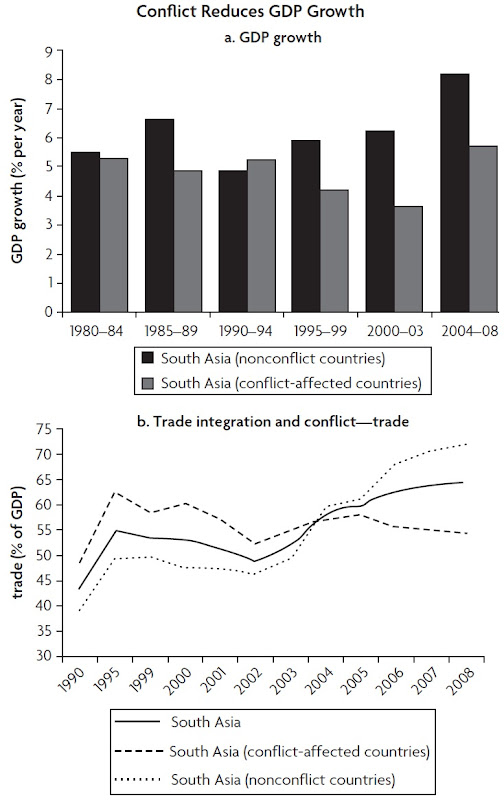
Conflict has severely impacted growth in South Asia. Given its income level, Nepal had the most fatalities between 1998 and 2004 as a result of conflict. Note that conflict-affected countries had lower GDP growth rate and trade.
 
Since 150 million people are entering the labor force in the next decade, without appropriate provision of providing them decent paying jobs, they could be a liability instead of providing demographic dividends. Workers are trapped in low-wage, low-productivity jobs. More jobs have to be created in the industrial sector. Skill enhancement and addressing high informality are also necessary.

[Here is a general summary of the book which argues that developing countries will come to the rescue of the world economy in the post-crisis period. Here is a summary of a chapter on economic crisis, migration and remittances/ )