This paper reviews recent state interventions in financial crises and draws lessons for crisis management. A number of areas are identified where crisis management could be strengthened, including with regard to the tools and instruments used to involve the private sector in crisis resolution (with a view to reducing the recent enhanced role of official bailouts and the associated moral hazard), to allow for the orderly resolution of systemically important financial firms (to make these firms "safe to fail"), and with regard to achieving better integration with ex ante macroprudential surveillance. The paper proposes the establishment of high level systemic risk councils (SRCs) in each country with responsibility for overseeing systemic risk in both tranquil times and crisis periods and coordinating the activities of key government ministries, agencies, and the central bank.
Monday, September 6, 2010
States role in forestalling financial crisis


Friday, September 3, 2010
Capping executives’ compensation in Nepal

My latest piece is about the issue of capping executive pay and compensation in Nepal. The central bank and Ministry of Finance are arguing for a cap on executive’s pay. The executives vehemently oppose it. Who is right? Well, I think the answer differs depending on if we look this issue from strictly business or societal perspectives. The issues I raise here is that it is not the central bank’s principle mandates to cap executive’s pay. It should rather try to fulfill its unfulfilled mandates.
Salary Ceiling
Is it NRB’s job to cap pay of executives?
The Nepal Rastra Bank (NRB) has locked horns with the financial sector over the recent capping of executives’ pay. The central bank wants to curb executives pay, but the executives vehemently oppose that notion. All over the world, the fat paycheck of executives have been the subject of controversy for quite some time now. It gained steam following the EU and the US governments’ decision to cap executives’ compensation of institutions bailed out by taxpayers during the global financial crisis. This monetary interventionist fad was picked up by the developing countries as well. Hence, we are witnessing the same happening in Nepal.
Amidst all the populist rant, it should be realized that NRB is stepping on a turf where it traditionally has not. This job is also not within its principle mandate, i.e. to maintain “price stability, and external and financial sector stability to facilitate high and sustainable economic growth”. High pay of executives has nothing to do with both these variables. In terms of incentives to drive a particular institution’s interests in a healthy competitive environment, the paycheck fetched by executives seems justified. On the other hand, from societal perspective and widening wage inequality, it is not morally okay. On this issue, the central bank has a very limited mandate and role to play.
Mind you, I am not defending extremely high compensation. I am just wondering why the NRB is engrossed in something it is not explicitly mandated and wasting time and resources when it has slacked on its explicit mandate. An appropriate body to look into this matter could be the Ministry of Finance (MoF).
Inflation has been double-digit since 2008. People are reeling under rapidly changing prices of daily consumable goods and services. Its policies to promote sustainable long-term growth are not working. It failed to check real estate bubble, which is scooping up most of the loans from the banking sector. This sector’s contribution to GDP has been very minimal. Lately, the NRB rolled out policies to restrict loans to the real estate sector. Though a right move, it might be a little too late. The damage is already done. It is now trying to mitigate the pain. Meanwhile, it has failed in monitoring and managing remittances inflows. The result has been devastating: Bubble in real estate and construction sectors, widening balance of trade deficit, and balance of payments deficit.
That said, in the present context, let’s be clear that the central bank can do very little in bringing down inflation rate as it is not a demand-driven rise in prices in the first place. A greater weight on the rise in price level has to do with cost push factors and supply side constraints such as supply chain disruptions, low production and cartels deliberately fixing prices at the product market. The MoF and the Ministry of Commerce and Supplies should play an active role in addressing these constraints. This has nothing to do with executives’ compensation. The same goes with the NRB’s effort to attain long-term sustainable economic growth.
Back to the row over executive pay. Executives are paid based on the pay scale sanctioned by an institution’s directors. If shareholders are dissatisfied with performance of an institution and its executives, then they can vote for changes based on the number of shares they own. They are the ones who should be running the show, not the central bank, whose intervention might affect incentives to perform to the fullest by executives. It is strictly a business dimension to the pay debate.
The issue of capping executives’ compensation emerged after the global financial crisis beginning mid-2008. Even after being bailed out by taxpayers, executives in big financial institutions in the US and the EU fetched huge amounts of bonuses and salary. Public anger fueled when they knew that the institutions rescued by the federal government were offering huge compensation to executives that had failed to deliver amidst rising foreclosures and layoffs. To quell public dissent, a “compensation czar” was appointed to monitor and recommend compensation of executives working in the institutions rescued by the US government. This constraint was lifted when institutions paid off the loan to the government. The EU is also restricting compensation of executives on a similar basis.
This incident is copied in Nepal, though wrongly. None of the banks or financial institutions (BFIs) has been rescued by the government by injecting taxpayers’ money. The only place where taxpayers’ money is being used is in the loss making public enterprises. The government must cap salary and bonuses in debt-ridden, loss-making public enterprises before it clamps down on the private sector, where it has not put in a dime for rescue efforts.
However, if the activities of BFIs pose systemic risk to the entire economy, then the central bank and MoF have to intervene to minimize damage, not through capping pay of executives but through tighter supervision and regulation. For instance, if the BFIs engage in excessive lending to a handful of sectors even after knowing that the risks might be pretty high, thus putting depositor’s money and the whole economy at risk, the central bank has to step in and curb such lending practices. This is what happened recently in the real estate and construction sectors. It does not mean that the central bank has to go after the income fetched by executives.
That being said, I am not sanctioning the notion that executives should fetch hefty salary and bonuses that are not justified by any means. No doubt, salary of executives is pretty high. Unaudited financial reports of 26 commercial banks show that salary and perks increased by 23 percent and bonus by 7 percent this fiscal year. Average monthly salary of a CEO is estimated to be above US$8,000. Lower rank employees barely earn US$150 per month. Roughly, the lowest to highest wage ratio is 1:40, which is extremely high in Nepali context. In fact, it is morally not right in a country where annual per capita GDP is below US$450. This a moral dimension to the pay debate. This also should not be ignored.
When job market is stagnating, macroeconomic situation deteriorating, inflation staying at a very high level, and opportunities squeezing, it obviously fuels anger when people read about executives fetching monthly salaries that an average citizen cannot even earn in his lifetime. This is something BFIs and executives should ponder upon because it independently fuels anger in the society they themselves are a part of. The government and central bank could give into public pressure any time.
There could be a middle path to business and moral dimensions to the executive pay debate. For instance, a “fair” way could be that executives’ paycheck may be a function of a basket of indicators: Long-term growth prospects, overall debt, non-performing loans, rate of return from unproductive sectors (which should have minimal weight as the returns appear to be cyclical in nature), long-term rate of return from productive sectors, and diversification of investment and loan portfolios, among others. If there are strict, transparent and easily comprehensible criteria, then there would not be much controversy over this issue, which has been wrongly taken up by the central bank while failing to fulfill its explicit mandate.
[Published in Republica, September 1, 2010, pp.6]

The wonders of mobile phone in Africa
Between 2003 and 2008, the number of cell phone subscriptions grew from 11 million to 246 million, faster in Africa than anywhere else in the world, according to the International Telecommunications Union. And while less than three percent of rural areas in Africa have landline telephone connection, the ITU estimated that over 40 percent of these areas have phone access via cell phone.
While Europe’s technology infrastructure was centered on the personal computer, Botha said Africa, and much of the developing world, is basing its infrastructure around the mobile phone.
"The developing world is coming into the information era with a development-centric point of view," Botha said, with communities embracing the mobile phone for its ease of use and ability to proliferate among communities.
While there is a trend among wealthy mobile phone users to buy expensive phones with internet or Bluetooth capability, Botha said most phone users need only three capabilities to be connected with each other: text and voice messaging, and Unstructured Supplementary Service Data, which allows phones to communicate with their service provider.
"If you want to connect to everyone, this is what you need to have," Botha said.
Recognising the proliferation of mobile phones in South Africa, CSIR’s Meraka Institute, with funding from the Department of Arts and Culture, worked to develop Lwazi, a cell phone-based system to disseminate government information.
More here
Thursday, September 2, 2010
Global trade is recovering...
World merchandise exports increase by 7% in the Q2 2010 in comparison to Q1 2010 and the value of world merchandise trade rose by approximately 25% in the first six months of 2010, says the WTO. Amidst fears of double-dip recession in the US, debt crisis, and fiscal tightening in the developed economies, this is at least a good news, though it is not guaranteed how long it will last.
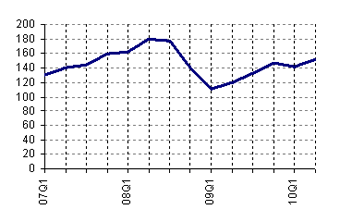 |
| World merchandise exports, first quarter 2007 to second quarter 2010; Indices, first quarter 2005=100 |

Wednesday, September 1, 2010
Can Africa continue to grow?
Source: McKinsey Quarterly
Bright light in Africa:
In the 1990s, the picture improved. The wars started subsiding. Many governments balanced their budgets and created a better, safer environment for companies, both foreign and domestic. And the African consumer began to stir. Now 80 million households earn at least the equivalent of $5,000 annually, the point where discretionary spending commences—an increase of 80 percent in eight years. Meanwhile, the continent’s GDP has been rising steadily, at around 5 percent a year, for the past decade, reaching $1.6 trillion in 2008. Last year, Africa was one of just two regions (the other was Asia) where GDP rose.
Tuesday, August 31, 2010
Beware its not over yet!
Carmen Reinhart and Vincent Reinhart warn that the impact of financial crisis is not over yet. It will last for some years to come.
The basis for sustained recovery is in place, and canny Fed officials are now alive to the dangers of both deflation and inflation. Similarly Jean Claude Trichet, head of the European Central Bank, spoke about how the dust had begun to settle on the crisis. Policymakers and financial markets seem to be looking at what comes next.
Such optimism, however, may be premature. We have analysed data on numerous severe economic dislocations over the past three-quarters of a century; a record of misfortune including 15 severe post-second world war crises, the Great Depression and the 1973-74 oil shock. The result is a bracing warning that the future is likely to bring only hard choices.
Our research found real per capita gross domestic product growth tends to be much lower during the decade following crises. Unemployment rates are higher, with the most extreme increases in the most advanced economies that experienced a crisis. In 10 of the 15 episodes we studied, unemployment never fell back to its pre-crisis level, not in the following decade nor right up to the end of 2009.
It gets worse. Where house price data are available, 90 per cent of the observations over the decade after a crisis are below their level the year before the crisis. Median prices are 15 to 20 per cent lower too, with cumulative declines as large as 55 per cent. Credit is also a problem. It expands rapidly before crises, but post-crash the ratio of credit to GDP declines by an amount comparable to the pre-crisis surge. However, this deleveraging is often delayed and protracted.
Our review of the historical record, therefore, strongly supports the view that large destabilising economic events produce big changes in long-term indicators, well after the upheaval of the crisis. Up to now we have been traversing the tracks of prior crises. But if we continue as others have before, the need to deleverage will dampen employment and growth for some time to come.
Part of these changed prospects after a crisis simply reflects the correction of expectations. During episodes of financial euphoria – from the diving bell, through the steam engine and thereafter – the old rules seem not to apply. Lenders provide easy credit, investors bid up asset prices, and businesses invest unwisely. Spending advances rapidly, and debt builds up. Yet recent discussions about the “new normal” leave the misleading impression that the pre-crisis environment was “normal”.
Wednesday, August 25, 2010
The role of state post-economic crisis
Ajay Chibber argues that the state is still an important player in economy. Its role, however, in the developed and developing countries will differ. He cautions that markets are wary of rising government debt in the developed countries that have launched massive fiscal stimulus to save the economy from going down the drain.
So what is the appropriate role of the state after the financial crisis? In the developed world, a permanent expansion is impossible, especially as ageing populations put further pressure on public finances. With almost half of GDP in state hands, it is not surprising that large stimulus packages helped stop the markets going over the edge. But with public debt in the developed world exceeding GDP, there is less scope for fiscal activism. If economies sink back into recession, further fiscal expansion could unnerve markets. In the long run, debt sustainability may require a fundamental review of the welfare state.
It is too early to predict the demise of the nation state. The state remains the ultimate protector of people’s interests as markets overreach, on both the upswings and the downswings of capitalism. Self-regulation – à la 16th-century Scottish bankers – or a light-touch regulatory system cannot be the solution for the modern financial world. A co-ordinated, activist and sceptical regulatory system is needed. The Group of 20 and more broadly the UN can play a bigger role.
Asian-style state-led capitalism has performed well during the crisis. With low public debt at around 40 per cent of GDP, Asia has shown the world that future capitalist development depends on an activist state, but not necessarily a large one. Unburdened by expensive welfare provision, developing countries in Asia and elsewhere must now build social protection systems but with “workfare” rather than European-style “welfare”.
With global warming – the mother of all market failures – looming, the role of the state becomes more critical. Investment in green technologies and public infrastructure must be the priority.
In terms of size, the state has reached its limits in the developed world. But there is a case for increasing its role in sectors such as banking and finance, as well as in addressing climate change. In the developing world, government needs to play a bigger role in social protection, basic services and rural infrastructure. Addressing corruption and ensuring delivery will be key to its legitimacy.
What will matter is what the state does, not how big it is. A smarter, more active state is the way forward.
Subscribe to:
Posts (Atom)