Saturday, April 3, 2010

The economics of happiness

David Brooks explains:

Marital happiness is far more important than anything else in determining personal well-being. If you have a successful marriage, it doesn’t matter how many professional setbacks you endure, you will be reasonably happy. If you have an unsuccessful marriage, it doesn’t matter how many career triumphs you record, you will remain significantly unfulfilled.

If the relationship between money and well-being is complicated, the correspondence between personal relationships and happiness is not. The daily activities most associated with happiness are sex, socializing after work and having dinner with others. The daily activity most injurious to happiness is commuting. According to one study, joining a group that meets even just once a month produces the same happiness gain as doubling your income. According to another, being married produces a psychic gain equivalent to more than $100,000 a year.

The second impression is that most of us pay attention to the wrong things. Most people vastly overestimate the extent to which more money would improve our lives. Most schools and colleges spend too much time preparing students for careers and not enough preparing them to make social decisions. Most governments release a ton of data on economic trends but not enough on trust and other social conditions. In short, modern societies have developed vast institutions oriented around the things that are easy to count, not around the things that matter most. They have an affinity for material concerns and a primordial fear of moral and social ones.

Tuesday, March 30, 2010

Global trade forecast: Trade to expand by 6.5 percent in 2010

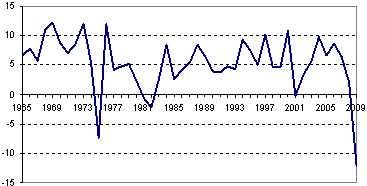
The WTO has estimated that global trade would increase by 9.5 percent in 2010. Last year, trade plunged by 12.2%, the sharpest decline since the WWII. The last time global trade volume fell were in 1975 (-7%), 1982 (-2%), and 2001 (-0.2%). Trade in US dollar terms declined even higher (-23%) than in volume terms. Meanwhile, global output fell by 2.3% last year.
 
Volume of world merchandise exports, 1965-2009 (Annual % change)

Exports from developed countries are expected to increase by 7.5% in volume terms. Meanwhile, shipments for the rest of the world are expected to increase by 11%. This projection is based on the assumptions that global GDP growth would be 2.9% at market exchange rates and the will be stability in oil prices and exchange rates. The WTO warns that a 9.5% growth rate for trade is not sufficient to attain pre-crisis levels of trade volume next year. But, two years of growth at the same rate (12.2%) would surpass the peaks of 2008 for developing countries. The developed countries would require three years of growth at the same rate (9.5%).
 
Despite the decline in trade and a severe recession, governments around the world, in most cases, refrained from imposing trade barriers. The WTO warns that persistent unemployment might intensify protectionist pressures.

The main reason for the sharp fall in global trade was a contraction in global demand. The complex web of supply chains led to a synchronized drop in trade across countries and regions. The source of all these: global recession triggered by the sub-prime mortgage crisis in the US. A fall in wealth caused households and firms to cutback expenditure on consumer durables and industrial machinery.
 
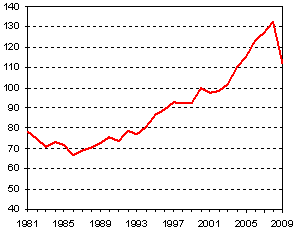
Ratio of world exports of goods and commercial  services to GDP, 1981-2009 (Index 2000=100)

What could dampen the optimistic trade forecasts? The WTO lists increases in oil prices, appreciation or depreciation of major currencies, and additional adverse developments in financial markets as the possible factors that could dampen global trade. But, if the unemployment rates fall quickly, trade could recover faster than expected. [This is not going to happen though, according to economists such as Krugman and Stiglitz because the stimulus packages around the world have not been in proportion to the severity of the crisis.]

Q&A: Fixed Exchange Rate between Nepali Rupee (NRs) and Indian Rupee (IRs)

Following the previous op-ed on the pegged exchange rate between Nepali rupee and Indian rupee, here are some of the questions/ comments raised by readers. The replies are very raw!
Question 1: " Devaluation – a deliberate downward adjustment in the official exchange rate – will reduce the currency’s value. By making exports less expensive, and discouraging imports, devaluation can indeed help reduce current account deficit." less expensive or more expensive ??
Adnan: Once you devalue, one Indian rupee now buys more of Nepali rupees. The exports are now relatively less expensive for foreigners. And imports more expensive for domestic users as it now takes more Nepali rupees to buy one Indian rupee.
Chandan: In other words, devaluation would increase the demand of Nepali goods (i.e. exports less expensive), decrease demand of Indian goods (decrease imports) = net effect would be a positive effect on balance of trade and potentially on balance of payments as well if negative net transfers are not higher than positive net exports.
Question 2: I would think that 'higher interest rates' will increase foreign investment.I agree with the idea of “growing” itself out of this crisis...Also focusing on areas where Nepal has comparative advantage will help.
Adnan: My own thinking has been, for some time now, that money attracted at higher interest rates cannot be loaned at lower interest rates. At the end of the day, any govt wants to provide affordable financing to its small businesses or consumers. In a small and poor country like Nepal, there aren't that many opportunities for businesses to overcome the high hurdle rate and make profit.
One argument can be that govt should subsidize the interest payments which will be "due" to these investors and offer cheaper loans to struggling industries or key sectors like agriculture. But this approach also comes back to bite the govt. Those subsidies will have to be financed by raising taxes. But if the businesses will be taxed through the nose to fund the subsidies, less incentive for businesses to make profits and ultimately less incentive to borrow money from bank. Ultimately, govt do not need to attract those higher interest rate investments. One has to assess the risk appetite of the domestic economy.
In other words, some of these countries may not have the capacity to absorb all these investments. 
Chandan: Usually, high interest rates entice "hot money", not foreign investment....
Question 3: What happens if Indian currency switches to fully convertibility ? Government of India is gradually planning to do that ...
Chandan: There are talks about India switching to full currency convertibility. This issues emerged after an Indian mobile company was unable to buy a South African telephone firm primarily due to restrictions on currency convertibility. The Indian finance minister said that they will slowly move in that direction. It will take some time before that happens. Meanwhile, Nepal can still opt to stay with the peg. I think the Indians will have no problem with that. :)
Question 4: Great stuff - though one thing is confusing me. The Marshall-Lerner Condition? Can you help me out?
Chandan: The sum of price elasticity of exports and imports seems to be definitely greater than 1. It means that devaluation might actually improve BOT and, given the conditions I mentioned above, possible BOP. So, M-L condition is satisfied. But, it says nothing about inflation, which is already high. (The J-curve effect also looks applicable in this context.)

Friday, March 26, 2010

Exchange rate of NRs vs IRs: Stay the Course

I co-authored my latest piece with Adnan. It is about the issues surrounding balance of payments deficit and the pegged exchange rate between Nepali rupee (NRs) and Indian rupee (IRs). Looking at the options available to the Nepali central bank, neither revaluation is good nor devaluation is good. Given the dire state of the Nepali economy, sticking with the existing peg is the best option. Here is an additional blog post on the issue.
------------------------------------------
ADNAN KUMMER and CHANDAN SAPKOTA
There are rumors about potential change in exchange rate of Nepali rupee (NRs) with Indian rupee (IRs), with which Nepal has pegged its currency at a rate of NRs 1.60 equal to IRs 1.00 since 1993. While some analysts are wondering why Nepal’s currency cannot be changed, or appropriately revalued, others are calling for devaluation at the rate of NRs 2.00 equal to IRs 1.00. Some people say that change in exchange rate is essential because the existing peg set almost two decades ago does not reflect changing trading environment and widening productivity gap undergone by these economies. Others point out a little more convincing situation relating to soaring trade deficit with India and the need to contain it.
The rumors about possible change in exchange rate picked up much steam since the economy experienced approximately Rs 20 billion hole in the balance of payments (BOP) in the first half of this fiscal year. To douse potential speculative attack on the currency, the finance secretary and the finance minister had to put out statements saying that exchange rate will not change as of now. Even the central bank is being pressured to come up with a formal statement. Given the state of our economy right now, staying the course, i.e. sticking with the existing exchange rate peg, seems to be the best option.
The most pressing macroeconomic problem right now is to find ways to narrow current account deficit and close the hole in BOP. The surge in imports and decline in remittances and exports have triggered this unfortunate situation. A revaluation of the currency is out of question because it would not address the core problems. In fact, it would widen current account deficit as imports from India become relatively cheaper to domestic consumers. Meanwhile, imports of Nepali items by Indian consumers would become expensive. It makes sense to revalue Nepali rupee against the Indian rupee if the demand of Nepali export items by Indian consumers is inelastic, i.e. no matter by how much prices change, Indian consumers would demand Nepali items. This is clearly not the case. In fact, the Indian market already has close substitutes of almost all the items Nepal exports.
Devaluation seems to be the most favored option among analysts of the Nepali economy. At present, it is definitely a better case than revaluation but a weaker case than status quo. There are short-term gains and long-term dangers associated with devaluation. Devaluation – a deliberate downward adjustment in the official exchange rate – will reduce the currency’s value. By making exports less expensive, and discouraging imports, devaluation can indeed help reduce current account deficit. If things turn out this way, then devaluation is not bad for the Nepali economy.
However, once the monetary and trade engines set in motion, it does not stop there; devaluation is not devoid of dire economic consequences. First, by increasing the price of imports and stimulating demand for exports, devaluation potentially increases economic activity but aggravates inflation. But, high inflation rate will force government to raise interest rates to control spiraling price rises, which is already hovering around 12 percent in Nepal.
As a consequence, the higher interest rates will cause a slower rate of economic growth by discouraging consumption and reducing investment by firms. Moreover, once the inflation genie is out of the bottle, we will have to let go a lot of economic growth before inflation can be contained again. The story of inflation is a little more complicated than what some are arguing simply that devaluation will result in a short-term high-inflation, but a long-run low-inflation. Economists and policymakers would have a simpler life if it was this straight-forward.
It makes sense to revalue Nepali rupee against the Indian rupee if the demand of Nepali export items by Indian consumers is inelastic, i.e. no matter by how much prices change, Indian consumers would demand Nepali items. This is clearly not the case.
There are a number of factors that affect inflation. We need to figure out what will be the greater source of inflation after devaluation: Demand-pull or cost-push inflation. Given such a high rate of unemployment and excess capacity in the economy, it is unlikely that inflation will come from the demand side. Moreover, if the demand is relatively inelastic in the export sector—which seems to be the case if we look at the level of exports to India in the past several years—the increase in volume of exports will be rather small. Instead, a greater fall will occur in the total value of exports. This avails no effective solution in addressing the pressing macroeconomic challenge.
A greater likelihood is that more inflation will creep into the economy from the supply side, both imported and domestic. Though it has changed a little bit recent years, historically, inflation in Nepali economy has followed the inflation pattern in the Indian economy. The increase in the price of imported goods and domestic supply constraints—both production-related and nonproduction related—will cause cost-push inflation. Note that Nepal imports almost 60 percent of total imports from India. According to NRB, the wholesale price inflation increased by almost 19 percent compared to 10.1 percent a year ago. Moreover, the exporting firms, for their part, now will have less incentive to cut their costs as devaluation will make their products more competitive in the export sector. Hence, in the long-run, both costs and inflation will increase. Inflation coming in from the supply side is sure to have long-term effects, and not just short-term. This will also undermine investor confidence in Nepal’s economy and diminish the ability to attract foreign investment.
With reserves to fund more than six months of imports, the central bank can comfortably sterilize pressure on the Nepali rupee. Generally, the IMF recommends reserves that can fund three months of imports. Right now, we are better off staying the course, i.e. no change in the exchange rate.
To address the current account deficit, which has deteriorated by around 245 percent in the first half of this fiscal year, Nepal should aim to “grow” itself out of this crisis rather than through currency manipulation. How? For the short term, one possible way is to make Nepal Tourism Year 2011 a success and generate substantial foreign exchange to ward off the pressure from surging imports and receding exports. Also, increasing price and quality competitiveness of Nepali goods will help increase exports. Meanwhile, increasing remittances inflow would provide a badly needed band aid to the economy.
The central bank has a very difficult task ahead. It has to rein in rumors about change in exchange rate, tame double-digit inflation, tighten liquidity in the real estate and ease in productive sectors, and effectively sterilize any pressure on the Nepali rupee. It has to take very cautious and pragmatic steps. In terms of NRs exchange rate with IRs, staying the course is the best option for now.
(Kummer is a graduate student at Johns Hopkins School of Advanced International Studies & Sapkota is a Junior Fellow at Carnegie Endowment for International Peace.)

[Published in Republica, March 23, 2010, pp.6]

Wednesday, March 24, 2010

Robert Wade on Industrial Policy

Duncan Green summarizes Wade's argument on industrial policy, particularly the distinction between 'leading the market' and 'following the market':

Leading the market is South Korean style picking winners – we want a steel or chip industry, so we’re going to spend big time and just make it happen. That worked in the Korean case, but has failed in many others. Following the market, on the other hand, is a much less risky form of industrial policy, based on systematically ‘nudging’ firms to upgrade their technologies through incentives, performance requirements, or the state playing a brokering role putting firms in touch with foreign investors. Robert saw this as a third way (sorry) between the command and control of South Korea, and the passive laissez faire of the traditional World Bank view that governments should stick to sorting out the ‘enabling environment’ of property rights and keeping the bureaucracy in check. Robert held up Taiwan as a model of successful following-the-market type industrial policy.

Tuesday, March 23, 2010

Barry Eichengreen on the next MD of the IMF

Barry Eichengreen argues that selection of the next managing director of the IMF should be based on merits, not geographic location.

The obvious choice is Asia, home to the most dynamic emerging markets. It is the region to which the world’s economic center of gravity is shifting. If you ask Asian leaders what would make them consider again approaching the Fund after their traumatic experience with IMF “assistance” in 1997-1998, they will answer: an Asian managing director.

In fact, this is precisely the wrong way to think about the problem. The IMF’s problem in the past has been parochialism and lack of accountability. The best way to ensure that the Fund remains open to new ideas is by selecting the person with the best ideas to lead it. The best way to ensure that the IMF’s management is accountable to all of its governmental shareholders is to prevent the top job from becoming the sinecure of any region, whether Europe or Asia.

The next managing director should be selected on the merits, not on the basis of nationality. There should be an open competition, in which the best candidate wins on the basis of his or her ideas.

The next managing director should be selected on the merits, not on the basis of nationality. There should be an open competition, in which the best candidate wins on the basis of his or her ideas.

Asia has plenty of competent economic officials who might be considered as the next managing director of the IMF. But just because they are Asian is not reason enough to select them.

Sunday, March 21, 2010

R.I.P. GPK!

Girija Prasad Koirala: A very important Nepali statesman who became prime minister for four times, supported for free press and liberal economic policies, convinced the Maoists to join democratic process thus playing a crucial role in ending the decade long civil war, staunchly opposed the Royal coup, lead the country during the immediate transition from autocratic Royal regime to a republic secular nation, and so on… passed away yesterday. R.I.P. GPK!

Obituaries here, here, here, here, here and here. Here is a piece about economic reforms during GPK’s time. His life in pictures here.