Wednesday, March 24, 2010

Robert Wade on Industrial Policy

Duncan Green summarizes Wade's argument on industrial policy, particularly the distinction between 'leading the market' and 'following the market':

Leading the market is South Korean style picking winners – we want a steel or chip industry, so we’re going to spend big time and just make it happen. That worked in the Korean case, but has failed in many others. Following the market, on the other hand, is a much less risky form of industrial policy, based on systematically ‘nudging’ firms to upgrade their technologies through incentives, performance requirements, or the state playing a brokering role putting firms in touch with foreign investors. Robert saw this as a third way (sorry) between the command and control of South Korea, and the passive laissez faire of the traditional World Bank view that governments should stick to sorting out the ‘enabling environment’ of property rights and keeping the bureaucracy in check. Robert held up Taiwan as a model of successful following-the-market type industrial policy.

Tuesday, March 23, 2010

Barry Eichengreen on the next MD of the IMF

Barry Eichengreen argues that selection of the next managing director of the IMF should be based on merits, not geographic location.

The obvious choice is Asia, home to the most dynamic emerging markets. It is the region to which the world’s economic center of gravity is shifting. If you ask Asian leaders what would make them consider again approaching the Fund after their traumatic experience with IMF “assistance” in 1997-1998, they will answer: an Asian managing director.

In fact, this is precisely the wrong way to think about the problem. The IMF’s problem in the past has been parochialism and lack of accountability. The best way to ensure that the Fund remains open to new ideas is by selecting the person with the best ideas to lead it. The best way to ensure that the IMF’s management is accountable to all of its governmental shareholders is to prevent the top job from becoming the sinecure of any region, whether Europe or Asia.

The next managing director should be selected on the merits, not on the basis of nationality. There should be an open competition, in which the best candidate wins on the basis of his or her ideas.

The next managing director should be selected on the merits, not on the basis of nationality. There should be an open competition, in which the best candidate wins on the basis of his or her ideas.

Asia has plenty of competent economic officials who might be considered as the next managing director of the IMF. But just because they are Asian is not reason enough to select them.

Sunday, March 21, 2010

R.I.P. GPK!

Girija Prasad Koirala: A very important Nepali statesman who became prime minister for four times, supported for free press and liberal economic policies, convinced the Maoists to join democratic process thus playing a crucial role in ending the decade long civil war, staunchly opposed the Royal coup, lead the country during the immediate transition from autocratic Royal regime to a republic secular nation, and so on… passed away yesterday. R.I.P. GPK!

Obituaries here, here, here, here, here and here. Here is a piece about economic reforms during GPK’s time. His life in pictures here.

Saturday, March 20, 2010

List of RTAs in the World (as of 2010-3-20)


Download it from here (PDF). I compiled it from the WTO website.

Daron Acemoglu profiled in F&D magazine

An interesting profile of Daron Acemoglu in IMF's Finance & Development magazine:

Governments are often barriers to the functioning of markets, but if you really want markets to function you need governments to support them—with law and order, regulation, and public services.

“We have done a lot of empirical work that shows a very clear causal link between inclusive economic institutions—those that encourage participation by a broad cross section of society, enforce property rights, prevent expropriation—and economic growth,” Acemoglu asserts. “The link to growth from democratic political institutions is not as clear.”

The textbook contends there was no sustained growth before 1800, first, because no society before that date had invested in human capital, allowed new firms to bring new technology, and generally unleashed the powers of creative destruction; and second, because all societies before 1800 lived under authoritarian political regimes. And economic takeoff started in western Europe because international trade rose after the discovery of the New World and the opening of new sea routes. The trade uptick boosted commercial activity and vested more economic and political power in a new group of merchants, traders, and industrialists, who then began to operate independently from European monarchies.

There will be three obstacles to growth under authoritarian regimes: there are always incentives for such regimes to be even more authoritarian; these regimes tend to use their power to halt Schumpeterian creative destruction, which is key to sustaining growth; and there is always infighting for control of authoritarian regimes, which causes instability and uncertainty.

“Dysfunctional societies degenerate into failed states,” asserts Acemoglu, “but we can do something about it. We can build states with infrastructure and law and order in which people are confident and comfortable going into business and relying on public services, but there is no political will to do that. You would not need armies to implement such a scheme—just a functioning bureaucracy to lay down the institutional foundations of markets.”

Thursday, March 18, 2010

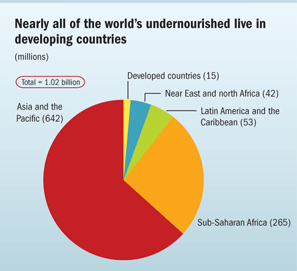
Hunger in the developing world after the crisis

Food and economic crises increased the number of hungry people to one billion in 2009.

Reasons: people's inability to afford food due to high prices and a slightly low harvests
 
Solutions:

In the medium and long term, the structural solution to hunger lies in increasing agricultural productivity to increase incomes and produce food at lower cost, especially in poor countries. The importance of longer-term measures is evidenced by the unacceptably high number of people who did not get enough to eat before the crises and are likely to remain hungry even after the food and economic crises have passed. In addition, these measures must be coupled with better governance and institutions at all levels.

Real Exchange Rate and Economic Growth

There is good reason and much evidence to suggest that the real exchange rate matters for economic growth, but why? The "Washington Consensus" (WC) view holds that real exchange rate misalignment implies macroeconomic imbalances that are themselves bad for growth. In contrast, Rodrik (2008) argues that undervaluation relative to purchasing power parity is good for growth because it promotes the otherwise inefficiently small tradable sector. Our main result is that WC and the Rodrik views of the role of misalignment in growth are observationally equivalent for the main growth regressions he reports. There is an identification problem: Determinants of misalignment are also likely to be independent drivers of growth, and these types of growth regressions are hard-pressed to disentangle the different channels. However, we confirm that not only are overvaluations bad but undervaluations are also good for growth, a result squarely consistent with the Rodrik story but one that requires some gymnastics from the WC viewpoint

Source: IMF WP 10/58