Wednesday, November 19, 2008

Paul Samuelson blasts libertarians

Paul Samuelson argues that there is no alternative to market system but this is not the same thing as unregulated capitalism. Based on his “rationality and experience” he prefers taking a dynamic moving center position, i.e. ideologically, he thinks Limited Centrist State should be the model for the economy. This piece is going to make the libertarians, who he says are emotional cripples and bad advice givers, very unhappy. He blasts Hayek’s “serfdom” concept, which Hayek uses to argue that increasing role of state will lead to serfdom. The book he is referring to is The Road to Serfdom (pretty good book to read).

Based on my observations of economic history, both short run and long run, I believe that there is no satisfactory alternative to market systems as a way of organizing both economically poor and economically rich populations.

However, using markets is not the same thing as unregulated capitalism so beloved by libertarians. Such systems cannot regulate themselves, either micro-economically or macro-economically. Wherever tried they systematically breed intolerable inequalities. And instead of such inequality being the necessary price to encourage dynamic progress via technological and managerial innovations, it instead breeds dysfunctional shortfalls in what economists call "total factor productivity."

…Libertarians are not just bad emotional cripples. They are also bad advice givers. I refer of course to the views of both Milton Friedman and Friedrich Hayek. The “serfdom” they warn against is not that of Genghis Khan or Lenin-Stalin-Mao or Hitler-Mussolini. Rather, they warn against the centrist states of the modern world. Think only of Switzerland, Britain, the US, the Scandinavian countries, and the Pacific Rim. Why do citizenries there report high indexes of “happiness” and enjoy broad freedoms of speech and belief?

…Yes, public policy should regulate (rationally regulate) corporate life and should work to stabilize the macro economy. Yes, future fiscal systems can in a limited degree reduce the more glaring evils of inequality. However, a centrist system can do measurable harm if it acts too strongly to reduce inequality. My goal is the Limited Centrist State.

I am not a centrist because I can’t make up my mind about the Right and the Left. It is because each of those has proved itself to be so non-optimal that rationality and experience move me toward the dynamic moving center.

Five Nobel prize winning economists write about the global economy here. More about Samuelson here and here. Thanks to Professor Farrant for the pointer.

Tuesday, November 18, 2008

Now India wants fiscal stimulus

So, technically the EU, Japan (and the US) are in a recession. The wave of global recession is in continuum right now. The crisis sparked by sup-prime mortgage crisis emanating from the US is getting harder to contain even in the face of rock bottom interest rates. This means monetary policy is getting ineffective. The last resort: call on the government! There has already been stimulus in the US, China, and some form of this sort in the EU. In its World Economic Outlook update for November, the IMF also argued that world output growth will fall to 2.2% and fiscal stimulus is the (only) option as monetary policy is not doing anything good right now. Already, India has lost $57 billion due to the current global crisis.

Now comes India, where businessmen surveyed by the WEF called for a fiscal stimulus package to uplift the quality of infrastructure and to prop up expected downslide in growth rate, which is forecasted to slide to 7% from 9% at present.

…“contra-cyclical fiscal stimulus” through the speeding the implementation of infrastructure projects already in the pipeline would certainly help economic growth to rebound.

More here.

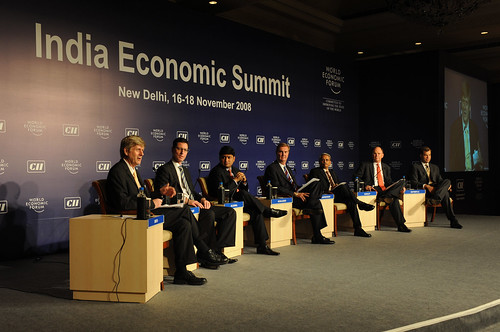
India Economic Summit 2008

Interestingly, some young Indian parliamentarians also argued that India now needs Obamas- not one, not two, but many!

“From our young sportsmen, our young businessmen, our young politicians,” said Rahul Bajaj, Chairman, Bajaj Auto; Member of Parliament, India, hopefully we are going to have more than one Barack Obama!”

New leadership and new ideas are desperately needed to address critical challenges faced by India. First among these, said Deepender Singh Hooda, Member of Parliament, India, is “the resurgence of divisions based on caste, religion and region.” Moreover, Hooda pointed out that, while India has enjoyed strong economic growth overall, certain sectors of society have been left behind and rising inequality is increasing class tension. Bihar is the most equal state in India: as states become more prosperous, they become more unequal. The shift from an agriculturally-based economy to services and manufacturing also increases tensions over issues like land rights.

More here.

Grim growth forecast and call for new policy stimulus

The IMF has again readjusted its global growth forecast due to rising financial sector deleveraging and dwindling producer and consumer confidence. World output growth forecast is scaled down by around 0.75 percentage point to 2.2 percent in 2009 (from 5% in 2007 to 3.75% in 2008 to 2.2% in 2009…this could go even down!). Both the advanced and emerging and developing economies are expected to further slow down. Worse, in advanced economies output is forecast to contract on a full-year basis in 2009, the first such fall in the post-war period, according to the IMF. It warns that the final outcome is highly uncertain and could much more worse than expected.

Rather than relating the magnitude of this crisis to the Great Depression, the World Economic Outlook Update from the IMF states that the current and expected contraction is “broadly comparable” in magnitude to those that occurred in 1975 and 1982.

Who will suffer the most? According to the WEO update, commodity exporters (because commodity price projects have been marked down), countries with acute external financing and liquidity problems.

In the face of worsening financial and economic conditions, markets are pricing in expectations of much higher corporate default rates, as well as higher losses on securities and loans, in part, because pressures have now broadened to emerging markets, raising recapitalization needs. Thus, financial conditions are likely to remain tight for a longer period and to be more impervious to policy measures than previously expected.

It also hints the ineffectiveness of monetary policy as interest rates are already close to zero. What’s next? Keynesianism…and fiscal stimulus!

…However, monetary policy may not be enough because monetary easing may be less effective in the face of difficult financial conditions and deleveraging. Also, in some cases room for further easing is limited as policy rates are already close to zero bound. There are condition where broad-based fiscal stimulus is likely to be warranted. Fiscal stimulus can be effective if it is well targeted, supported by accommodative monetary policy, and implemented in countries that have fiscal space.

In Sub-Saharan Africa output is expected to decrease by 0.6% in 2008 and 1.2% in 2009.

Monday, November 17, 2008

Links of Interest (11/16/08)

Back again!

What happened at the G20 Summit on Saturday? 

Bill Easterly reviews The Bottom Billion (Two criticisms of Paul Collier’s book: (i) correlation does not equal causation…military intervention does not cause reduction in civil wars and poverty level and (ii) selection bias…that Collier cherry-picks troubled nations and timeframe of growth rates to show that they are trapped in low income and low growth state. (Africa left behind by Collier here)

Rethinking the growth diagnostics approach: Questions from the practitioners

The Politics of Hunger: How Illusion and Greed fan the food crisis (Paul Collier says three policies can be helpful in solving the food crisis: expanding large commercial farms, ending the GM-crop ban, and doing away with the U.S. subsidies on ethanol)

The birth of doing business report

Macro policy in a liquidity trap

Buddha boy reappears in Nepal

The IMF in focus

Dr Keynes’s Chinese patient

Saturday, November 8, 2008

Food security: From agricultural to industrial to back to agricultural society!

Food insecurity is one of the main global issues right now and many nations are in danger of facing starving population. Here is a discussion about global food crisis.
 
Here is Michael Pollan writing a letter to the next President about organic food and its advantages against inorganic food. He argues that for the sake of food security, energy independence, and ecological preservation, it makes perfect sense to look for reverting back to old ways of agriculture: from the agricultural to the industrial society, and back to the same society, but with a slight variation! This is an excellent article (pretty long, but worth reading) about how the American food subsidies, increasing use of oil and petroleum products in agriculture, and the general eating habit (of consumers eating products made from a limited number of crops) is leading to food insecurity, national security problems, ecological disaster, and energy crisis. Time to change habits!

The sun-food agenda must include programs to train a new generation of farmers and then help put them on the land. The average American farmer today is 55 years old; we shouldn't expect these farmers to embrace the sort of complex ecological approach to agriculture that is called for. Our focus should be on teaching ecological farming systems to students entering land-grant colleges today. For decades now, it has been federal policy to shrink the number of farmers in America by promoting capital-intensive monoculture and consolidation. As a society, we devalued farming as an occupation and encouraged the best students to leave the farm for "better" jobs in the city. We emptied America's rural counties in order to supply workers to urban factories. To put it bluntly, we now need to reverse course. We need more highly skilled small farmers in more places all across America - not as a matter of nostalgia for the agrarian past but as a matter of national security. For nations that lose the ability to substantially feed themselves will find themselves as gravely compromised in their international dealings as nations that depend on foreign sources of oil presently do. But while there are alternatives to oil, there are no alternatives to food.

...To change our children's food culture, we'll need to plant gardens in every primary school, build fully equipped kitchens, train a new generation of lunchroom ladies (and gentlemen) who can once again cook and teach cooking to children. We should introduce a School Lunch Corps program that forgives federal student loans to culinary-school graduates in exchange for two years of service in the public-school lunch program. And we should immediately increase school-lunch spending per pupil by $1 a day - the minimum amount food-service experts believe it will take to underwrite a shift from fast food in the cafeteria to real food freshly prepared.

...Oil is one of the most important ingredients in our food, and people ought to know just how much of it they're eating. The government should also throw its support behind putting a second bar code on all food products that, when scanned either in the store or at home (or with a cellphone), brings up on a screen the whole story and pictures of how that product was produced: in the case of crops, images of the farm and lists of agrochemicals used in its production; in the case of meat and dairy, descriptions of the animals' diet and drug regimen, as well as live video feeds of the CAFO where they live and, yes, the slaughterhouse where they die. The very length and complexity of the modern food chain breeds a culture of ignorance and indifference among eaters. Shortening the food chain is one way to create more conscious consumers, but deploying technology to pierce the veil is another.

...Your sun-food agenda promises to win support across the aisle. It builds on America's agrarian past, but turns it toward a more sustainable, sophisticated future. It honors the work of American farmers and enlists them in three of the 21st century's most urgent errands: to move into the post-oil era, to improve the health of the American people and to mitigate climate change. Indeed, it enlists all of us in this great cause by turning food consumers into part-time producers, reconnecting the American people with the American land and demonstrating that we need not choose between the welfare of our families and the health of the environment - that eating less oil and more sunlight will redound to the benefit of both.

Highly recommended for those seeking an in-depth analysis of the food crisis and where's it leading us! Worth seeing the video as well. Thanks to my friend Eric Dichter for the pointer!
 

Monday, November 3, 2008

African Cheetahs ≠ Asian Tigers

Here is a short article from the IPC about why one should not rejoice the impressive growth rates in sub-Saharan Africa (SSA) as the growth rate (4.4% between 2000 and 2007 for the whole SSA and five countries had 7% growth rate) and  is based largely on commodity exports, not on the contribution of manufacturing sectors. The author concludes with a nice sentences: Cheetahs (high- and medium-growth economies in SSA) run fast, but no for long. Learning the lessons of history may lead them to the Tiger’s (Asian Tigers) trail.

The manufacturing value added (MVA) matters for stable growth and development, which has not been seen in Africa because MVA is pretty low; the Asian Tigers had four times higher MVA than the share of high-and medium-growth economies of SSA. Manufacturing’s share of total merchandise exports is just 1.7% in high-growth economies and 9.7% in medium-growth economies in SSA, as opposed to 83% in the Asian Tigers. The Cheetahs of SSA are Botswana, Cape Verde, Mauritius, Angola, Chad, Equatorial Guinea, Sierra Leone, and Sudan.

The author argues that though high-growth performances are encouraging, there is little sign of expansion in manufacturing activities among the “Cheetahs” in SSA. This means that countries that are relying on commodity exports (especially oil and diamonds) will have to face a low income elasticity of demand, leading to unexpected impact on growth performance due to price volatility of commodity exports; in other words, the growth rate is not reliable unless it is underpinned by increasing MVA.

Why manufacturing? It is well established that the sector is superior in productivity increases, economies of scale and spurring all-round linkages. The sector also demands and absorbs a mix of high- and low-skilled labour. This is what distinguishes the Tigers from the Cheetahs. The former reaped the benefits of industrial policy. For instance, the Tigers managed allocations of credit and coordinated its flow to the manufacturing sector. They relied more on the provision of credit-based than on equity-based financing. Manufacturers in South Korea were subsidised by as much as 75 per cent when obtaining credit.