Saturday, October 18, 2008

Ubiquitous Keynes

Keynesianism is in high demand! Come crisis the markets cannot deal with, bank on Keynes, whose life’s mission was “to save capitalism from itself”. Could not agree more!! Even Hayek described him as “the one really great man I ever knew, and for whom I had unbounded admiration”. Here is a nice piece from the FT.

As the world reels from a 1929-style stock market plunge and a 1931-style banking crisis, his words are a fair assessment of the dangers we face once again. Keynes, whose life’s mission was to save capitalism from itself, is more relevant than at any time since his death in 1946.

His renewed influence can be seen everywhere: in Barack Obama’s planned stimulus package, for example. When George W. Bush said his administration’s plan to take equity in banks was “not intended to take over the free market, but to preserve it”, he could have been quoting Keynes directly.

The heart of the book [The General Theory of Employment, Interest and Money, 1936] is the idea that economic downturns are not necessarily self-correcting. Classical economics held that business cycles were unavoidable and that peaks and troughs would pass. Keynes contended that in certain circumstances economies could get stuck. If individuals and businesses try to save more, they will cut the incomes of other individuals and businesses, which will in turn cut their spending. The result can be a downward spiral that will not turn up again without outside intervention.

That is where government comes in: to pump money back into the economy by some means, such as spending on public works, to persuade individuals and businesses to save less and spend more themselves.

Markets are either imperfect or heavily distorted or agents lack incentives or there are rampant failures (or all) in the developing countries. So, the need of Keynesian approach is ever increasing. Remember that the fantasy to institute markets in a place where there was no foundation for it to take place, usually Africa, in the 80s and 90s did not lead to progress in growth and development (also, the number of conflicts at a given point of time did not decrease). What is needed is not austerity but a sensible application of Keynesian approach so that while aggregate demand and economy are stimulated, the market incentives are not tempered as well. The market and government can be complements and save each other from going down. There is no more for one and less for the other. It depends on contexts and circumstances individual countries are in. There are some sectors where letting markets loose bring wonders but there are also some sectors where markets cannot simply work or even if they work, they work for a select few. Government can help create an unsuitable place for market into a suitable place by sharing risks, building perquisites for the markets to function properly, instituting good governance, providing productivity enhancing subsidies, etc.—there are a whole slew of demand management techniques to follow (sensibly).

That being said, there should be no room for failed Marxist ideology. China has already experienced it. So has Vietnam. Now, Nepal (where Maoists party run the government…yes, they were elected by the people) should follow suit rather than getting bogged down on sloppy socialist slogans. Keynesianism is neither socialism nor Marxism. It is a complementary buddy of the market!

A nice description of Keynes:

image He was an imposing figure, six feet, six inches tall and full of jokes, gossip and sharp observations. Alongside economics, he had an array of other interests as mathematician, administrator, academic, investor, journalist, art collector, politician, impresario and diplomat. He was even an exemplary husband, devoted to his wife, Lydia Lopokova, a ballerina. In his language he could be carelessly provocative. But, as he said: “Words ought to be a little wild, for they are the assaults of thoughts on the unthinking.”

When bad policies were making economic problems worse, he felt a moral obligation to change them. He worked with distinction at the Treasury during the first world war and at the war’s end argued presciently against the imposition of excessively harsh conditions on Germany. When his advice was ignored, he left and published his views in his first great polemic, The Economic Consequences of the Peace .

Here is a full text link to Keynes’ masterpiece: The General Theory of Employment, Interest, and Monetary Theory. Downloadable version of The Economic Consequences of The Peace. More about Keynes and the current financial crisis here.

Keynes, Keynes, Keynes…

Krugman argues that there is not much the Federal Reserve can do right now because despite repeated interest rate cuts, unemployment is rising and credit market is still tight. So, way out of rising unemployment is to go by the Keynesian rules, i.e. in the face of ineffective monetary policies, use fiscal policies to stimulate aggregate demand by public investment in infrastructure, unemployment benefits, and emergency aid. With this comes deficit, which Krugman says can be forgotten for now.

In other words, there’s not much Ben Bernanke can do for the economy. He can and should cut interest rates even more — but nobody expects this to do more than provide a slight economic boost.

On the other hand, there’s a lot the federal government can do for the economy. It can provide extended benefits to the unemployed, which will both help distressed families cope and put money in the hands of people likely to spend it. It can provide emergency aid to state and local governments, so that they aren’t forced into steep spending cuts that both degrade public services and destroy jobs. It can buy up mortgages (but not at face value, as John McCain has proposed) and restructure the terms to help families stay in their homes.

And this is also a good time to engage in some serious infrastructure spending, which the country badly needs in any case. The usual argument against public works as economic stimulus is that they take too long: by the time you get around to repairing that bridge and upgrading that rail line, the slump is over and the stimulus isn’t needed. Well, that argument has no force now, since the chances that this slump will be over anytime soon are virtually nil. So let’s get those projects rolling.

Here is similar call for Keynes by Jayati Ghosh. Here is Keynes and the Crisis by Axel Leijonhufvud.

Friday, October 17, 2008

Bhagwati on the financial mess

Jagdish Bhagwati calls for a truly independent commission of experts to scrutinize each financial innovation’s potential downside. He terms the back-and-forth appointment of bigwigs from the Wall Sts to Treasury department and then again to the Wall Sts a “Wall Street-Treasury Complex”. Nice naming there!

When the dust has settled, we must ask the question: why did this crisis occur? There are specifics that are not applicable everywhere. The crisis was, for example, kicked off by highly leveraged lending for uncreditworthy mortgages by the quasi-governmental Freddie Mac and Fannie Mae. But the problems became huge because “policy innovations” had been racing ahead of comprehension. The securitisation of mortgages was an innovation that led unwittingly to what Wall Street calls “betting the company”. Credit-default swaps allowed AIG to bring in huge returns but at high risk if things went wrong, which they did.

The Long Term Capital Management crisis had a similar problem. At its heart were derivatives that no one quite understood. …The downside had not been anticipated.

The failure to think about the downside results from what I call the “Wall Street-Treasury Complex”. Robert Rubin went from Goldman Sachs to the Treasury and back to Citigroup. Hank Paulson went from Goldman Sachs to the Treasury and will doubtless return also to Wall Street. This network shares the optimistic scenarios that Wall Street spins. Mr Rubin was in charge of the Treasury during the Asian financial crisis, whereas Mr Paulson was among the five major investment banking chief executives who persuaded the Securities and Exchange Commission not to extend prudential reserve requirements to their companies.

The question is: how can you assess the downsides without first letting the innovation play into real economy? If something is an innovation, then it is a new thing, which essentially means that even the innovator is not fully aware of its full potential or risks or downsides. The innovator can argue that the innovation will work by showing high degree of success (i.e. the probability of success might be pretty high). But this itself is not fully guaranteed because no one can test innovation against unexpected circumstances or yet-to-be-known risks. The best way to assessing downsides of an innovation would be to periodically review its impact on the economy—this means that you cannot test an innovation beforehand because you don’t know the set of circumstances under which it will not work (the innovator might have an idea of the set of circumstances where it can work, but he or she cannot list the full elements of the set). But having a regulatory authority that can assess risks beforehand is a good idea. We are yet to have one of these things in the world! Anyway, thats it for now. Its getting too late. Time to go to bed!

Nice sentences about a good economist

Sourced from The Economist:

In neither contribution did Mr Krugman claim great originality for his ideas or great realism. His achievement was to formalise insights that many people had previously had informally. Ideas that had fluttered in and out of people’s grasp for decades, he pinned down like a butterfly on display. Sometimes a good economist, like a good columnist, succeeds not by making a point before everyone else, but by making it better than anyone else.

Resource curse in Congo

Policy Innovations has a nice article about resource curse, weak government, and violence in the Democratic Republic of Congo (DRC):

The DRC's turmoil can be traced to the country's toxic combination of tempting mineral wealth, feeble government, vast size, and weak cohesion. This mixture turns the DRC's rich natural resource heritage into a poison that affects every aspect of its body politic.

Instead of acting as the country's economic engine, the plentiful deposits—including uranium, diamonds, and copper—have repeatedly fueled violent conflict and corruption. Local militia and foreign armies smuggle vast amounts out of the country—an estimated $400 million in diamonds and gold alone have been lost this way annually in recent years—while doing everything within their power to prevent a weak state from establishing its authority.

Barely connected to each other by meager transportation, communication, and institutional links, local groups have little reason to profess loyalty to an ineffective and distant state—and every incentive to seek enrichment at that state's expense. As a result, the country's history has been plagued by a zero-sum competition among mutually antagonistic cities, regions, and ethnic groups.

The author argues that traditional Western prescription-elections, economic reform, and administrative restructuring- of fixing conflict-prone countries is not going to work. He recommends three institutional innovations:

  1. Multinational natural resource companies could play a greater role in protecting major mineral sites and providing services to citizens.Although many people might recoil at this idea, major international corporations have the strongest management capacity in the country and—under the right contractual arrangement—could have the greatest incentive to ensure that the state's mineral wealth be used to improve the lives of the DRC's people.
  2. Instead of attempting to build the DRC along the lines of the Western model of top-down governance, the international community should be advocating a far more horizontal model. The main governing structures would be shaped around cities and their surrounding rural areas, with programs built from the ground up. A looser, more horizontal governing structure, in which power and responsibility flowed from large municipalities upward and outward would make individual units far more effective, especially if outside assistance focused on improving their management, transparency, and accountability.
  3. International donors could improve government performance if they focused more on designing systems that would keep local officials responsible to their constituents. Elections alone will not dramatically improve how government operates—especially elections for leaders in distant cities who have little influence on local programs (the international community spent more than $500 million on national elections

The dismal output from trade liberalization in Africa

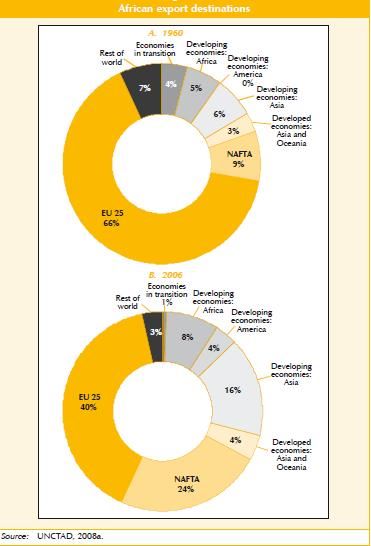
What happens when trade liberalization is not followed by reforms in structural and institutional constraints? Well, the level and composition of exports will not change and will lead to decrease in market share as foreign goods and services flood domestic market, which lacks strong industrial background. According a report from UNCTAD, trade liberalization in Africa in the past 25 years has led to decrease in market share for world exports from 6%  in 1980 to 3% in 2007. Moreover, there is barely any headway in the level and composition of exports.

The report highlights that despite trade liberalization, the African countries have not diversified their exports towards more dynamic primary commodities and manufacturing goods, which are less prone to the vagaries of international markets. The report attributes Africa’s weak supply response as the most important impediment to the continent’s export performance. It recommends that future export policies should focus more on way to increase production for export.

In a way the report declares that the structural adjustment programs, spearheaded by the IMF and the WB, in Africa was a complete failure. By 1985, 60% of African countries were under the SPAs and by 1995, almost all the African nations were under the such programs. The result after two and a half decades: dismal performance in the very sector the reform programs were supposed to help Africa grow! The Washington Consensus was an utter failure in Africa.

Export diversification is very low in Africa. African countries remain principally primary commodity exporters and the dependence of African countries on a small number of export products has increased in the period following liberalization. Many countries in the region are at present less able to withstand price shifts for a few key  commodities than they were prior to liberalization.

The tide of trade liberalization (cut high taxation and “getting prices right”)was expected to increased production of tradables, generate positive externalities for the economy by improving efficiency of production, generate substitutions effect so that price of imported inputs were lower and thus promote exports by increasing production, increase investment both from domestic as well as foreign investors, etc. However, huge subsidies in the US and EU on agricultural sector basically wiped off the African agricultural base because cheap products not only displaced African agriculture production in the market but also created disincentives among farmers to engage in agriculture, leading to high dependence rate on foreign food aid and imports.

Production and marketing costs increased during liberalization, with the removal of subsidies and currency devaluations, while the dissolution of marketing boards added price risks to the uncertainties of rain-fed agriculture. The consequence is that much of Africa continues to be dependent on traditional bulk agricultural commodities for a major share of its export earnings. Paradoxically, African countries have been losing market share to other developing countries even in exports of these commodities.

The report recommends increase in public investment in R&D, including roads and irrigation facilities, health and education. Also, facilitating access to inputs, encouragement of new investment, and better access to market information would help improve overall efficiency in agricultural trade. The point that remains unanswered is: how much of a damage does subsidies inflict on agriculture development in Africa.

For the manufacturing sector the report recommends to:

  • increasing firm competitiveness at the economy level and at the firm level
  • encouraging establishment of large manufacturing firms
  • facilitating access to credit to invest and foster firm growth
  • creating a framework of interaction between financial institutions and private sector

The report states that trade liberalization should not be seen as an end in itself; it should be a subset of a comprehensive developments strategy. Focus should be shifted back to the development strategies that are consistent with the development challenges and priorities of African countries.