David Pilling argues that it is vital that more labor from low-productivity farm sector migrate to higher-productivity industry so that India achieves an economic growth rate that has power to reduce poverty and increase prosperity in a large scale. He draws out a recent day dichotomy: the tussle between Tata’s Nano factory in West Bengal and protests by farmers displaced from land where the factory is to being built. He argues that if there is to be large scale industrialization, then India better solve these problems and let the process of prosperity roll forward.
…As many as 600m people, or about 47 per cent of China’s population, live in cities, at least 100 of which have swelled to more than 1m inhabitants.
In India…of the 406m labour force in 2000, 78 per cent lived in rural areas against just 22 per cent in towns and cities. The structural transformation from low-productivity farm labour to higher-productivity industry has been painfully slow. Today, agriculture employs about 60 per cent of the workforce but accounts for a measly one-fifth of national output. The predominantly urban, “organised” sector produces 40 per cent of output with just 7 per cent of the workforce.
…India’s information technology and service sector, no matter how dynamic, simply cannot absorb enough labour. To truly shine, India will need millions, perhaps tens of millions, more manufacturing jobs.
…More fundamentally still, as the dispute over land in West Bengal shows, it is hard to engineer mass migration in a democracy. In contrast to 18th century Britain and 21st century China, the vote of a dispossessed Indian peasant is worth the same as that of a would-be industrialist. Collectively, it is worth more. “You have to hand it to Indian democracy,” says Mr Hasan. “It does give you a voice. But that makes it very difficult to negotiate change.”
It is really hard to solve these kind of problems because the poor farmers can easily vote out the party which takes decision in favor of industries trying to displace people from their land to make factories. Term it ironical or whatever, the reality is that this is democracy. The poor farmers have no choice. Same applies for the manufacturing industries because if they cannot get land, then they will not invest.
This is very tricky problem for the politicians. The leftist parties take advantage of these situations and win election on the back of popular slogans. Though low quality or even absence of education and healthcare are one of the roots of these problems, I don’t think they are as important as Pilling thinks in creating this kind of deadlock. A major problem lies in the century old caste system and the scourges associated with it. Remember, India is a very culturally, ethnically, and politically divided country. Let short, quick judgment not overshadow other important constraints!
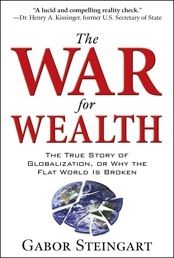
This book is light read yet a compelling one. You will neither find rigorous arguments, data, and detailed descriptions like you get in books written by Rodrik, Stiglitz, or Bhagwati nor you will find anti-globalization (anti-trade) sentiments resonated in Lou Dobbs’ and, to so degree in, Naomi Klein's books. This is not an intellectually challenging book on globalization but is thought-provoking. It looks more like a journalistic work; reporting style writing and not so surfacial but also not too in-depth analysis! The analysis is heavily skewed towards the plight of working class in the US (and to some degree in the Europe). Steingart dismisses Thomas Friedman's idea that "the world is flat" by arguing that disproportionate gains from trade and globalization do not add up to the world being a flat world.
He accentuates, over and over again, the differences between capital and labor market (labor market is not and cannot be flat) and how cheap labor in China and India are gaining and how middle class is emerging in these countries while in the West there have been erosion of low-tiered jobs and slow erosion of middle class.
He refutes the prevailing notion (on trade related debate) of structural adjustment in the job market by presenting statistics on job losses not only in the low-tier jobs but also in the blue-collar jobs. Meanwhile, service sectors jobs are also not increasing in the West. This means that globalization has been unfair, i.e. it is not producing win-win situation, as predicted by some trade theories, in the West. It is a win-lose situation in the West and a win-win situation in the emerging developing nations like India, China, Vietnam, and Brazil.
He also has objection with the profit-minded capitalists who overlook basic labor and environment standards in factories in China and back-office service companies in India. Steingart is worried that the US will be left behind even in knowledge market as Chinese and Indian government pour in more and more money for research and development; he fears that the next Einstein would be from India or China.
He argues that globalization is not debated as is see in reality. He also presents seven fallacies of globalization debate. His book also contains an interview with Paul Samuelson, who also resonates Steingart's argument (or it might be the other way round) that globalization has produced a win-lose situation in the US and the Europe.
…The war for wealth, a bitter struggle for a share of affluence, and the related struggle over political and cultural dominance in the world, are the real conflicts of our day. The war on terror is overblown, the man in the White House has set the wrong priorities, and the public— deliberately or not—is being kept in the dark over the true extent of the global shift of power and wealth. (pp.ix)
…The opponents and proponents of today’s globalization are united in being mistaken. Without knowing it or wanting it, they are part of a single party one could call “America, Don’t Move.” This party appears on no ballot, never holds party conventions, and has never organized a fund-raiser. It doesn’t send any of its luminaries to appear on Meet the Press or post promotional videos on YouTube, nor does it hire pollsters to investigate the opinions of farmers, housewives, and minorities. (pp.9)
Steingart’s seven fallacies of globalization debate (pp.10-21):
The natural progression for a developed economy is to move from an industry-based to a service-based economy.
Economics and morals have nothing in common.
The new world is flat.
The tide of globalization automatically lifts all boats.
Globalization is a great work of peace.
The nation can no longer do anything for the people in its care.
Globalization is a hot issue.
The flat world is broken!
…Within a period of time that would amount to barely a blip in history, 3 billion additional people and there- fore 1.5 billion new workers joined the world’s labor force and helped bring about an unprecedented shift in the balance of power. The West’s 350 million well-trained but costly workers, who until then had been responsible for a large segment of world production, became a minority almost overnight. (pp.133)
…The world is by no means running out of work, as some claim. As long as the number of goods that are produced, sold, and consumed increases, there can be no loss of jobs. At the beginning of the twenty-first century, the global economy is experiencing one of its biggest growth spurts in decades. Despite the advent of the Internet and industrial automation, the sheer volume of jobs continues to increase. What has changed, however, is the distribution of labor in the context of a global labor market. This labor market is unlimited—but not for the Western worker. (pp.141)
Samuelson’s take on the outcome of globalization:
…The globalization leads to a win-win situation for people in China. That’s true for the poor people in China and for the wealthier people in China. In the United States, the development appears to be very different. Highly specialized and professional members of the workforce will profit, while the run-of-the-mill working-class people will be the losers. It’s a win and lose situation. (pp.267)
…In the globalized society, we will see a deeper split within the developed nations. I think the lower half of the income distribution will be the losers. Globalization means two things: in all probability it means an increase in inequality, and in all probability it also means a loss of serenity. Globalization brings us more prosperity, but it also leads to more uncertainty, tension, and enhanced inequality. In America, it has already led to a cowed workforce. Even for an MIT graduate, things have changed. (pp. 270)
Finally, Samuelson’s advice:
My first piece of advice would be: choose the middle way. There is no substitute for the market mechanism— but the market mechanism has no brain, it has no heart. Without political programs it will inevitably breed inequality. My second piece of advice would be: globalization in its current shape and speed makes the world a more insecure and nervous place. We should try to slow down, and, in our own long-run interest, try to be less aggressive. (pp.274)
Oh, I don’t want to miss this! Samuelson on Keynes and Schumpeter:
…First, I was against Keynes because he was contradicting what all my wonderful professors believed. But finally I decided, am I going to let reality take over or am I going to let ideological reverence prevail? My teacher at Harvard University was Joseph Schumpeter, the famous Austrian economist who had come to Harvard from Weimar Bonn University. Schumpeter was erroneous on the Great Depression. He saw it as a healthy thing. His diagnosis was that the Great Depression was a good thing because it was going to improve productivity. Well, of course it didn’t. Of the 40 most gifted graduates in the physical sciences and the 40 most gifted graduates in the biological sciences, in my first year none had a job for the next year. What good was that going to do for the productivity of the subsequent U.S. economy?
...It used to be said that Schumpeter’s nose was out of joint, that he was kind of jealous of Keynes. He said to me: “You are in favor of Keynes because you are a socialist.” I said: “Professor Schumpeter , I come from the University of Chicago—the citadel of capitalism! When was I ever a socialist? You don’t have to be a socialist to be in favor of Keynes.” And he said: “Well, you are a socialist in the sense that you don’t revere the capitalist system.” Well, that was true. I spent my first 15 years under the rule of pure capitalism, and it had lots of advantages and lots of disadvantages. (pp.165-6)
An analysis of the so-called export-led growth (interesting paper from the IMF… the main point is that solely focusing on export-led through tradable sector might not be wholly right; non-tradable sector led-growth could be as powerful as tradable export-led growth)
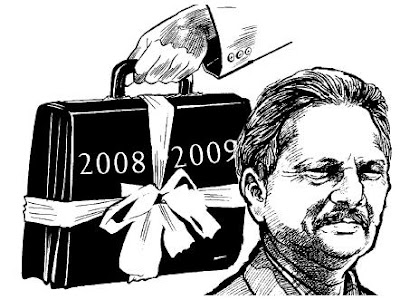
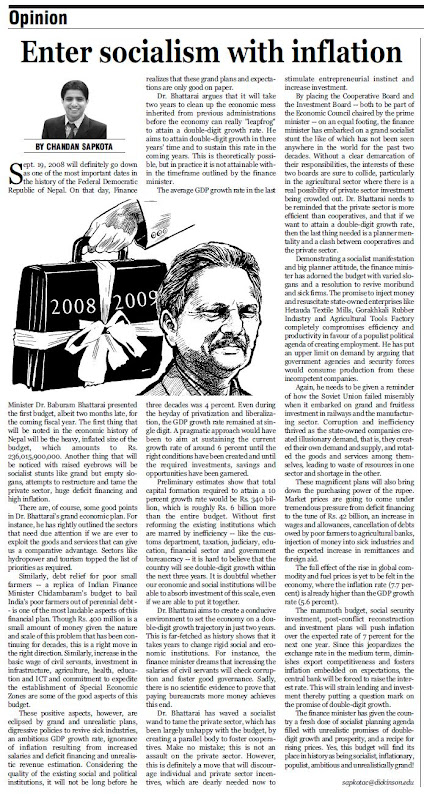
My latest Op-Ed published today is titled “Enter Socialism with Inflation”. It is about the quantity and quality of budget presented on September 19, 2008 by Finance Minister Dr. Baburam Bhattarai, to the first elected parliament of the Federal Democratic Republic of Nepal.
Although I am happy that sectoral priorities have been quite upfront and to the point this time- putting hydropower and tourism on the top of priority list- I am not satisfied with the inflated budget, econ-political slogans, policies to tame the private sector, promotion of cooperatives, plans to revive sick and moribund firms, and complete disregard to rising inflation rate. This budget is crafted with a socialist and planner mentality, which might not necessarily lead to a servile state but is certain to screw up individual and private sector incentives, which is the last thing Nepal needs if it wants to see the light of a double-digit growth rate.
Read the full article here. My preliminary notes on this budget article is here. Extended summary of the budget is here.
Sept. 19, 2008 will definitely go down as one of the most important dates in the history of the Federal Democratic Republic of Nepal. On that day, Finance Minister Dr. Baburam Bhattarai presented the first budget, albeit two months late, for the coming fiscal year. The first thing that will be noted in the economic history of Nepal will be the heavy, inflated size of the budget, which amounts to Rs. 236,015,900,000. Another thing that will be noticed with raised eyebrows will be socialist stunts like grand but empty slogans, attempts to restructure and tame the private sector, huge deficit financing and high inflation.
…positive aspects, however, are eclipsed by grand and unrealistic plans, digressive policies to revive sick industries, an ambitious GDP growth rate, ignorance of inflation resulting from increased salaries and deficit financing and unrealistic revenue estimation. Considering the quality of the existing social and political institutions, it will not be long before he realizes that these grand plans and expectations are only good on paper.
…Dr. Bhattarai has waved a socialist wand to tame the private sector, which has been largely unhappy with the budget, by creating a parallel body to foster cooperatives. Make no mistake; this is not an assault on the private sector. However, this is definitely a move that will discourage individual and private sector incentives, which are dearly needed now to stimulate entrepreneurial instinct and increase investment.
By placing the Cooperative Board and the Investment Board -- both to be part of the Economic Council chaired by the prime minister -- on an equal footing, the finance minister has embarked on a grand socialist stunt the like of which has not been seen anywhere in the world for the past two decades. Without a clear demarcation of their responsibilities, the interests of these two boards are sure to collide, particularly in the agricultural sector where there is a real possibility of private sector investment being crowded out. Dr. Bhattarai needs to be reminded that the private sector is more efficient than cooperatives, and that if we want to attain a double-digit growth rate, then the last thing needed is a planner mentality and a clash between cooperatives and the private sector.
…These magnificent plans will also bring down the purchasing power of the rupee. Market prices are going to come under tremendous pressure from deficit financing to the tune of Rs. 42 billion, an increase in wages and allowances, cancellation of debts owed by poor farmers to agricultural banks, injection of money into sick industries and the expected increase in remittances and foreign aid.
The mammoth budget, social security investment, post-conflict reconstruction and investment plans will push inflation over the expected rate of 7 percent for the next one year. Since this jeopardizes the exchange rate in the medium term, diminishes export competitiveness and fosters inflation embedded on expectations, the central bank will be forced to raise the interest rate. This will strain lending and investment thereby putting a question mark on the promise of double-digit growth.
The finance minister has given the country a fresh dose of socialist planning agenda filled with unrealistic promises of double-digit growth and prosperity, and a recipe for rising prices. Yes, this budget will find its place in history as being socialist, inflationary, populist, ambitious and unrealistically grand!
Jeffrey Sachs and Bono are writing a blog for the FT from the MDGs summit starting today. Here is a link to the blog.
Earlier, development economist Paul Collier wrote an Op-Ed in the NYT calling for vigorous pursuit of MDGs, increase in aid, and offering a sense of hope to help the bottom billion.
Easterly would stab this paragraph:
The laggards in the struggle for the MDGs are not the poor countries or their ostensibly corrupt governments. The laggards are the rich world, so full of promises and high rhetoric and so low on delivery. The MDGs are falling short because of a lack of promised financing to put in place the clinics, schools, roads, power, and other investments needed for their success. Six years ago, the rich countries pledged in Monterrey, Mexico to “make concrete efforts toward the international target of 0.7 per cent of GNP in official development assistance.” Yet the United States stands are 0.16 per cent, Japan at 0.17, Italy at 0.19, Canada at 0.28, Germany at 0.37, and France at 0.39.
Paul Colliercalls for a vigorous pursuit of MDGs, increase in aid, and offering a sense of hope to help the bottom billion. In the wake of UN General Assembly starting today, he questions why the UN did not did not act to set international guidelines on taxation and investment in resource rich poor countries, why it did not intervene in Mauritania when a coup was staged recently, why it does not do anything on biofuel scam and the prospects of genetically modified seeds in Africa, etc. As always, Collier’s pieces are thought-provoking, lucid, and to the point.
…Hope makes a difference in people’s ability to tolerate poverty; parents are willing to sacrifice as long as their children have a future. Our top priority should be to provide credible hope where it has been lacking. The African countries in the bottom billion have missed out on the prolonged period of global growth that the rest of the world has experienced. The United Nations’ goal should not be to help the poor in fast-growing and middle-income countries; it should do its utmost to help the bottom billion to catch up. Anti-poverty efforts should be focused on the 60 or so countries — most of them in Africa — that are both poor and persistently slow-growing.
A further weakness with the Millennium Development Goals is that they are devoid of strategy; their only remedy is more aid. I am not hostile to aid. I think we should increase it, though given the looming recession in Europe and North America, I doubt we will. But other policies on governance, agriculture, security and trade could be used to potent effect.
…Why, also, did the United Nations not intervene militarily when the democratic government of Mauritania, another country in the bottom billion, was overthrown by a coup last month? Where is an alternative initiative to open international trade to poor countries now that the Doha round talks have collapsed? Above all, with a five-year-old commodities boom transferring wealth to some of the countries of the bottom billion, where are the international guidelines on taxation and investment that might help these countries convert earnings from exports of depleting minerals into productive assets like roads and schools?
…We need not just a “Year of the Bottom Billion,” but several decades. This session of the United Nations is an appropriate moment to get started.