Saturday, June 21, 2008

Pariah for couple of days:Taboo that needs abolition


A Maoist worker in menstruation, from Bhairavsthan VDC in remote Achham district, living in isolation in a makeshift tent near her house, Friday. This practice known as Chhaupadi is widely condemned by women’s rights groups as inhuman. In this part of Nepal, women are considered impure for 11 days after childbirth and four to seven days during menstruation and kept in isolation. (Source: The Kathmandu Post, June 21)

Easterly ranks aid agencies

Always critical of aid agencies, Easterly has now come up with his own raking of aid agencies. Starting his assumptions from a distrust on aid agencies, of whatever nature they are, he focuses on the difficulties faced by aid agencies because "they are typically not accountable to their intended beneficiaries." He considers dimensions of aid practices like transparency, specialization (the degree to which aid is not fragmented among too many donors, countries, and sectors), selectivity (the extent to which aid avoids corrupt autocrats), use of ineffective aid channels such as tied aid, food aid, and technical assistance, and the overhead costs of aid agencies.

Among the 48 aid agencies he looked at, the World Bank's IDA, of which he is always critical of, is in the first place. Here is the full ranking

aid agency ranking

The first five on the list are: International Development Assistance (IDA), Department of International Development (DFID), African Development Bank, Asian Development Bank, and Inter-American Development Bank. The IMF is ranked in 26th position, which is worse than USAID's 16th position.

Easterly said that he was surprised by the performance of the World Bank: “The World Bank is seen as professional and staff is chosen on the basis of merit." Meanwhile, the UN agencies have performed poorly in his list. I am surprised that UN WFP is third from the last in his list. UNHCR is in the last. Easterly argues that this happened because these agencies are considered "bloated and politicized." He is also unhappy with limited information disclosure from WFP. This might have skewed the results further because it is unbelievable that WFP and UNHCR are in the bottom of the list. These agencies conduct targeted aiding in the most difficult places in the world. And, the outcome is generally positive. Food aid directly given to the most affected people, be it in an in a country run by an autocrat or in a democratic country, should not be viewed differently. Targeted food aid is for survival and WFP's work in the despot states should not be viewed negatively, thus affecting its ranking. Easterly explains that the data are incomplete, which means that the ranking is just another ranking with doubts in its findings.

The main conclusions of our paper appear somewhat contradictory: (1) the data are terrible, and (2) the pat- terns the data show are terrible. If the data are terrible, how do we know the patterns they seem to show hold true? Still, we remain convinced that some data is better than no data. Also, we hope that as researchers publish findings based on the currently available fl awed data, additional data collection and quality improvement will take place. The data situation among aid agencies, such as the murky data available on operating costs of aid agencies and the non-reporting of essential items like aid tying and sectoral shares of aid spending, would be unacceptable in most areas of economics in rich country democracies. It is particularly sad in an area where the objective of these agencies is helping the poorest people in the world, and where one of the few mechanisms for accountability is for outsiders to check what they are doing.

Our findings on aid best practice tend to confirm a number of long-standing complaints about foreign aid. The aid effort is remarkably splintered into many small efforts across all dimensions—number of donors giving aid, number of countries receiving aid from each donor, and number of sectors in which each do- nor operates. A lot of aid still goes to corrupt and autocratic countries, and to countries other than those with the lowest incomes. Aid tying, the use of food aid-in-kind, and the heavy use of technical assistance continue to persist in many aid agencies, despite decades of complaints about these channels being ineffective. In addition, some agencies have remarkably high overhead costs. The broad pattern that emerges from our evidence is that development banks tend to be closest to best practices for aid, the UN agencies perform worst on these dimensions, and the bilaterals are spread out all along in between. Explaining why each of these patterns persists over time raises an interesting agenda for research in political economy


Friday, June 20, 2008

Collier in favor of coups!

Paul Collier argues that, in light of international incapacity and unwillingness to deal with dictators, in order to topple tyrant regimes like that of Mugabe of Zimbabwe and General Shwe of Burma, the West needs to support coups by the country's own army. Quite disturbing argument at least for those who always drumbeat the virtues of democracy. But, as Collier argues, this is essential because if tyrants cannot be toppled by international pressure while they continue to plunder on domestic resources at the cost of starving/dying citizens, then it is better to support domestic coups, which might provide a glimmer of hope when there is none. He favors coups because the existing system of governance would simply get worse without change in power/leaders. However, coups, which are "unguided missiles," should be provided with a guidance system so that governance is better than in a tyrant's rule.

So how can the grossly excessive powers of the Mugabes and Shwes of the world be curtailed? After Iraq, there is no international appetite for using the threat of military force to pressure thugs. But only military pressure is likely to be effective; tyrants can almost always shield themselves from economic sanctions. So there is only one credible counter to presidential power: the country's own army.

Realistically, Mugabe and Shwe can be toppled only by a military coup. Of course, they are fully aware of this danger, and thus have appointed their cronies as generals and kept a watchful eye on any potentially restless junior officers. Such tactics reduce the risk of a coup, but they cannot eliminate it: On average, there have been two successful coups per year in the developing world in recent decades. A truly bad government in a developing country is more likely to be replaced by a coup than an election: Mugabe will presumably rig the runoff vote scheduled for Friday by intimidation. Or he could follow the example of the last Burmese dictator, who held an election, lost and simply ignored the result.

I find it a little awkward to be writing in praise, however faint, of coups. They are unguided missiles, as likely to topple a democracy as a dictatorship. But there is still something to be said for them.

Since the fall of the Soviet Union, the international community has taken the rather simplistic position that armies should stay out of politics. That view is understandable but premature. Rather than trying to freeze coups out of the international system, we should try to provide them with a guidance system. In contexts such as Zimbabwe and Burma, coups should be encouraged because they are likely to lead to improved governance. (It's hard to imagine things getting much worse.) The question then becomes how to provide encouragement for some potentially helpful coups while staying within the bounds of proper international conduct.

Good article! Read the full article in the Washington Post on June 22.

Thursday, June 19, 2008

New country ranking on trade facilitation/enabling

The World Economic Forum (WEF) has published a report titled The Global Enabling Trade Report 2008, which ranks countries by looking at four issues/indexes: market access, border administration, transport and communications infrastructure, and the business environment.

The first subindex measures the extent to which the policy and cultural framework of the country welcomes foreign goods into the country. Once goods have been allowed in to the country, the second subindex assesses the extent to which the administration at the border facilitates their entry. Once goods have made it over the border, the third subindex takes into account whether the country has the transport and communications infrastructure necessary to facilitate the movement of the goods from the border to destination.

These "pillars of enabling trade" are further divided into ten subindexes: tariffs and non-tariff barriers, proclivity to trade, efficiency of customs administration, efficiency of import-export procedures, transparency of border administration, availability and quality of transport infrastructure, availability and quality of transport services, availability and use of ICTs, regulatory environment, and physical security.

The index basically measures the factors, policies, and services facilitating the free flow of goods over borders and to destination. The top ten countries based on the index are:
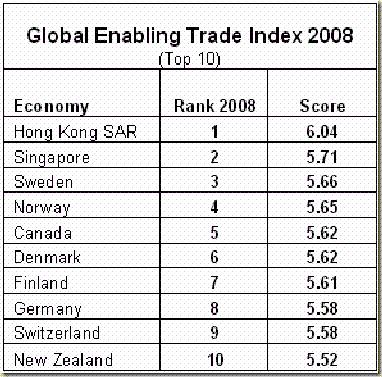
GETR_index


The results bear witness to Hong Kong and Singapore’s openness to international trade and investment as part of their successful economic development strategy. Both countries have put into place customs administrations that are highly efficient in getting goods over borders. They are also endowed with well developed transport and telecommunications infrastructures ensuring rapid transit to final destination. These attributes are further supported by business environments that are conducive to the logistics and transport industry.

The report describes China's trade position as:

China occupies the 48th position.This fairly low position for one of the world’s most successful exporters highlights a number of underlying weaknesses in China’s economy and its trading regime.Above all, China is a fairly closed country. Although its economic success relies heavily on exports, imports are still severely inhibited by tariff and non-tariff barriers, despite the country’s accession to the WTO.The country ranks 108th out of 118 economies on tariff barriers, which amount to almost 15 percent.The country’s border administration is fairly efficient; importing products is not costly, although it can be quite time-consuming. A particular concern when exporting and importing is the lack of transparency of border administration, which can be particularly heavy for foreign businesses. Because of large export volumes, the country is well connected to international markets, yet its transport infrastructure is not on a par with the world’s best. In particular, airport density and the quality of air transport infrastructure are fairly low.The quality and availability of transport services, however, are among the best in the world, ranked 17th overall. Improvements to the regulatory and security environment would further enable trade. In particular, greater encouragement of FDI and more openness to foreign air transport service providers would help.

About India:

Further down the rankings we find India, at 71st place. India’s weak position reflects a mixed performance on the four pillars of the ETI.While it boasts fairly good border administration and an acceptable business environment, market access continues to be severely restricted. Indeed, India ranks 105th on the relevant component with, unlike most other countries, tariff barriers representing a more serious impediment than nontariff barriers. Only a small share of goods is imported duty-free. India’s border administration meets many needs of importers and exporters. Ranked 55th on this indicator, a vast number of customs-related services is available in India and clearance entails low pecuniary costs, although it is time-consuming. Border administration continues to be affected by corrupt practices, however, hampering an efficient transport of goods across borders.Trade-related infrastructure and the relevant services are equally fairly well developed in India, ranking 52nd in the overall sample. However, although the country is well connected through maritime routes, it needs more airports and high-quality roads. India’s business environment is in line with the country’s overall assessment, with the regulatory environment ranked 64th and security assessed at 56th among the countries assessed.

Highlights of the report is available here. It needs to be seen how representative the results are because it is an outcome of "Survey data" and "hard data". The Survey data was collected by surveying the opinions of CEOs and top business leaders in all economies covered by their research. It just reflects the views of the owners of big companies and their opinions are highly subjective, probably giving bad score to things that increase their cost of business/procurement. The report claims that trade openness is associated with higher growth and poverty reduction. This is quite a claim in light of stagnant poverty and growth figures of countries that are fairly open to trade. In most of the cases the countries with low rankings suffer from corrupt custom administration, lack of transparency, limited market access, bad quality of communication and transport infrastructure, and insecurity.

What about my own country, Nepal? Well, it is in third position from the last! Nepal's overall ranking is 116 (with a score of 2.70), just above Burundi and Chad. In the individual subindexes, Nepal's rankings are 106 (with a score of 2.77) in market access, 94 (with a score of 3.14) in tariff and non-tariff barriers, 115 (with a score of 2.41) in proclivity to trade, 108 (with a score of 2.70) in border administration, 117 (with a score of 1.92) in efficiency of customs administration, 101 (with a score of 3.37) in efficiency of import-export procedures, 103 (with a score of 2.83) in transparency of border administration, 113 (with a score of 2.34) in transport and communications infrastructure, 111 (with a score of 2.45) in availability and quality of transport infrastructure, 97 (with a score of 2.97) in availability of transport services, 115 (with a score of 1.61) in availability and use of ICTs, 118 (with a score of 2.98) in business environment, 116 (with a score of 3.14) in regulatory environment, and 117 (with a score of 2.82) in physical security.

Here is a video where Robert Lawrence, Albert Williams Professor of Trade and Investment at the John F. Kennedy School of Government, Harvard University comments on the results of the World Economic Forum's Global Enabling Trade Report 2008.

Wednesday, June 18, 2008

Links of Interest

The expected benefits of trade liberalization for world income and development  (it is much more lesser than previously expected/claimed...using the MIRAGE model, the authors estimate that full trade liberalization would increase world real income by US$100 billion (+0.33 percent) after 10 years of implementation....a different study had found that full trade liberalization would increase world welfare between 0.2 to 3.1 percent only.)

How imbalances led to credit crunch and inflation 

A fair Zimbabwe poll is not enough 

How best to manage global imbalances 

Mohamed El-Erian writes: "...the fact that the system has ended up eschewing the superior policy solution speaks to the urgency of learning from them. An increasingly interconnected world cannot maintain high growth and low inflation without a bold modernisation of the mechanisms for international policy co-ordination, starting with the G7. Governments must continue to refine their policy instruments and pay greater attention to the secondary and tertiary consequences of their actions. The private sector must assume greater responsibility for ­forward-looking risk management. In the absence of these changes, the inevitable adjustment of the global imbalances will continue to entail a serious cost in global welfare."

Does money transcend cultural identity?  

Lessons from Latin America: Donors, democracy and development 

How a Kenyan village tripled its corn harvest (thanks to Sachs's Millennium Villages Project)

Georgy Dyson at the TED: The birth of the computer

Tuesday, June 17, 2008

Time to look for new patterns of consumption and production

Joe Stiglitz argues that the scale of food and fuel crisis right now is an indication for the need to look at new patterns of consumption and production.

The world needs to rethink the sources of growth. If the foundations of economic growth lie in advances in science and technology, not in speculation in real estate or financial markets, then tax systems must be realigned. Why should those who make their income by gambling in Wall Street's casinos be taxed at a lower rate than those who earn their money in other ways? Capital gains should be taxed at least at as high a rate as ordinary income. (Such returns will, in any case, get a substantial benefit because the tax is not imposed until the gain is realised.) In addition, there should be a windfall profits tax on oil and gas companies.

Given the huge increase in inequality in most countries, higher taxes for those who have done well – to help those who have lost ground from globalisation and technological change – are in order, and could also ameliorate the strains imposed by soaring food and energy prices. Countries, like the US, with food stamp programmes, clearly need to increase the value of these subsidies in order to ensure that nutrition standards do not deteriorate. Those countries without such programmes might think about instituting them.

Two factors set off today's crisis: the Iraq war contributed to the run-up in oil prices, including through increased instability in the Middle East, the low-cost provider of oil, while biofuels have meant that food and energy markets are increasingly integrated. Although the focus on renewable energy sources is welcome, policies that distort food supply are not. America's subsidies for corn-based ethanol contribute more to the coffers of ethanol producers than they do to curtailing global warming. Huge agriculture subsidies in the US and the European Union have weakened agriculture in the developing world, where too little international assistance was directed at improving agriculture productivity. Development aid for agriculture has fallen from a high of 17% of total aid to just 3% today, with some international donors demanding that fertiliser subsidies be eliminated, making it even more difficult for cash-strapped farmers to compete.

Rich countries must reduce, if not eliminate, distortional agriculture and energy policies, and help those in the poorest countries improve their capacity to produce food. But this is just a start: we have treated our most precious resources – clean water and air – as if they were free. Only new patterns of consumption and production – a new economic model – can address that most fundamental resource problem.

Links of Interest

Tanzania: An African success story?

Nepal Maoist chief to get top peace award

The paralysed and inefficient institutions of Kosovo

Is Ethiopia really enjoying economic development?

A theory of military dictatorships