Saturday, November 22, 2008

Capitalism with Chinese Characteristics

Here is an interesting piece about the Chinese economic model. Professor Yasheng Huang challenges the Beijing Consensus (that incremental privatization in rural areas was the key to increased prosperity) and says that rural privatization has actually been rolled back in the past 15 years. TVEs led to helped reduce poverty by 154 million between 1978 and 1988 but after this rural privatization was rolled back by restricting loans to entrepreneurs willing to invest beyond agriculture sector and taxes were raised in the rural areas to fund urbanization. Interesting!

He argued that the reforms in the 1980s were very far reaching and substantial for private sector development, especially in rural areas led by township and village enterprises (TVEs). In the 1990s, however, those reforms slowed, and privatization was rolled-back.

From 1978 to 1988, poverty in rural China declined by 154 million people, while it only declined by 62 million people from 1989 to 1999. Huang argued that the key to the greater success in the 1980s were TVEs, which were a focus of the early reforms of the 1980s. Out of 12 million TVEs existing in 1985, fully 10 million were totally private. Along with an abundance of government loans that were easily accessible to small businesses, this strategy created rapid poverty alleviation.

In the 1990s a fundamental reversal was made in rural policy. First, there was a substantial increase in the qualifications enterprises needed for loans. Second, the government’s loan policy emphasized agricultural production instead of expanding rural entrepreneurship beyond agriculture. Farmers found it difficult to obtain money to start a non-agricultural business. Third, although most Chinese live in rural regions, a new focus was put on developing the urban regions. To pay for these urban reforms, the government heavily taxed rural citizens and reduced services in rural health and education. The result of these policy changes was a reversal that slowed down rural poverty alleviation and sharply increased the gap in urban-rural household income. 

Though Huang made a strong case for widely varying economic policies in China between the 1990s and 1980s, his explanation for the reversal, he admitted, is not based on an exhaustive review of the facts. Nevertheless, he suspects that the reason is technocratic. In the 1980s, the Chinese Communist Party (CCP) was led by individuals who grew up in rural regions, while the leadership of the 1990s came from urban areas. Furthermore, this may explain why today’s CCP leaders, like rural-born Hu Jintao, are refocusing on rural reforms.

Here is his book Capitalism with Chinese Characteristics: Entrepreneurship and the State reviewed by The Economist.

Thursday, November 20, 2008

World Development Report 2009

The World Development Report 2009 is titled Reshaping Economic Geography.The gist of the report: growth is unbalanced but development can be inclusive…to promote long-term growth policies should be designed to facilitate concentration and economic integration, both within and across countries. Overview of the report here. Full text Part 1 and Part 2

The report warns that trying to fight markets just because it is unfavorable to certain sectors and groups is tantamount to fighting prosperity. Let markets do its function and governments facilitate geographic concentration of production. That being said, governments should institute policies that make provision of basic needs- of schools, security, streets, and sanitation- more universal, the report recommends.

Four main points:

  • Economic activity concentrates as places prosper. (Take the fact that the effects of economic growth on concentration of industries and population is uneven. Examples: Tokyo is barely 4% of Japan’s total area but has 35 million people)
  • Living standards converge with development. (Estimates from over 100 living standards surveys show that households in the most prosperous areas of developing countries like Ghana and Indonesia have an average consumption nearly 75 percent higher than that in their lagging areas. In wealthy countries, this difference is less than 25 percent.)
  • Growth requires geographic transformations. (…what matters for economic growth is the ‘thickness’ of economic borders, which depends on the restrictions on the flow of goods, capital, people, and ideas. Borders between countries in Western Europe are now about one-fourth as thick as those in Western Africa.)
  • Prosperity demands mobile people and products. (Korea went from more than 80 percent rural to more than 80 percent urban between 1950 and 1990, as its per capita income grew from present-day Benin’s to more than Portugal’s. The United States, the world’s largest economy, is also among the most mobile, with about 35 million people changing their place of residence every year. In China, more than 150 million people moved to coastal areas during the late 1990s.)

“Lagging and leading places can be brought closer economically by unleashing the market forces of agglomeration, migration and specialization, as we have seen in North America, Western Europe, and East Asia, where intra-industry trade has powered prosperity,” said Justin Lin, World Bank Chief Economist and Senior Vice President, Development Economics. “How well markets and governments work together to harness these forces will determine the wealth of cities, provinces, and nations.”

Trying to spread out economic activity can hinder growth and does little to fight poverty. For rapid, shared growth, governments must promote economic integration which, at its core, is about the mobility of people, products, and ideas.

“In a world where economic concentration is a fact of life, governments should improve land policies, provide basic services everywhere and invest efficiently in infrastructure,” said Katherine Sierra, Vice President, Sustainable Development. “As the WDR shows, incentives intended to attract industry to lagging areas should be used sparingly.”

The WDR reframes the policy debates to include all the instruments of integration—common institutions, connective infrastructure, and targeted interventions. By common institutions, the report means regulations affecting land, labor and commerce, and social services such as education and health financed through taxes and transfers. Infrastructure refers to roads, railways, ports, airports, and communications systems. Interventions include slum clearance programs, special tax incentives to firms, and preferential trade access for poor countries.

This report is related to Nobel laureate Paul Krugman’s work on New Economic Geography and the discussion about increasing returns and transportation costs. I had written an Op-ed about how policies can be designed so that governments can facilitate concentration and agglomeration in the Nepali economy, which has seen massive concentration of industries in few places while leaving other areas at bay. My main policy recommendation in the Op-ed was: invest in transportation and infrastructure and facilitate credits to companies willing to invest in new areas. This report kind of challenges this argument saying that trying to “spread out economic activity can hinder growth and does little to help poverty”. Well, without investing in transportation, domestic integration is not possible in countries like Nepal. And, if money is invested in transportation infrastructure, then lower per unit transportation costs will help spread the concentration of industries. It does not necessarily mean that this will thin out already existing concentration.

In short, the report says: promote concentration and let markets work but also engage in welfare programs so that those unaffected by markets are taken care of. Let growth be unbalanced, but effective policies will make development inclusive. Also, the report flatly states that the world is not flat (on page 8 of extended summary)…I wonder how Thomas Friedman would review this report.

More about the report here and here.

Wednesday, November 19, 2008

Paul Samuelson blasts libertarians

Paul Samuelson argues that there is no alternative to market system but this is not the same thing as unregulated capitalism. Based on his “rationality and experience” he prefers taking a dynamic moving center position, i.e. ideologically, he thinks Limited Centrist State should be the model for the economy. This piece is going to make the libertarians, who he says are emotional cripples and bad advice givers, very unhappy. He blasts Hayek’s “serfdom” concept, which Hayek uses to argue that increasing role of state will lead to serfdom. The book he is referring to is The Road to Serfdom (pretty good book to read).

Based on my observations of economic history, both short run and long run, I believe that there is no satisfactory alternative to market systems as a way of organizing both economically poor and economically rich populations.

However, using markets is not the same thing as unregulated capitalism so beloved by libertarians. Such systems cannot regulate themselves, either micro-economically or macro-economically. Wherever tried they systematically breed intolerable inequalities. And instead of such inequality being the necessary price to encourage dynamic progress via technological and managerial innovations, it instead breeds dysfunctional shortfalls in what economists call "total factor productivity."

…Libertarians are not just bad emotional cripples. They are also bad advice givers. I refer of course to the views of both Milton Friedman and Friedrich Hayek. The “serfdom” they warn against is not that of Genghis Khan or Lenin-Stalin-Mao or Hitler-Mussolini. Rather, they warn against the centrist states of the modern world. Think only of Switzerland, Britain, the US, the Scandinavian countries, and the Pacific Rim. Why do citizenries there report high indexes of “happiness” and enjoy broad freedoms of speech and belief?

…Yes, public policy should regulate (rationally regulate) corporate life and should work to stabilize the macro economy. Yes, future fiscal systems can in a limited degree reduce the more glaring evils of inequality. However, a centrist system can do measurable harm if it acts too strongly to reduce inequality. My goal is the Limited Centrist State.

I am not a centrist because I can’t make up my mind about the Right and the Left. It is because each of those has proved itself to be so non-optimal that rationality and experience move me toward the dynamic moving center.

Five Nobel prize winning economists write about the global economy here. More about Samuelson here and here. Thanks to Professor Farrant for the pointer.

Tuesday, November 18, 2008

Now India wants fiscal stimulus

So, technically the EU, Japan (and the US) are in a recession. The wave of global recession is in continuum right now. The crisis sparked by sup-prime mortgage crisis emanating from the US is getting harder to contain even in the face of rock bottom interest rates. This means monetary policy is getting ineffective. The last resort: call on the government! There has already been stimulus in the US, China, and some form of this sort in the EU. In its World Economic Outlook update for November, the IMF also argued that world output growth will fall to 2.2% and fiscal stimulus is the (only) option as monetary policy is not doing anything good right now. Already, India has lost $57 billion due to the current global crisis.

Now comes India, where businessmen surveyed by the WEF called for a fiscal stimulus package to uplift the quality of infrastructure and to prop up expected downslide in growth rate, which is forecasted to slide to 7% from 9% at present.

…“contra-cyclical fiscal stimulus” through the speeding the implementation of infrastructure projects already in the pipeline would certainly help economic growth to rebound.

More here.

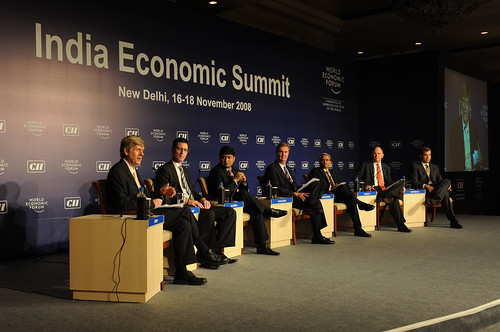
India Economic Summit 2008

Interestingly, some young Indian parliamentarians also argued that India now needs Obamas- not one, not two, but many!

“From our young sportsmen, our young businessmen, our young politicians,” said Rahul Bajaj, Chairman, Bajaj Auto; Member of Parliament, India, hopefully we are going to have more than one Barack Obama!”

New leadership and new ideas are desperately needed to address critical challenges faced by India. First among these, said Deepender Singh Hooda, Member of Parliament, India, is “the resurgence of divisions based on caste, religion and region.” Moreover, Hooda pointed out that, while India has enjoyed strong economic growth overall, certain sectors of society have been left behind and rising inequality is increasing class tension. Bihar is the most equal state in India: as states become more prosperous, they become more unequal. The shift from an agriculturally-based economy to services and manufacturing also increases tensions over issues like land rights.

More here.

Grim growth forecast and call for new policy stimulus

The IMF has again readjusted its global growth forecast due to rising financial sector deleveraging and dwindling producer and consumer confidence. World output growth forecast is scaled down by around 0.75 percentage point to 2.2 percent in 2009 (from 5% in 2007 to 3.75% in 2008 to 2.2% in 2009…this could go even down!). Both the advanced and emerging and developing economies are expected to further slow down. Worse, in advanced economies output is forecast to contract on a full-year basis in 2009, the first such fall in the post-war period, according to the IMF. It warns that the final outcome is highly uncertain and could much more worse than expected.

Rather than relating the magnitude of this crisis to the Great Depression, the World Economic Outlook Update from the IMF states that the current and expected contraction is “broadly comparable” in magnitude to those that occurred in 1975 and 1982.

Who will suffer the most? According to the WEO update, commodity exporters (because commodity price projects have been marked down), countries with acute external financing and liquidity problems.

In the face of worsening financial and economic conditions, markets are pricing in expectations of much higher corporate default rates, as well as higher losses on securities and loans, in part, because pressures have now broadened to emerging markets, raising recapitalization needs. Thus, financial conditions are likely to remain tight for a longer period and to be more impervious to policy measures than previously expected.

It also hints the ineffectiveness of monetary policy as interest rates are already close to zero. What’s next? Keynesianism…and fiscal stimulus!

…However, monetary policy may not be enough because monetary easing may be less effective in the face of difficult financial conditions and deleveraging. Also, in some cases room for further easing is limited as policy rates are already close to zero bound. There are condition where broad-based fiscal stimulus is likely to be warranted. Fiscal stimulus can be effective if it is well targeted, supported by accommodative monetary policy, and implemented in countries that have fiscal space.

In Sub-Saharan Africa output is expected to decrease by 0.6% in 2008 and 1.2% in 2009.

Monday, November 17, 2008

Links of Interest (11/16/08)

Back again!

What happened at the G20 Summit on Saturday? 

Bill Easterly reviews The Bottom Billion (Two criticisms of Paul Collier’s book: (i) correlation does not equal causation…military intervention does not cause reduction in civil wars and poverty level and (ii) selection bias…that Collier cherry-picks troubled nations and timeframe of growth rates to show that they are trapped in low income and low growth state. (Africa left behind by Collier here)

Rethinking the growth diagnostics approach: Questions from the practitioners

The Politics of Hunger: How Illusion and Greed fan the food crisis (Paul Collier says three policies can be helpful in solving the food crisis: expanding large commercial farms, ending the GM-crop ban, and doing away with the U.S. subsidies on ethanol)

The birth of doing business report

Macro policy in a liquidity trap

Buddha boy reappears in Nepal

The IMF in focus

Dr Keynes’s Chinese patient

Saturday, November 8, 2008

Food security: From agricultural to industrial to back to agricultural society!

Food insecurity is one of the main global issues right now and many nations are in danger of facing starving population. Here is a discussion about global food crisis.
 
Here is Michael Pollan writing a letter to the next President about organic food and its advantages against inorganic food. He argues that for the sake of food security, energy independence, and ecological preservation, it makes perfect sense to look for reverting back to old ways of agriculture: from the agricultural to the industrial society, and back to the same society, but with a slight variation! This is an excellent article (pretty long, but worth reading) about how the American food subsidies, increasing use of oil and petroleum products in agriculture, and the general eating habit (of consumers eating products made from a limited number of crops) is leading to food insecurity, national security problems, ecological disaster, and energy crisis. Time to change habits!

The sun-food agenda must include programs to train a new generation of farmers and then help put them on the land. The average American farmer today is 55 years old; we shouldn't expect these farmers to embrace the sort of complex ecological approach to agriculture that is called for. Our focus should be on teaching ecological farming systems to students entering land-grant colleges today. For decades now, it has been federal policy to shrink the number of farmers in America by promoting capital-intensive monoculture and consolidation. As a society, we devalued farming as an occupation and encouraged the best students to leave the farm for "better" jobs in the city. We emptied America's rural counties in order to supply workers to urban factories. To put it bluntly, we now need to reverse course. We need more highly skilled small farmers in more places all across America - not as a matter of nostalgia for the agrarian past but as a matter of national security. For nations that lose the ability to substantially feed themselves will find themselves as gravely compromised in their international dealings as nations that depend on foreign sources of oil presently do. But while there are alternatives to oil, there are no alternatives to food.

...To change our children's food culture, we'll need to plant gardens in every primary school, build fully equipped kitchens, train a new generation of lunchroom ladies (and gentlemen) who can once again cook and teach cooking to children. We should introduce a School Lunch Corps program that forgives federal student loans to culinary-school graduates in exchange for two years of service in the public-school lunch program. And we should immediately increase school-lunch spending per pupil by $1 a day - the minimum amount food-service experts believe it will take to underwrite a shift from fast food in the cafeteria to real food freshly prepared.

...Oil is one of the most important ingredients in our food, and people ought to know just how much of it they're eating. The government should also throw its support behind putting a second bar code on all food products that, when scanned either in the store or at home (or with a cellphone), brings up on a screen the whole story and pictures of how that product was produced: in the case of crops, images of the farm and lists of agrochemicals used in its production; in the case of meat and dairy, descriptions of the animals' diet and drug regimen, as well as live video feeds of the CAFO where they live and, yes, the slaughterhouse where they die. The very length and complexity of the modern food chain breeds a culture of ignorance and indifference among eaters. Shortening the food chain is one way to create more conscious consumers, but deploying technology to pierce the veil is another.

...Your sun-food agenda promises to win support across the aisle. It builds on America's agrarian past, but turns it toward a more sustainable, sophisticated future. It honors the work of American farmers and enlists them in three of the 21st century's most urgent errands: to move into the post-oil era, to improve the health of the American people and to mitigate climate change. Indeed, it enlists all of us in this great cause by turning food consumers into part-time producers, reconnecting the American people with the American land and demonstrating that we need not choose between the welfare of our families and the health of the environment - that eating less oil and more sunlight will redound to the benefit of both.

Highly recommended for those seeking an in-depth analysis of the food crisis and where's it leading us! Worth seeing the video as well. Thanks to my friend Eric Dichter for the pointer!