Monday, October 27, 2008

Larry Summers argues for activist policy

Larry Summers argues that policy activism, especially in the fiscal side, spurs growth (well, at least it did after the WW II). He agrees that investment in interstate highway system, air travel and electronics led to such growth rate.

The most plausible explanation is that an array of transforming investments and technologies – the interstate highway system, widespread air travel and the expansion of electronics – were spurs to growth during the postwar period.

And, he also argues for selective policy intervention—identification of investments that stimulate demand in the short run and positively affect productivity in the long run. Does not this sound familiar, like industrial policy, to which Summers is so opposed to. See this as well.(This is exactly what Senator Obama has been arguing for in his campaign speeches).

So there is a need to ensure that the pressure to increase spending is directed at areas where it will have the most transformational impact. We need to identify those investments that stimulate demand in the short run and have a positive impact on productivity. These include renewable energy technologies and the infrastructure to support them, the broader application of biotechnologies and expanding broadband connectivity, an area where the US has fallen behind.

All of these considerations suggest that the pendulum will swing – and should swing – towards an enhanced role for government in saving the market system from its excesses and inadequacies. Policymakers need to be attentive to potential government flaws as well. For example, they need to recognise that, even as events compel larger deficits in the short run, they reinforce the need for longer-term measures to keep government finances on a sound footing. They must also be wary of measures that have a short-term superficial appeal, yet have adverse long-term consequences.

Nepal at a loss of $256 million due to financial crisis

$256.16 million is the amount of loss the Nepali manufacturing sector will have to incur because of the global financial crisis (and ensuing economic slowdown). This estimate comes from the Confederation of Nepalese Industries (CNI). Though not a huge sum in terms of the scale of bail out package in the West, this means a lot to an economy with GDP amounting to US$ 42 billion. Also, this number accounts for just the manufacturing sector. The main sectors to be hit hard will be tourism sector, and possible hydropower—the two most prioritized sectors that could lead to stimulation of economic growth in the short and medium term. Moreover, melting purchasing power of customers in the West mean less demand for exportable products from Nepal. This loss will be much more higher and severe than the number CNI came up with. In Nepal, the effect will be seen in full scale in late 2009/early 2010 if the financial meltdown in the West reaches its nadir by this end of this year.

The industries that are hit hard now are iron, plastic, edible oil, metals an other manufacturing industries. It is also expected to affect tourism sector, FDI, housing and financial transactions and remittance inflow. This will pose a challenge in meeting the expected revenue for the current fiscal years, as was outlined by the Finance Minister in his budget speech.

The recent decision by the central bank to increase reserve ratio from 10 to 20% has worried investors because of potential tightening of credit market. Due to series of collapse of banks in recent months in the US and EU, the Nepali government increased reserve ratio by 10 percentage point to avert bank failures in Nepal. However, it seems that it comes with high opportunity cost of high cost of borrowing/finance for the private sector, the engine of growth for the economy.

Sunday, October 26, 2008

A mockery of copyrights


Big Mac...actually, its Yac Donalds!


7-Eleven up in the mountains...

These pictures are interesting. They were taken in Mustang, a trekking site in Nepal very popular among domestic and foreign tourists. I sourced the pics from Manoj Gajurel's facebook album.He is a popular comedian in Nepal.

And, a real pic of Kagbeni, Mustang:


Friday, October 24, 2008

The (insurmountable) level of crisis in the emerging countries

Dani Rodrik gives a feel about what the scale of the present financial crisis would be in the emerging countries. He thinks that the emerging countries would face much more severe crisis than the developed counterparts.

Emerging markets for the most part have weak and fragile fiscal systems, and the magnitude of the potential run is huge relative even to the large mountains of reserves that many of them have built up.  Socialization of private liabilities may enhance confidence in the rich countries; it will likely magnify the run in emerging markets.  So we are talking about economic collapses that could be significantly bigger than what the rich countries will experience.  And this time developing countries can legitimately say: it wasn't our fault!

It would be interesting to know what new ideas transpired/were floated when Rodrik, Rogoff, Stiglitz, Birdsall, and Sachs met with the UN Secretary-General Ban Ki-Moon recently. Rodrik sees a possible role for the IMF as a true global lender (massive) of last resort (without too many preconditions).

On a similar note, here is an interesting perspective: From capital flow bonanza to financial crash:

To examine the potential links with financial crises of various stripes, we constructed a family of country-specific probabilities. For each of the 64 countries, this implies four unconditional crisis probabilities, that of: default (or restructuring) on external sovereign debt, a currency crash, and a banking crisis. We also constructed the probability of each type of crisis within a window of three years before and after the bonanza year or years, this we refer to as the conditional probability of a crisis. If capital flow bonanzas make countries more crises prone, the conditional probability should be greater than the unconditional probability of a crisis.

For the full sample, the probability of any of the three varieties of crises conditional on a capital flow bonanza is significantly higher than the unconditional probability. Put differently, the incidence of a financial crisis is higher around a capital inflow bonanza. However, separating the high income countries from the rest qualifies the general result. As for the high income group, there are no systematic differences between the conditional and unconditional probabilities in the aggregate, although there are numerous country cases where the crisis probabilities increase markedly around a capital flow bonanza episode.

For sovereign defaults, less than half the countries (42%) record an increase in default probabilities around capital flow bonanzas. (Here, it is important to recall that about one-third of the countries in the sample are high income.) In two-thirds of the countries the likelihood of a currency crash is significantly higher around capital flow bonanzas in about 61% of the countries the probability of a banking crises is higher around capital flow bonanzas.

Most emerging market economies have thus far been relatively immune to the slowdown in the US. Many are basking in the economic warmth provided by high commodity prices and low borrowing costs. If the pattern of the past few decades holds true, however, those countries may be facing a darkening future.

Wasteful investment

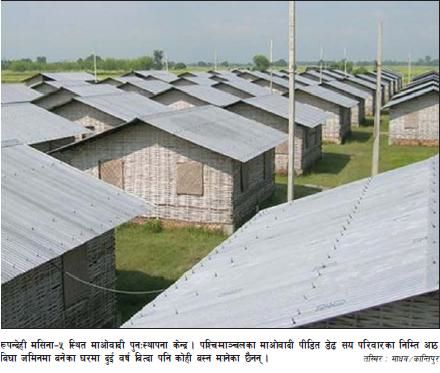
This picture shows what happens when supply is created irrespective of demand. Wasteful investment!

These houses were built two years ago under the Maoists resettlement program. Two training centers and 80 houses (one for two family) were built. Some form of wearing and tearing (depreciation) is already seen in these houses without a single family residing on it. This is a complete waste of resources by the government.

Without first assessing whether the displaced families want to resettle in this particular location (Rupendehi) the government went ahead with the project. Officials now concede that the choice of location was wrong in the first place. This is a typical waste of resource resulting from lack of careful diagnostic of incentives and constraints to resettlement.

Money wasted: NRs 1 crore 65 lakhs (do the maths in dollars, US$1=NRs 74). More here.

Thursday, October 23, 2008

Stiglitz for transparency, oversight and fair competition

Here is a piece from Joseph Stiglitz, who argues that letting financial markets run wild was a risky business and now there is a need for more transparency, oversight and fair competition. Always interesting to read his pieces! He claims that the financial markets are not fulfilling their function- to mobilize savings, allocate capital and manage risk, transferring it from those less able to bear it to those more able.

In America, and some other countries, financial markets have not performed these functions well. They encouraged spendthrift patterns, which led to near-zero savings. They massively misallocated capital. And they created risk, did not manage it well and left huge risks with ordinary Americans, who are now bearing huge costs because of these failures. These problems have occurred repeatedly and are pervasive. The failures in financial markets have effects that spread out to the entire economy.

There are three related reasons for these failures: poorly designed incentive structures, inadequate competition and inadequate transparency.

Strong competition is an essential aspect of well-functioning markets. But information imperfections often limit the extent of competition. America's financial markets have gone beyond these natural limitations of competition to engage in anti-competitive practices…The failure to have strong competition enforcement has meant that there are a number of institutions that are so large that they are too big too fail. That provided an incentive to engage in excessively risky practices.

Finally, markets often fail to produce efficient outcomes (let alone fair or socially just outcomes) when information is imperfect or asymmetric. But information imperfections and asymmetries are at the centre of financial markets - that is what they are about. Our financial markets have even worked hard to exacerbate these problems, as they created non-transparent products that were so complex that not even those who created them fully understood them. This non-transparency is a key part of the credit crisis we have experienced over recent weeks.

Here is what Stiglitz thinks is needed for the wild markets (we need more of some Keynesian stuff):

We need more transparency to ensure that incentive structures do not encourage excessively risky short-sighted behaviour and to reduce the scope of conflicts of interest - our financial markets are rife with them. At the very least, they need to be disclosed. We need countercyclical capital adequacy/provisioning requirements and speed limits. We need to proscribe predatory lending - many of our problems are a result of lending that was both exploitive and risky. We need a financial products safety commission to make sure that the products purchased by, say, a bank or pension fund are safe and appropriate, designed to manage the risks they face; and a financial systems stability commission, to assess the overall stability of the system.

Part of the problem has been our regulatory structures. If government appoints as regulators those who do not believe in regulation, one is not likely to get strong enforcement. We have to design robust regulatory systems, where gaps in enforcement are transparent. Relatively simple regulatory systems may be easier to implement and more robust, and more resistant to regulatory capture.

Structural shift in employment, migration and inclusive growth in Nepal

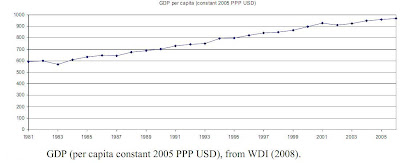
Nepal, which has a per capita GDP of US $470 (2007/08), has witnessed impressive progress in poverty reduction in the last decade. According to NLSS II, the headcount poverty rate declined from 42% to 31% between 1995/96 and 2003/04, urban poverty declined from 22% to 10%, and rural poverty declined from 43% to 35%. However, income inequality is increasing: 6.4% per year for the richest 20%, as compared to 3.7% for the next quintile, and 2.5% for the lowest 20%.

The main four reasons for decrease in poverty level are remittances, farm wages, urbanization, and decline in fertility. But this decrease in poverty level is not uniform among all the population groups. Two factors that account for this are shift in structural employment and discrepancy in migration, according to a paper on inclusive growth in Nepal. This is a pretty different explanation as compared to the earlier standard explanations from the WB and government reports. This probably is true for regional reduction in poverty. Also, the author argues that he finds a strong relation between social exclusion, as defined by the caste system, and economic poverty.

The main pathways out of poverty from 1995 to 2003 have been landless farm workers who became subsistence farmers, construction or manufacturing workers, and subsistence farmers who added to their income by working in the same trades of construction and manufacturing industries, or as migrants to India.

The high poverty rates among the Tamang and Rai people of the eastern hills are reflected in the high average poverty rate of the eastern hills as reported in NLSS (2005). The eastern hills of Nepal is the only part of the country where the poverty rate increased from 1995 to 2003. This supports the conclusion that labor migration is a main explanation for the decline in poverty…. migration is at the lowest in the eastern hills, and if they migrate they tend to migrate within Nepal. In the western hills, on the other hand, a large majority migrate to India. The high level of labor migration to India from the western hills may explain the reduction in poverty in this region.

Can more households follow the same pathways out of poverty? The paper states that this (quite predictably) depends on the economic policy of the government. The author suggests that the government can learn from the experiences of successful Indian states like Kerela and Punjab. Meanwhile, for inclusive growth in sustainable agricultural sector and manufacturing sector hold the key to path out of poverty—for instance, employing Dalits and marginalized groups in manufacturing and construction business in semi-urban areas and freeing permanent laborers from landlords in villages and enacting moderate land distribution schemes, the author argues.

A combination of a social security net with competitive markets and secure property rights, may foster domestic and foreign investments in productive physical and human capital. The role of the government will be to broaden the tax base, and spend the tax incomes, as well as foreign aid, on public goods in support of the combined goal of social security and economic growth. This implies investments in roads, transmission lines for electricity, irrigation, as well as primary education and subsidized health services. Nepal may also consider to copy the rural employment guarantee of India. With a sound social and economic policy Nepal may in general be able to copy the developments of the most successful states of India, with a combination of the policies of Kerala and Punjab, where Kerala focused early on the social sectors, while Punjab focused on agriculture. 
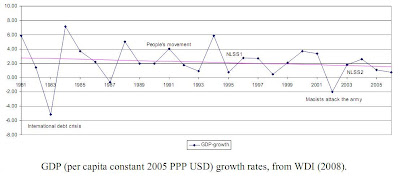
Note that the present government is run by the Maoists who have gained popular support on the back of land reforms and end to feudalism. But the question is how are they going to do land reforms with tempering market and individual incentives? Concerns of private appropriability is running high. I remain skeptical about land redistribution program because of the unclear policies of the Maoists in this regard. A Maoist land minister had to resign last month after he refused to refute and retune a land grab stint Maoists party cadres did on his leadership! My concerns about the land reforms under the red flag here.
Policy interventions for inclusive growth:

Education and training programs leads to improved human capital. Subsidized health services insure people against major risks, which, in turn, allow them to make profitable investments rather than investments that make them able to handle different types of risk. Investments in physical capital, like transmission lines, roads and irrigation is necessary for economic growth, and a broad-based tax system is necessary to finance these and other costs. Finally, some targeted programs may be beneficiary, such as land redistribution to landless Dalits in remote villages of terai, and experiments with a rural employment guarantee in the same areas.

More on poverty in Nepal here.