Wednesday, September 17, 2008

Wall Sts meltdown and the developing economies

Hardly anyone is talking about the impact of the Wall Sts meltdown on the developing countries. Here is one view from the WB'S PSD blog. I think the hurricane in the Wall Sts is going to affect the emerging economies more than the developing countries, which have immature financial market and are very loosely, if any, connected to the outside markets. I guess a large part of Sub-Saharan Africa and South Asia would not be affected. East Asian countries, China, India, and other emerging nations might feel some pinch though.

  1. The end of export-led growth: Just last week, Dani Rodrik wrote an article suggesting that the export-led growth that was typical of many Southeast Asian countries will no longer be nearly as viable for the developing world. As he points out, "[t]he most immediate threat is the slowdown in the advanced economies." The collapse of Lehman, the emergency sale of Merrill Lynch, and the troubles of AIG will only exacerbate this slowdown. I suspect Rodrik will look prescient on this one. (China, it seems, is already taking action to deal with an expected drop in demand for exports.)
  2. Financial sector regulation: Stock markets in many emerging markets are becoming increasingly democratized, as the middle class has seen greater access to equities as a vehicle for investment. However, these markets don't yet offer the kind of complex financial instruments seen on Wall Street. Financial authorities in the rest of the world will be watching closely. If U.S. financial markets rebound relatively quickly, the failure of Lehman will be seen as a triumph for creative destruction. The lesson will be that light regulation is best (even though, as Tyler Cowen points out in this NYT's article, Wall Street is not, in fact, as unregulated as is sometimes supposed). If the U.S. sees a prolonged recession, however, I would wager that we will see an impetus for greater regulation of the financial sector in many parts of the world as more complex financial instruments are introduced to emerging markets.

ADB Outlook 2008: Growth rate down, Inflation rate up in Asia

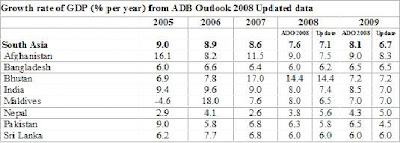
The Asia Development Bank has updated its growth rate projection for the developing countries in Asia. According the updated Asian Development Bank Outlook 2008 Update, regional economic growth for 2008 is scaled down to 7.5% due to "unstable financial markets and rising commodity prices." It projects that the regional growth in 2009 to be 7.2%. Meanwhile, inflation rate is expected to be 7.8% (up from 5.1%) in 2008 and 6% in 2009. Clearly, rising food and fuel prices are pushing up price level and putting strain in GDP growth rates.

The figure below shows statistics for South Asia:

Meanwhile, for Nepal the report shows some encouraging numbers.

  • GDP growth rate in 2008: 5.6% (up from 2.6% in 2007)
  • GDP growth rate in 2009 (projected): 5.0%
  • Inflation as of mid-July 2008: 13.4%
  • Expected average inflation in 2009: 8.5%
  • Budget surplus in 2008: 1.9% of GDP (improvement from a deficit of 0.1% in 2007)
  • Expected budget surplus in 2009: 1.5% of GDP (supported by sustained growth in remittances and tourism receipts)

Tuesday, September 16, 2008

Redefining the "R" word

The Economist seeks a new definition of recession:

To the average person, a large rise in unemployment means a recession. By contrast, the economists’ rule that a recession is defined by two consecutive quarters of falling GDP is silly. If an economy grows by 2% in one quarter and then contracts by 0.5% in each of the next two quarters, it is deemed to be in recession. But if GDP contracts by 2% in one quarter, rises by 0.5% in the next, then falls by 2% in the third, it escapes, even though the economy is obviously weaker. In fact, America’s GDP did not decline for two consecutive quarters during the 2001 recession.

However, it is not just the “two-quarter” rule that is flawed; GDP figures themselves can be misleading. The first problem is that they are subject to large revisions. An analysis by Kevin Daly, an economist at Goldman Sachs, finds that since 1999, America’s quarterly GDP growth has on average been revised down by an annualised 0.4 percentage points between the first and final estimates. In contrast, figures in the euro area and Britain have been revised up by an average of 0.5 percentage points. Indeed, there is good reason to believe that America’s recent growth will be revised down. An alternative measure, gross domestic income (GDI), should, in theory, be identical to GDP. Yet real GDI has risen by a mere 0.1% since the third quarter of 2007, well below the 1% gain in GDP. A study by economists at the Federal Reserve found that GDI is often more reliable than GDP in spotting the start of a recession.

Forget about the horrors associated with the "R" word. Read this joke and laugh (or at least, try to laugh):

... when your neighbour loses his job, it is called an economic slowdown. When you lose your job, it is a recession. But when an economist loses his job, it becomes a depression. Economists who ignore the recent rise in unemployment deserve to lose their jobs.

Stiglitz on the Wall Sts meltdown

Stiglitz puts the blame on "a pattern of dishonesty on the part of financial institutions, and incompetence on the part of policymakers."

The present financial crisis springs from a catastrophic collapse in confidence. The banks were laying huge bets with each other over loans and assets. Complex transactions were designed to move risk and disguise the sliding value of assets. In this game there are winners and losers. And it's not a zero-sum game, it's a negative-sum game: as people wake up to the smoke and mirrors in the financial system, as people grow averse to risk, losses occur; the market as a whole plummets and everyone loses.

Financial markets hinge on trust, and that trust has eroded. Lehman's collapse marks at the very least a powerful symbol of a new low in confidence, and the reverberations will continue.

Hypocrisy of free market:

We had become accustomed to the hypocrisy. The banks reject any suggestion they should face regulation, rebuff any move towards anti-trust measures - yet when trouble strikes, all of a sudden they demand state intervention: they must be bailed out; they are too big, too important to be allowed to fail.

Eventually, however, we were always going to learn how big the safety net was. And a sign of the limits of the US Federal Reserve and treasury's willingness to rescue comes with the collapse of the investment bank Lehman Brothers, one of the most famous Wall Street names.

What caused Kosi flooding?

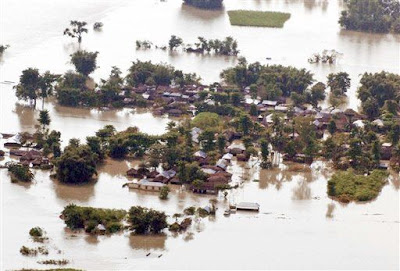
I was thinking of blogging on this topic earlier but was unable to find a balanced analysis of the causes behind the tragedy. The political leaders were busy in blame game while villages after villages both in Nepal and India, were being overwhelmed by the Kosi river. Some attribute the flooding, which killed hundreds of people and left millions homeless and forced people to shift to high altitudes, to natural factors. But, Gywali argues that this was a man-made tragedy; it is a product of poor planning and corruption.

The Kosi acts as a massive conveyor belt taking sediment from the Himalaya to the Bay of Bengal. Some one hundred million cubic meters of gravel, sand and mud flow out of the Chatara gorge in mountainous Nepal every year. This flow cannot be blamed on deforestation: we have more forest cover in the Kosi catchment today than ever before. It is caused by Himalayan geotectonics coupled with the monsoon regime. As the river slows down in the flat plains beyond, it deposits its sediment, filling up the river's main channel until it overflows and begins a new course. This natural process produced the large inland delta that lies across southern Nepal and the Indian state of Bihar.

But, for the last half century, the 'Kosi Project' has used embankments to restrict the river's course. This has kept sediment deposits within the main canal, perching the river some four meters above the surrounding land. It was a disaster waiting to happen. Indiscriminate embankment building could never hold back the Kosi's sediment. The river flow at the time of last month's breach was not even high. Rather, it was lower than the minimum average flow for August.

...an Indian scholar writing in Bombay's Economic and Political Weekly, estimated that as much as 60 per cent of the 2.5–3 billion rupees spent annually by the Bihar government on construction and repair works was pocketed by politicians, contractors and engineers. It is said there is a perfect system of percentages in which a share exists for everyone who matters, from the minister to the junior engineer. The actual expenditure never exceeds 30 per cent of the budgeted cost. Contractor's bills are paid without being verified — many of the desiltation and maintenance works allegedly completed are never done at all, and yet payments are made.

Monday, September 15, 2008

Lehman to 'Layman Brothers'

This is not directly related to development economics but is interesting in the sense that how incapable our system is to deal with the economic and psychological consequences of failure of a firm seen earlier as a foster child of liberal financial market. Lehman Brothers is now scrambling to find saviors, but in vain . The only road left to explore now is liquidation (which loosely means termination of a business operation by using its assets to discharge its liabilities). In other words, a slow but certain death! What a tragedy for the liberal financial market system!! Chapter 11 protection in high demand, again!

The NYT reports:

...But that plan fell apart on Sunday, making it likely that Lehman would be forced to liquidate.

What remained unclear was how a liquidation might proceed. One option that was discussed on Saturday would have major banks and brokerage firms continue to do business with Lehman as it unwinds its assets and liquidates over a period of months, according to several people briefed on the discussions. That would buy Lehman time to sell those assets in an orderly way and avoid a fire sale that could depress prices of similar assets held by other banks.

Here is a piece from the BBC News:

...If no new financing is found before Wall Street opens on Monday, Lehman will have to seek so-called Chapter 11 bankruptcy protection.

Here is WSJ on why didn't Lehman use Fed's discount window?

Why wouldn’t Lehman borrow? For one thing, it may not need to. As in the case of Fannie Mae and Freddie Mac, one of its key problems is with capital and not short-term funding. Another possibility: Taking a discount window loan while everyone is watching for it — and expecting it — might create a new set of confidence problems. Because there was no borrowing leading up to this week, Lehman would’ve been tagged as the borrower of any loan taken out. (The Fed does not disclose the identities of the borrowers.) One way around it would be for several other firms — healthier ones — to step up and offer cover, taking loans and somehow signaling publicly that they also had done so. Another would be to wait until the weekly reporting period ended Wednesday and then borrow on Thursday, allowing a week of breathing room before the next report comes out.

Update: see this one as well: Nightmare on Wall Street

Sunday, September 14, 2008

Links of Interest (09/13/08)

1) Dani Rodrik questions whether export led growth strategy still fulfills its purpose (of stimulating growth).

Many countries are trying to emulate this growth model, but rarely as successfully because the domestic preconditions often remain unfulfilled. Turn to world markets without pro-active policies to ensure competence in some modern manufacturing or service industry, and you are likely to remain an impoverished exporter of natural resources and labor-intensive products such as garments.

Nevertheless, developing countries have been falling over each other to establish export zones and subsidize assembly operations of multinational enterprises. The lesson is clear: export-led growth is the way to go.

(The title of this piece is similar to the title of Paul Krugman's 1987 paper: Is Free Trade Passe?)

2) Jones, Ocampo, and Calice propose channeling 1 percent of developing countries' foreign-exchange reserves to investment in infrastructure.

Although economic growth and poverty reduction in many developing countries has been impressive in recent years, a significant increase in investment in areas such as infrastructure is required to sustain such growth in the future. We propose that a very small portion of developing countries’ total foreign-exchange reserves – say, 1% – be channeled to the expansion of existing regional development banks or the creation of new ones that would invest in infrastructure and other crucial sectors.

Indeed, infrastructure investment is recognized as a key ingredient in sustaining and accelerating growth. However, there is a large financing gap. According to the World Bank, developing countries spend an average of 3-4 % of GDP on infrastructure every year, compared to an estimated 7% of GDP required to meet existing infrastructure needs for maintaining rapid growth. This translates into an annual gap of at least $300 billion at current prices.

3) Pedro de Araujo urges to increase condom distribution and awareness among the poor and uneducated in India to avert rising risk of HIV infections.

HIV knowledge in the Indian population is very poor. Seventeen percent of males and 40% of females say that they have never heard of HIV/AIDS. These numbers are much higher when compared to responses from populations of sub-Saharan African countries. Those who said they knew of AIDS were not necessarily very knowledge: when asked if a healthy looking person could have AIDS, 27% of males and 38% of females did not know the answer. These statistics raise some concerns as to how inadequately prepared the population is in the advent of an outbreak. Another point of concern is the reported levels of stigma in the population. Thirty six percent of males and 37% of females would not buy vegetables from an HIV-infected person. This variable is the most commonly used proxy to measure stigma in these surveys.

...Even though a great part of the Indian population is faithful and abstains from sex, there are still large segments of the population at risk of contracting HIV. Because condom use is very low and knowledge about the disease is very poor, especially with respect to females and poorer and uneducated single males, preventive policies should be targeted at these groups by increasing condom distribution and awareness, increasing substantially HIV/AIDS basic education, and promoting women’s empowerment particularly with respect to sexual choices.

4) Brookings papers: The unofficial Economy and Economic Development (by Rafael La Porta and Andrei Shleifer) and The Real Exchange Rate and Economic Growth (by Dani Rodrik)..links via Rodrik's blog.