Thursday, April 24, 2008

Food Inflation Watch: Maize export ban by Nepal

The Nepali government has banned export of wheat from the country amidst rising food crisis in the international market. This move comes on the backdrop of shortage of wheat in the country because producers were increasing exports to Bangladesh, where wheat price is much higher than in Nepal. This reduced wheat supply in the Nepali market and shot up prices. Nepali flour mills, bakeries, biscuit, and noodle factories are expected to benefit from this move.

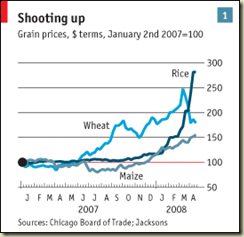
India, Vietnam, China, Bangladesh, Thailand, Philippines, Egypt, and many others have either imposed export ban or quotas and liberalized imports. Meanwhile, there have been riots in Latin America, Asia, and Sub-Saharan Africa. If all countries follow suit, then individual acts would stall international trade. This is going to put another hurdle in passage of the Doha Round, where agricultural sector reform has been a bone of contention between the West and the developing countries. What would be an acceptable solution?

My reaction: now even Nepal is fueling speculative drive in the international market. Prices began to rise rapidly after India impose ban on exports, followed by China, Vietnam, Thailand, and many others. More worse to come. The countries are ruining their own markets!

Will Green Revolution Help Solve Poverty and Hunger in Sub-Saharan Africa?

No, says a policy brief (an old one, published in October 2006) from the Institute for Food and Development Policy. I somehow stumbled upon this policy brief. It looks interesting though I think that a global effort to promote (rather revive) the Green Revolution is definitely going to produce some good outcomes.

The policy brief is titled : Ten reasons why the Rockefeller and the Bill and Melinda Gates Foundations' Alliance for another green revolution will not solve the problems of poverty and hunger in Sub-Saharan Africa.

The authors argue that, based on the first Green Revolution experience, this initiative will not succeed because:

  1. the Green Revolution actually deepens the divide between rich and poor farmers.
  2. over time, Green Revolution technologies degrade tropical agro-ecosystems and increase environmental risk.
  3. the Green Revolution leads to the loss of agro-biodiversity.
  4. hunger is not primarily due to a lack of food, but rather because the hungry are too poor to buy the food that is available.
  5. without addressing structural inequities in the market and political systems, approaches relying on high input technologies fail.
  6. the private sector alone will not solve the problems.
  7. genetic engineering (GE) will make Sub-Saharan smallholder systems more environmentally vulnerable.
  8. GE crops into smallholder agriculture will likely lead to farmer indebtedness.
  9. the assertion that "There Is No Alternative" (TINA) ignores the many successful agro-ecological and non-corporate approaches to agricultural development.
  10. AGRA's "alliance" does not allow peasant farmers to be the principal actors in agricultural improvement.

Recommendation from the authors: Invest in the service of the struggle by peasant and farmer organisations and their allies to truly achieve food sovereignty.

The recommendation is quite blurry. At a time when there have been calls for revival of the Green Revolution in Sub-Saharan Africa due to sky-rocketing food prices, it won't hurt to look at the concerns of the authors of this policy brief.

Food Inflation Watch: Zoellick's take on high food prices

The World Bank president Robert Zoellick argues that we have to solve the burden of high food prices on the most vulnerable people in the short run and in the long run, through a New Deal for Global Food Policy, we need to solve not only the food crisis but its underlying causes (energy, yields, climate change, investment, marginalization of women, economic resiliency, and growth). The column is pretty much snippets of the same speech he delivered at a CGD event in Washington, D.C.

Nancy Birdsall and Arvind Subramanian propose that under such a "new deal major developing country producers set aside for now their reasonable objections to traditional rich country agricultural protection -- the bone of contention in the Doha trade round -- at least in the case of food staples (if not cotton and cocoa). Rich countries would ideally reduce this protection on their own (as their taxpayers might well like in the case of domestic production subsidies). But for a hunger deal now their long-perverse agricultural protection is not a central issue -- and leaving it aside has the political virtue of greasing the wheels of a global deal on hunger."

Rodrik agrees that "unilateral trade policies in this area have clear negative externalities--export taxes in food exporting countries and import liberalization in food-importing countries both raise world food prices--the case for some kind of international coordination is indeed quite strong." However, he finds it pretty "mischievous" that Birdsall and Subramania want Zoellick to head the effort.
image

We should start by helping those whose needs are immediate. The United Nations' World Food Program requires at least $500 million of additional food supplies to meet emergency calls. The U.S., European Union, Japan and others must act now to fill the gap -- or many more people will suffer and starve.

Skyrocketing food prices have increased attention to the larger challenge of overcoming hunger and malnutrition, the underlying cause of the deaths of an estimated 3.5 million children under 5 each year. More than 20 percent of maternal deaths are traced to malnutrition. It weakens immunities to diseases. Hunger and malnutrition are a cause, not just a result, of poverty.

A shift from traditional food aid to a broader concept of food and nutrition assistance must be part of this New Deal. In many cases, cash or vouchers, as opposed to commodity support, is appropriate and can enable the assistance to build local food markets and farm production. When commodities are needed, purchasing from local farmers can strengthen communities. School lunch programs draw children to classrooms, while helping healthy kids to learn, and some offer parents food, too.

We can help create a "Green Revolution" for sub-Saharan Africa by assisting countries to boost productivity throughout the agricultural value chain and help small-holder farmers to break the cycle of poverty.


Food Inflation Watch: Drought in Thailand

Thailand is one of the largest rice producer and exporter. Now, reprots are coming in that it is too suffering drought. This is going to potentially push the food prices up. Too bad! Also see this


More than 10 million people in parts of Thailand's rice bowl region have been hit by drought, the government said on Monday, causing further concerns as prices of the staple grain soar. Thailand's Disaster Prevention and Mitigation department reported that 55 of the kingdom's 76 provinces were struggling with drought, mostly in the central, north and northeastern regions. More than 151,000 rai (60,000 acres) of farmland has been affected, they said in a statement, including half of the key central rice growing provinces.

The first rice harvest of the year in Thailand, the world's biggest rice exporter, traditionally ends in late March or early April. Farmers then let the fields recover, before planting a second harvest in May. But as export and domestic rice prices hit record highs, many farmers are trying to plant a third crop or move their second harvest forward to take advantage of the boom. The benchmark Thai variety, Pathumthani fragrant rice, was priced on April 9 at 956 dollars per tonne for export, up about 50 percent from a month earlier, the Thai Rice Exporters Association said in its price survey. International demand for Thai rice has soared after other top exporters, Vietnam and India, imposed limits on exports to ensure domestic supply.

Monday, April 21, 2008

Private school fad in Pakistan

A new WB reprot on the state of education in Pakistan (particularly a survey from Punjab)argues for reevaluation of the education sector policies and reforms. It argues that there has been a dramatic rise in private schools in Pakistan and the public schools, with similar wage rate for teachers, are vying with the private schools to attract students. The report argues that the government should reevaluate its education policies and rather than fostering neck-to-neck competition between public and private schools, it should focus on providing better information to the public by assessing the quality of education-both public and private- so that households can make better decision. This means that the government should try to narrow information asymmetry gap. The report finds that between 2000 and 2005, the number of private schools increased from 32,000 to 47,000, and by the end of 2005, one-third of enrolled children at the primary level was studying in a private school.

Just an increase in the number of private schools is not a stuff to celebrate. What matters is the type and quality of education in the private and public schools and their reach in the rural areas. As generally expected, the report finds out that children in private schools score significantly higher than those in government schools, even when they are from the same village. In fact, it will take children in government schools 1.5 - 2.5 years of additional schooling to catch up to where private school children are in Class 3.
So, why are we seeing such a tendency in Pakistan? Well, the report argues that it is because the wedge between public and private school household expenditure is decreasing, i.e. private schools are becoming cheaper- one month's fee in a private school is roughly the equivalent of one day's wage for an unskilled labor. This means that sending kids to a private school is becoming cheaper and easier. It should be noted that people in South Asia view those attending private school as "well-off" than those attending public school, even if the private and public schools are identical in all respect. It is a matter of status in the society. This might explain the influx of students to private schools despite the fact that the report shows outcome from attending private school is more than from public school.
I am wondering why the government is still operating public schools when the cost to educate a child in a private school is Rs.1000 per year whereas in a public school it is Rs.2000. The report also finds out that since 1995, 50% of all new private schools have set up in rural areas. Is it becasue of private school are biased against operating in rural areas? More
here.

Saturday, April 19, 2008

Maoists, price distortion, and economy

The Kathmandu Post has a nice editorial about the need for the Maoists to face the reality and get hit by the forces of market. The Maoists are vociferous against any decrease in fuel subsidies and increase in fuel prices. The country has been reeling under fuel shortages, whose reason range from strikes to subsidies to colossal deficit in NOC's balance sheet to IOC's unwillingness to supply fuel without NOC clearing its outstanding dues to mismanagement and corruption. The main reason why the NOC is running in deficit and debt and is not able to pay dues to the IOC is because of huge price distortion. Any attempt to up fuel prices was met by violent riots and closures, mainly initiated by the Maoists. Now, the real test for the Maoists have come. They have won the election with a landslide victory and when they take over the government, it will be interesting to see how they deal with the pressure from IMF, WB, and the donor agencies to reduce price distortions. They got to realize that populist agenda can bring them in power but it cannot rectify the distortions in the market. Meanwhile,I am wondering from where they would find money to break-even the balance sheet of NOC, which is already at a loss of over Rs 3 billion.

Good paragraph from The Kathmandu Post:

Why should the Nepali Congress and the UML remain out of the government? First, the people have rejected them. Second, the Maoists will never be completely exposed in public otherwise. The people should get to understand that even the Maoists cannot stop taking the overdue action of raising the price of petroleum. Both the people and the Maoists have to realize that price rises are not under anybody’s control. The only way to fight inflation is economic growth and job creation. Third, the political parties should go to the people and reform their grassroots structure. They will have enough time for that purpose, if they refrain from joining the government. This is also an opportunity for the parties to weigh their colleagues and find out who are really committed to democratic principles and who are opportunists.

More on fuel crisis in Nepal here, here, here, and here.

Wednesday, April 16, 2008

Africa’s Economic Growth

I attended one more discussion forum yesterday. Actually, it was a book launch ceremony organized by the Center for Global Development (CGD). The huge, expensive two volume book “The Political Economy of Economic Growth in Africa, 1960-2000” is written by nine authors, whose profession range from academicians to central bank governors.

book Frankly, the program was boring, not in terms of content but in style of presentation (monotonous style). Also, the book is too expensive (costs more than $250; it is a little less than GDP per capita of a Nepali!).

Anyway, I tried to follow what is unique about this book, apart from the historical background and blame on crisis, political strife, famine….the list goes on and on. Benno J. Ndulu, Governor of Central Bank of Tanzania argued that 1980-2000 was “two decades of lost opportunity” for Africa. Why? I did not get his reasoning for this! I think he was implying that the large countries like Nigeria, DRC, and Sudan are not growing as China and India have done. The growth rate of Sub-Saharan Africa (SSA) was just 0.5% between 1960 and 2004. The developing countries had a growth rate of 2.5%.

He argued that the endowment argument does not explain the variation in growth in Africa. For instance, Zambia and Botswana are both resource-rich and landlocked, and Cote d’Ivoire and Mauritius both have coast and are resource-poor. They have different development paths. Four stuff worth noting from the book:

  • Growth experience varied and was episodic

  • Slow productivity growth (investment return is just 1/3 that of Asia)

  • Policy and governance matters a great deal for growth

  • Disadvantage from geography and resource-curse (account for 1/3 of the gap of growth with other LDCs)

The other speakers were a bit unclear about the stuff they were presenting. It might be that they were skipping and speeding parts of their presentation in the interest of time. So what does Africa need? One of the speakers said, it needs “four big I”: Investment, Infrastructure, Innovation, and Institutional Capacity. More here