Wednesday, April 16, 2008

Africa’s Economic Growth

I attended one more discussion forum yesterday. Actually, it was a book launch ceremony organized by the Center for Global Development (CGD). The huge, expensive two volume book “The Political Economy of Economic Growth in Africa, 1960-2000” is written by nine authors, whose profession range from academicians to central bank governors.

book Frankly, the program was boring, not in terms of content but in style of presentation (monotonous style). Also, the book is too expensive (costs more than $250; it is a little less than GDP per capita of a Nepali!).

Anyway, I tried to follow what is unique about this book, apart from the historical background and blame on crisis, political strife, famine….the list goes on and on. Benno J. Ndulu, Governor of Central Bank of Tanzania argued that 1980-2000 was “two decades of lost opportunity” for Africa. Why? I did not get his reasoning for this! I think he was implying that the large countries like Nigeria, DRC, and Sudan are not growing as China and India have done. The growth rate of Sub-Saharan Africa (SSA) was just 0.5% between 1960 and 2004. The developing countries had a growth rate of 2.5%.

He argued that the endowment argument does not explain the variation in growth in Africa. For instance, Zambia and Botswana are both resource-rich and landlocked, and Cote d’Ivoire and Mauritius both have coast and are resource-poor. They have different development paths. Four stuff worth noting from the book:

  • Growth experience varied and was episodic

  • Slow productivity growth (investment return is just 1/3 that of Asia)

  • Policy and governance matters a great deal for growth

  • Disadvantage from geography and resource-curse (account for 1/3 of the gap of growth with other LDCs)

The other speakers were a bit unclear about the stuff they were presenting. It might be that they were skipping and speeding parts of their presentation in the interest of time. So what does Africa need? One of the speakers said, it needs “four big I”: Investment, Infrastructure, Innovation, and Institutional Capacity. More here

Growth Strategies for the Developing Countries

Today I attended a very useful panel discussion on Economic Growth Strategies for Developing Countries in an Era of Global Uncertainty. The discussion focused less on the global uncertainty and more on how to propel growth and policy recommendations based on the experiences of China and India. Particularly amazing was the disagreement between Michael Spence and Lawrence Summers, who argued that the conclusions drawn by Spence and Mohamed A. El-Erian in a paper titled Growth Strategies and Dynamics: Insights from Country Experiences, a working paper series published by the Commission on Growth and Development, is biased towards the unconventional thinking in development economics.

photo

The panel consisted of very well-known economists: Michael Spence (Nobel Laureate in Economics in 2001 and professor at Stanford University), Lawrence Summers (professor of economics at Harvard University), Robert Rubin (director and chairman of executive committee of the Citi Bank), Han Duck-soo (former Prime Minister of South Korea), Danny Leipziger (VP for Poverty Reduction and Economic Management, PREM at the World Bank), and Lael Brainard (VP and director of the Global Economy and Development Program and Chair in International Economics at the Brookings Institution). The event was organized by the Brookings Institution.

Spence presented the main findings of his paper. He argued that the advanced countries’ model of growth strategies is an incomplete guide but not worthless for the developing countries. He was arguing for the gradualism in growth strategies and polices as seen in China and to a lesser extent in India. Experimental approach is needed for successful navigation of growth strategies and policies, again as done by China. He also argued for the effectiveness of government intervention in key areas to bring coordination in economic activity. Governments should engage in vigorous policy debate with a definite end, i.e. policy wrangling is not enough, there should an end to policy debates and concrete action should follow such debate. Moreover, governments should admit and fix mistakes (especially ex-post determined).

He outlined key areas of policy debates with incomplete maps:

  • Speed of opening up the current account

  • Financial sector maturity and opening up of capital account...(see how Rodrik responds to this issue here)
  • Stimulate export diversification (lessen inefficiency and provision of transitory incentives)
  • Industrial policy (exchange rate and capital account management)
  • Surplus labor problems in the early stages of growth
  • Finding successful formula and doing it for too long
  • Protecting people and families during transition (creation/destruction during transition)

Spence was pretty much positive on all the points listed above. He also briefly talked about climate change and argued that we need to reduce per capital CO2 emission by a factor of 2. He was stressing more on the growth model of China and the experimental approaches to policy design.

Larry Lawrence Summers was not happy with the conclusion of the paper. He argued that he sensed trouble with three issues: (i) Methodology and policy recommendation, (ii) Cheap shot nature of growth strategies recommendation (not to be quick to pick up Chinese success and advocate its emulation in one or the other form. Remember, how WDR 1979 extolled Romanian growth model, which crumbled few years later...), and (iii) Belief in unconventional approaches...

Larry seems very much discontent with the way Spence recommended unconventional approaches followed by countries like China. He labeled the unconventional approach a “modern mercantilist approach” obsessed with export-led strategy, which Spence favors as a growth strategy in early stages, partly because of the existence of surplus labor in the agricultural sector in the developing countries. As Larry was arguing, the discussion was becoming intense (I think Larry felt he was being pounded hard when other panelist kind of agreed to Spence’s conclusion…Larry was showing strong discontent with the “cheap shot” approach of policy recommendation and the glorification of industrial policy). Anyway, he thinks there are three key problems with the unconventional approach recommended by Spence.

  1. How can an industrial policy differentiate whether one sector is better than the other? How sure are we that there is existence of labor surplus in the developing countries?...(wait Larry, please see Rodrik's paper Normalizing Industrial Policy... also see this one.)

  2. If all the developing countries try to subsidize exports (like South Korea, Mauritius, Malaysia) then who guarantees that the increased volume of goods would be bought? Who is going to be importer and will there be enough import demand?

  3. How capable is government to execute policy reform?

Larry argued that these questions are overlooked by the unconventional approaches, which overemphasize heterodoxy. He is very skeptical of local heterodoxy model followed by China and argued that those who derive quick conclusion on the effectiveness of heterodoxy looking at China are making arguments like Joe Stiglitz does! Larry was pretty much pissed by this time (quite visible from his white-turned-red face in just ten minutes!). Meanwhile, I was wondering why Larry is so pessimistic about import demand. Why does he think that whatever the developing countries produce has to be consumed by the West for the former to grow? South-South trade is already rising up at record level and if businesses concentrate more in serving the bottom billions, then there is huge demand, both domestic and import demand. I wonder why Larry does not consider the bottom billions as potential customers. See here how cell phones are already customized to tap the huge bottom billion market. Larry seems pretty much obsessed with the neoclassical approach, whose steadfast followers have gained little in the past five decades.

After Larry’s fiery discontent, Han Duck-soo came to Spence’s rescue. Being a PM of a country which had followed the unconventional approaches during the early stages of growth, Han argued that the world foreign demand of exportable goods is elastic and there is still scope for export-led growth strategies. He argued that South Korea tried to eliminate widespread distortions in the economy by harmonizing the activities of the private sector through an industrial policy. The businesses were competing with each other in an unhealthy fashion and there were a lot of distortions. All the government did was to reduce coordination failure, minimize information asymmetry, and maximize positive spillover effects in the economy. This is the unconventional approach Larry doubted. But he gave a caveat: there should be strong political leadership and effective government though. Moreover, an industrial policy can differentiate the best sector after looking at the constraints and harmonizing similar activities in the economy. The ingredients of growth are in an economy but not always in a good combination. They need to be harmonized through a good policy package. Spence and Han resonated the arguments usually argued by Rodrik (as far as I know!).

Then Robert Rubin argued that there is nothing wrong with export-led policy in the low income countries. However, the US should cope with the changes in the global economy and focus on distributional and social safety nets in the domestic market. Rubin argued that an effective government is itself an ingredient for growth. Also, he said that a relatively authoritarian government in the early stages of growth has been successful (South Korea, China, Malaysia). The biggest challenge now is: How to promote effective governance with a democratic system?

There was so much stuff going on in there. Unfortunately, I cannot summarize all of them. I will definitely go through the paper in the next couple of days and write a summary. The paper is highly recommended. Also, credit for the first picture goes to my friend Jehea Song, whose company and event pictures from her iphone I always enjoy!

Tuesday, April 15, 2008

BOP, Cellphones, and Poverty Reduction

The NYT has a special report (Can the Cellphone Help End Global Poverty?) about how businesses are reaching out the bottom billions and how cellphones can help reduce poverty in the developing countries. Sounds something like the Bottom of the Pyramid (BOP) concept of CK Parhalad! Cellphones are increasingly being used by rural farmers to check market prices in real time. More symmetric information flow leads to market clearance, which obviously is far from perfect in this imperfect world. Technology that is customized to the needs, capacity, and ability of the bottom billion helps to bridge the gap between perfection and imperfection.

I found one study particularly amazing: A study by London Business School in 2005 concluded that for every additional 10 mobile phones per 100 people, a country’s G.D.P. rises 0.5 percent. This is quite an extrapolative finding because though I do believe that cellphones help to speed up the rate of transmission of information (see Greg Clarks book 'A Farewell to Alms' to know how faster was the rate of transmission of information after the discovery of telephone- an aiding factor for the industrial revolution in England), it does not directly help raise GDP by 0.5%. Contradictory example: look at the increase in rate of cellphone owners in Nepal and the sluggish GDP growth rate). But no doubt, people can do wonders by using cellphones! More on the use of wireless communication from The Economist: Mobility: Nomads at last. Watch a related video here.

...This sort of on-the-ground intelligence-gathering is central to what’s known as human-centered design, a business-world niche that has become especially important to ultracompetitive high-tech companies trying to figure out how to write software, design laptops or build cellphones that people find useful and unintimidating and will thus spend money on. Several companies, including Intel, Motorola and Microsoft, employ trained anthropologists to study potential customers, while Nokia’s researchers, including Chipchase, more often have degrees in design. Rather than sending someone like Chipchase to Vietnam or India as an emissary for the company — loaded with products and pitch lines, as a marketer might be — the idea is to reverse it, to have Chipchase, a patently good listener, act as an emissary for people like the barber or the shoe-shop owner’s wife, enlightening the company through written reports and PowerPoint presentations on how they live and what they’re likely to need from a cellphone, allowing that to inform its design.

...To get a sense of how rapidly cellphones are penetrating the global marketplace, you need only to look at the sales figures. According to statistics from the market database Wireless Intelligence, it took about 20 years for the first billion mobile phones to sell worldwide. The second billion sold in four years, and the third billion sold in two. Eighty percent of the world’s population now lives within range of a cellular network, which is double the level in 2000. And figures from the International Telecommunications Union show that by the end of 2006, 68 percent of the world’s mobile subscriptions were in developing countries.

...“You don’t even need to own a cellphone to benefit from one,” says Paul Polak, author of “Out of Poverty: What Works When Traditional Approaches Fail” and former president of International Development Enterprises, a nonprofit company specializing in training and technology for small-plot farmers in developing countries. Part of I.D.E.’s work included setting up farm cooperatives in Nepal, where farmers would bring their vegetables to a local person with a mobile phone, who then acted as a commissioned sales agent, using the phone to check market prices and arranging for the most profitable sale. “People making a dollar a day can’t afford a cellphone, but if they start making more profit in their farming, you can bet they’ll buy a phone as a next step,” Polak says.

...Robert Jensen, an economics professor at Harvard University, tracked fishermen off the coast of Kerala in southern India, finding that when they invested in cellphones and started using them to call around to prospective buyers before they’d even got their catch to shore, their profits went up by an average of 8 percent while consumer prices in the local marketplace went down by 4 percent.

...Public health workers in South Africa now send text messages to tuberculosis patients with reminders to take their medication. In Kenya, people can use S.M.S. to ask anonymous questions about culturally taboo subjects like AIDS, breast cancer and sexually transmitted diseases, receiving prompt answers from health experts for no charge.

...A cellphone in the hands of an Indian fisherman who uses it to grow his business — which presumably gives him more resources to feed, clothe, educate and safeguard his family — represents a textbook case of bottom-up economic development, a way of empowering individuals by encouraging entrepreneurship as opposed to more traditional top-down approaches in which aid money must filter through a bureaucratic chain before reaching its beneficiaries, who by virtue of the process are rendered passive recipients.

...Ugandans are using prepaid airtime as a way of transferring money from place to place, something that’s especially important to those who do not use banks. Someone working in Kampala, for instance, who wishes to send the equivalent of $5 back to his mother in a village will buy a $5 prepaid airtime card, but rather than entering the code into his own phone, he will call the village phone operator (“phone ladies” often run their businesses from small kiosks) and read the code to her. She then uses the airtime for her phone and completes the transaction by giving the man’s mother the money, minus a small commission. It’s a rather ingenious practice...an example of grass-roots innovation, in which people create new uses for technology based on need...

Thursday, April 10, 2008

Economics Conference at Elizabethtown College

Here are the pictures (actually summary of my one day errand in pictures!)  from the 8th Annual Student Economics and Business Conference, where I presented my paper 'Exploring the link between Poverty and Growth,' at Elizabethtown College, PA. The campus and the conference hall, plus the audience, were all great!

on the way to conference

On the way to the conference...

before conference

Peace time before my presentation...

conference place

The Hoover Center, conference hall

conference

My time to listen...

conference1

My time to present...

conference2

Again...on Poverty & Growth...

conference3

Now comes Inequality, Poverty & Growth...

conference4

Then some crazy graphs and statistics...

elizabethtown

Out of the conference...

waiting for Amtrak

Waiting for Amtrak

Indian dinner with Kshitiz

Dinner time: Indian food with Kshitiz at Harrisburg

passed out

Then passed out...too tired!!!

back in the house

Finally, back in the house at Dickinson College...

Tuesday, April 8, 2008

Botswana: For how long can it spark on diamonds?

The IMF Working Paper series has published a new report that looks at the sustainability of rising Botswanian expenditure financed by diamond mining, which contributes on average 38.5 percent to GDP. Since the past three decades Botswana economy has grown at a rate of 7 percent, usually due to diamond mining and good investment climate. For more on the role of good investment climate check out a paper by AJR on Botswana: An African Success Story. They argue that Botswana has been able to grow and attract investment because of the strong institutions of private property.
This new report from the IMF African Department is titled "Are Diamonds Forever? Using the Permanent Income Hypothesis to Analyze Botswana’s Reliance on Diamond Revenue". Obviously, the conclusion is that Botswana will not be able to sustain the current level of high expenditure just from the diamond mining and trade. Recommendation: it needs to save (to the tune of 1.2 points of GDP each year) to ensure a policy of no debt because diamond reserve could deplete by 2029, leading to sharp shortfall in fiscal revenue (by almost two-thirds). Here is the summary:

This study assesses the sustainability of Botswana's diamond-related fiscal revenue. Diamond reserves are not adequate to generate enough permanent revenue to sustain a high level of expenditure. Under the current fiscal rule that no debt may be accumulated, Botswana will have to save more to avoid an abrupt adjustment in the medium term.
Also, check out IMF's Finance and Development magazine, March 2008. The title for the issue is Commodity Boom: How Long Will It Last?

Thursday, April 3, 2008

Zoellick’s “One Percent Solution” to Africa’s problems

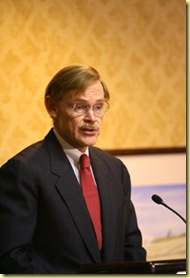
Today I attended a discussion forum organized by the Center for Global Development (CGD) in DC. The World Bank President Robert B. Zoellick gave an interesting and insightful speech titled “A Challenge of Economic Statecraft.” Zoellick floated an idea to work with sovereign wealth funds, which amount to almost $3 trillion in assets, to create a “One Percent Solution” for equity investment in Africa. Watch the speech here and read the WB's press release here.

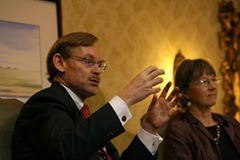
photo(2) He argued that if only one percent (around $30 billion) of this fund is invested in Africa, the African continent would be able to find its own “sources of growth”….wondering what own “sources of growth” mean? Well, this is kind of diversification of growth (which is not as much affected by the current financial crisis as the West is) China and India are experiencing right now. He wants to invest sovereign wealth funds in Africa so that they could find their own diversified “sources of growth.” Well, I wonder why with already more than $1.3 trillion of aid, the sub-Saharan Africa (SSA) is not still able to find its own “sources of growth”? Is the problem a lack of aid money (volume) or very few effective programs (efficient, down-to-earth) that utilizes local knowledge and stimulates local economy? Bill Easterly, any comments?... Also, he is in favor of more direct cash assistance rather than commodity assistance to effectively tackle hunger and poverty issues. This reminds me of Breakfast and Lunch Program and several other food assistance programs in the US.

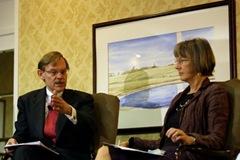
Zoellick and Birdsall He made good points about finding solutions to the current food crisis and the need to pass the Doha Development Round by 2008. He argued for a “New Deal for Global Food Policy” so that the people in desperate need of food and nutrition are taken care of immediately in the short run and in the long run a sustainable agricultural “Green Revolution” should be created by helping build local food markets and by boosting farm production in the SSA. So, what does the WB did on its part? It invested in knowledge (research) and increased lending for agriculture in Africa from $450 million to $800 million. Again, more aid and lending! Can we reach the same goal by getting rid of astronomical subsidies and agriculture trade restrictions in the West? He is obviously against these restrictive measures though:

This moment of decision is not only for the Doha Round.  It is for trade itself. Powerful voices across the political spectrum, including in my own country, are calling for, and rationalizing, protectionism. This economic isolationism signals a defeatism that will reap the losses, not the gains, of globalization.

He also talked about Extractive Industries Transparency Initiative (EITI), which basically encourages resource rich countries to publish and verify company payments and revenues from oil, gas and mining so their citizens can hold them more accountable.  The WB is now planning to launch EITI++, which would expand EITI to include such areas as the awarding of contracts, improving economic management, and investing revenues effectively in sustainable development.

Birdsall and Zoellick Overall, it was a good speech. The Q&A session was okay...a lot of time Bob digressed from the main point of the questions. Luckily, there was Nancy Birdsall, President of the CGD, who tried to keep him on track! I met with some professional and academic people during the lunch time. It was nice to build networks while staying in DC.    :)...Also, the first picture was taken by my friend Jehea Song using her beloved iphone! :-)

Highlights from the speech:

…There is a challenge of statecraft in times such as these: to recognize the changing landscape, often as events and fate rush by, so as to address pressing needs, while also planting seeds that may become the supportive timbers of the future.   Today, we need to counter immediate threats while also building an inclusive and sustainable globalization that will offer more sources of growth and innovation for the future, enhance multilateral cooperation to deal with shocks and downturns, and maximize opportunity and hope for all.

… We need a New Deal for Global Food Policy.   This New Deal should focus not only on hunger and malnutrition, access to food and its supply, but also the interconnections with energy, yields, climate change, investment, the marginalization of women and others, and economic resiliency and growth.   Food policy needs to gain the attention of the highest political levels, because no one country or group can meet these interconnected challenges. Skyrocketing food prices have increased attention to the larger challenge of overcoming hunger and malnutrition, the “Forgotten” U.N. Millennium Development Goal (MDG).

Zoellick …Hunger and malnutrition are a cause, not just a result, of poverty.

...  In many cases, cash or vouchers, as opposed to commodity support, is appropriate and can enable the assistance to build local food markets and farm production.   When commodities are needed, purchasing from local farmers can strengthen communities.   Funds can buy micro-nutrients customized to locations.   School lunch programs draw children to classrooms, while helping healthy kids to learn, and some offer parents food, too.

… A fairer and more open global trading system for agriculture will give more opportunities – and confidence – to African and other developing country farmers to expand production. Taxpayers and governments can save the costs of subsidies, improving budgets.

… The cuts in tariffs in both agriculture and manufactured goods will be through formulae that cut higher figures more than through a straight percentage; higher farm subsidies will also be cut more deeply… These negotiations are not worldwide poker contests, where Ministers hold cards tight, and a winner sweeps the pot of chips.   They are complex problem-solving exercises.   Everyone must return home with benefits and political explanations.