Tuesday, May 12, 2020

Indian states are amending laws to attract investment

Several Indian states are now amending labor and land laws to attract investment in the post-COVID-19 era, especially targeting those companies that want to shift production from PRC or want to create a second line of supply chain. 

Amending the Land Reforms Act of 1961, Karnataka government now allows firms to buy land directly from farmers. Previously, firms would get government allotted agricultural land. 

The industries will still be required to seek permission from the revenue department. It will, however, be deemed approved if the deputy commissioner doesn’t raise red flags or clear the application within 30 days. Earlier, industries could get agricultural land allotted only through government agencies. The amendment was notified after the Karnataka governor approved the Karnataka Land Reforms (Amendment) Bill, 2020, that had been approved by the legislature in March. The April 27 gazette notification repeals the related Karnataka Land Reforms (Amendment) Ordinance 2019. On January 25, chief minister BS Yediyurappa had said the government would amend Section 109 of the Land Reforms Act to facilitate industry to purchase land directly from farmers. 
“A three-year process now takes just about 30 days -- a major reform that we’ve been demanding for long. Tamil Nadu, Andhra Pradesh and Telangana have been allowing this for a while now. We are glad the CM understood our concerns. A lot of credit must go to the principal secretary of commerce and industries department and the industries minister,” CR Janardhan, president, FKCCI, said.

Recently, Uttar Pradesh government amended its labor law, exempting businesses from the purview of almost all labor laws for the next three years. Hire and fire is easy now. 

The laws that are relaxed include those related to settling industrial disputes, occupational safety, health and working conditions of workers, and those related to trade unions, contract workers, and migrant labourers. However, Building and Other Construction Workers Act, 1996; Workmen Compensation Act, 1923; Bonded Labour System (Abolition) Act, 1976; and Section 5 of the Payment of Wages Act, 1936 (the right to receive timely wages), will remain intact for both the existing businesses and the new factories being set up in the state. The state government’s statement said that the decision is taken in the wake of losses incurred to businesses and economic activities.


Here is a brief snapshot of the changes in some states:
  • Madhya Pradesh: Only one register and the return sufficient to take business license now instead of the requirement to fill 61 registers and 13 returns. Overtime allowed up to 72 hours and working shift increased to 12 hours from 8 hours. No inspection in firms employing less than 50 workers. In SMEs, inspection to take only with the permission of labor commissioner or in case of complaint.
  • Uttar Pradesh: Labor laws relaxed for the next three years. No need to worry about inspection or enforcement, among others. 
  • Rajasthan: Increased working hours to 12 hours from 8 hours a day. Amended Industrial Disputes Act to increase the threshold for lay-offs and retrenchment to 300 from 100 earlier. Trade union recognition only after 30% membership (up from 15%).
  • Maharashtra: Firms allowed to submit consolidated annual returns instead of multiple returns under various labor laws.
  • Kerala: State government will facilitate new industrial licence application within a week if firms agree to complete formalities in a year.
  • Punjab, Himachal Pradesh and Gujarat: Amended Factories Act to increase working time to 12 hours a day and 72 hours a week. 

Saturday, May 9, 2020

Addressing high NPAs caused by COVID-19 pandemic

Arvind Subramanian and Josh Felman argue that there will be a significant deterioration of bank's balance sheet, which would heighten financial sector stress. Around December 2014, there was twin balance sheet challenge: banking sector and infrastructure firms had come under severe financial stress. Now, stressed balance sheets has risen to four: NBFCs and real estate sectors in addition to infrastructure firms and banks. The economic fallout of COVID-19 pandemic has pushed households, firms and financial sector into stress as income and revenue have fallen dipped. A significant increase in NPAs is a very likely scenario.

How bad is the damage likely to be? Reports suggest that around one-third of industrial and service firms have applied for moratoria on their bank loans. If only a quarter of these deferred loans eventually go bad, then the stock of non-performing assets (NPAs) would increase by Rs 5 lakh crore. And this is a conservative estimate. Senior bank officials have been quoted as estimating that the stock of NPAs could increase by as much as Rs 9 lakh crore. In this case, we would be looking at NPAs of Rs 18 lakh crore, equivalent to around 18 per cent of current loans outstanding. For planning purposes, it is worth considering who will pay for such losses, if they do materialise.

Someone will have to pay for the rise in NPAs and to facilitate credit. The government's own fiscal position is stressed with rising fiscal deficit and outstanding public debt. Increasing taxes may not be an ideal policy now. 

They suggest acknowledging the stress faced by households, businesses and government in the first place, and take steps to minimize losses by creating a guarantee fund to support lending, and by resolving defaults quickly. The strategy is to sort out bad loans quickly.

First, by preventing bankruptcies from occurring in the first place. To do this, banks will need to identify the firms that are viable, and lend them the funds they need to tide them over the immediate crisis. But banks are facing their own difficulties, and are reluctant to bear the risk of making such loans. So, the government might need to create a guarantee fund to support lending, as one of us has proposed.
Second, when firms do default, they need to be resolved as quickly as possible. Speed is necessary because the financial position of stressed firms tends to worsen over time. By definition, stressed firms have poor cash flows and can’t obtain much in the way of loans from banks. So, they don’t have enough money to fund their operations properly, which means that over time their underlying business deteriorates, destroying the firms’ market value. 

Tuesday, May 5, 2020

Land provision for investment and shortage of workers after lockdown

From The Times of India: India is developing a land pool nearly double the size of Luxembourg to lure businesses moving out of China, according to people with the knowledge of the matter. A total area of 461,589 hectares has been identified across the country for the purpose, the people said, asking not to be identified because they aren't authorized to speak to the media. That includes 115,131 hectares of existing industrial land in states such as Gujarat, Maharashtra, Tamil Nadu and Andhra Pradesh, they said. Luxembourg is spread across 243,000 hectares, according to the World Bank.
Land has been one of the biggest impediments for companies looking to invest in India, with the plans of Saudi Aramco to Posco frustrated by delays in acquisition. Prime Minister Narendra Modi's administration is working with state governments to change that as investors seek to reduce reliance on China as a manufacturing base in the aftermath of the coronavirus outbreak and the resultant supply disruption.
[..]The government has hand-picked 10 sectors -- electrical, pharmaceuticals, medical devices, electronics, heavy engineering, solar equipment, food processing, chemicals and textiles -- as focus areas for promoting manufacturing. It has asked embassies abroad to identify companies scouting for options. Invest India, the government's investment agency, has received inquiries mainly from Japan, the US, South Korea and China, expressing interest in relocating to the Asia's third-largest economy, the people said.

Labor shortages to hit industrial sector in India

After the massive reverse migration during the lockdown, restarting factories might be a challenge in urban and peri-urban areas due to shortage of workers. Migrant workers are being offered goods welfare package back in their own states to deal with the hardship caused by the COVID-19 pandemic and lockdowns. Attracting them back to workplaces might require offering higher incentives, which many MSMEs may not be able to afford. Here are a few implications outlined in an article in The Economic Times.
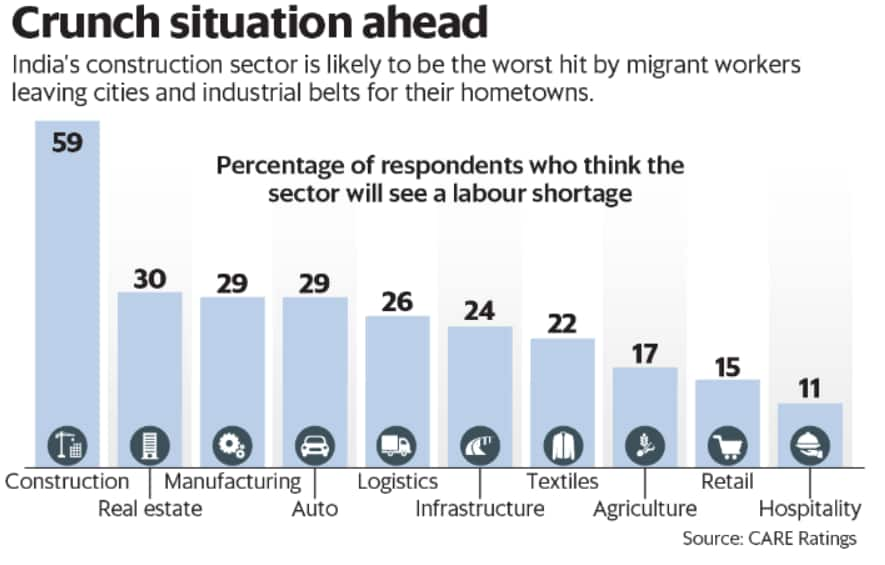
  • Insufficient labor could severely impact construction operations even if supply of materials normalizes in the next few weeks
  • There will be stress on logistics and local distribution. 
  • The India Cellular & Electronics Association expects 30% normalcy by the end of May. Foxconn has got approval to resume production with 10% workforce, but getting labour is turning out to be a big challenge
  • MSMEs could resume with just 20-25% capacity
  • Food processing would be affected severely due to the shortage of workers and difficulty in getting working capital loans at low interest rates. Retailers usually have stock for just 3-4 weeks.
  • Export shipments are being hit due to shortage of workers. In two days, around 10,000 workers engaged at Kandla had registered to return to native states.
  • Most workers are unlikely to return for the next three months once they reach home. Local leaders in Uttar Pradesh, Bihar and Rajasthan need to appeal to the workers to stay put in their places of work
Here is chart from Mint showing the sectors badly hit by shortage of workers:

Sunday, May 3, 2020

Covid-19: Impact and response

It was published in The Kathmandu Post, 03 May 2020.


The strict lockdown to contain the spread of SARS-CoV-2 and supplies disruptions are wreaking havoc on the economy. It is going to push many vulnerable households below the absolute poverty line and will likely increase inequality. According to the latest projections, gross domestic product growth will fall sharply to 2.3 percent in the fiscal year 2019-20, much lower than the 7.1 percent last fiscal and the government’s pre-Covid-19 target of 8.5 percent.

A sudden lockdown, coupled with the lack of contingency plans to smoothen consumption, supplies and housing, has inflicted appalling hardships on migrant workers and the poor and vulnerable. Similarly, businesses are facing financial stress or are outright bankrupt. The economy urgently needs a fiscal relief package for the vulnerable population and micro, small and medium enterprises (MSMEs), followed by a recovery package after the spread of Covid-19 is largely contained. However, effective last-mile delivery—that actually reaches the intended beneficiary households and businesses—is a huge challenge due to weak accountability and targeting mechanisms.


During the lockdown, over 90 percent of economic activities have come to a grinding halt. The latest projections show that the agricultural, industrial and services sectors are projected to grow by 2.6 percent, 3.2 percent and 2 percent, respectively. These numbers are drastically lower than the growth these sectors experienced last fiscal year.

The economy was already weak before the lockdown and social distancing measures were implemented. For instance, a delayed monsoon, shortage of fertilisers, use of substandard seeds and an armyworm invasion dented agricultural output before the Covid-19 pandemic. The pandemic exacerbated the situation through agricultural inputs crunch (such as workers and fertilisers), especially to harvest winter crops, connect to agricultural markets, and prepare for summer crops.

Similarly, weak capital spending and the lack of an investment-friendly environment affected industrial output before the pandemic. The Covid-19 outbreak in Nepal happened to exacerbate the situation as it hit in the second half of the fiscal year—the period when a majority of economic activities occur. No wonder, mining and quarrying, manufacturing and construction activities are expected to contract in the current fiscal year. Work from home norms do not apply to these activities and productivity losses will continue to linger for some quarters.

Within the services sector, a deceleration of remittance income and decline in imports were already affecting retail and wholesale trade, which has the second-largest share in the GDP. After the pandemic, this sub-sector is expected to grow by just 2.1 percent, down from 11.1 percent last fiscal. Travel and tourism-related activities such as hotels and restaurants, and transport, storage and communications are expected to contract. Other services activities that are badly hit are financial intermediation, real estate and business activities, and education. Note that casual workers and informal sector firms, mostly MSMEs, are concentrated in the services sector.

Overall, consumption has been subdued, and fixed public and private investments are contracting. The government’s 2.3 percent growth estimate for the fiscal year might itself be a bit optimistic because it assumes that the affected economic activities, except for international tourism-related activities, will start to pick up pace from mid-May. But this is highly unlikely, owing to the uncertainties over Covid-19 contagion, unfavourable external factors (decline in remittances and foreign direct investment), difficulty to quickly reverse the dispersal of workers, and supply disruptions.

This crisis will increase the fiscal deficit because of lower than expected revenue mobilisation and nominal GDP growth, and higher than expected expenditure needs. Inflation may rise, but not to the extent seen during previous crises as depressed consumer demand will somewhat counteract cost-push inflationary pressures arising from a shortage of goods and services. Similarly, a decline in exports as well as imports, and deceleration of remittance inflows might have a net effect of reducing the current account deficit. However, foreign exchange reserves will fall. This is not good, as it jeopardises external sector stability.

Importantly, since a large proportion of the households are clustered just above the absolute poverty line, an income shock due to the Covid-19 will push many of them below the poverty line. It will also potentially widen inequality because the poorest households are disproportionately affected. Note that over 62 percent of the employed workforce is in the informal sector and about 85 percent of them are employed informally—that is, those who do not have paid annual leave or sick leave benefits and whose employers do not contribute to their social security. Social protection problems, as well as unemployment, are going to exacerbate as mass internal layoffs and returning migrant workers increase in the coming weeks. The unemployment rate was already over 11.4 percent and the labour underutilisation rate, which includes unemployed, time-related unemployed and potential labour force, was even higher at 39.3 percent.

Crisis response

Given the enormity of the emerging health, social and economic problems, a well-coordinated and synchronised relief and recovery package is of urgent need. Extraordinary circumstances require exceptional measures, but the government’s economic response has been ordinary at best.

A detailed relief and recovery package is missing. The immediate-term focus should be to stabilise aggregate demand and to lower the burden on workers due to unemployment and income shock. These are best done through the expansion of social protection measures and easing regulatory as well as liquidity constraints faced by MSMEs. After Covid-19 pandemic subsides and is largely contained, a full economic recovery package is required to help struggling businesses and workers. This is also a time to think of import-substituting production and the diversification of sources of economic growth and poverty reduction.

Further, although the fiscal space is already tight, thanks to expansionary redistributive budgets in the previous years, there should be no confusion about financing Covid-19 related measures by tweaking expenditure allocation. Of course, revenue mobilisation will be lower than projected and so will be spending. But, a repurposing of the recurrent budget (especially those allocated to use of goods and services) and capital budget (allocated for vehicle purchase, consultancy, land acquisition and some civil works) is still possible. The government can issue bills and bonds as planned and raise the required money for immediate needs.

It can be used to expand unemployment and other social security-based direct cash transfers, boost healthcare spending, provide relief to farmers, subsidise food and daily essentials, guarantee credit on additional working capital for MSMEs, subsidise employee retention, cover the short-term interest on loans taken by MSMEs, expand insurance coverage, and pay premium perks for frontline workers, among others. Similarly, the government can use funds related to social security, foreign employment welfare, constituency development, and prime minister employment scheme. It could also use funds lying idle at various autonomous authorities. These measures do not necessarily jeopardise fiscal sustainability.

Moreover, the government can request the Asian Development Bank and the World Bank—the largest multilateral lenders to Nepal—to repurpose existing assistance towards the government’s new immediate and medium-term priorities. It can also seek additional concessional loans, given the enormity of the crisis and the fiscal burden in the next few years. Multilateral lenders have rapid disbursement facilities for emergency assistance and policy-based loans for budget support to help the government’s agenda.

Finally, the government could issue a pandemic bond and request the central bank to purchase it under a special one-off mechanism. For instance, the central bank can repurchase government bonds from the market and return the funds to the government’s account when they are due. Or it can perpetually roll it over.

Friday, May 1, 2020

INR 111 trillion National Infrastructure Pipeline in India

Accroding to PIB, Task Force on National Infrastructure Pipeline (NIP) submitted its Final Report on NIP for FY 2019-25 to the Union Minister for Finance & Corporate Affairs Smt. Nirmala Sitharaman on 29 April 2020. FM Sitharaman had announced a five-year Rs. 100 lakh crore infrastructure investment in her budget speech 2019-20. NIP is aimed at improving project preparation, attracting investments (both domestic and foreign) into infrastructure. It is considered to be crucial for target of becoming a $5 trillion economy by FY2025. NIP was also featured in FY2021 budget.

The final report of NIP Task Force is projecting total infrastructure investment of Rs 111 lakh crore during the period FY 2020-25 in light of additional/amended data provided by Central Ministries/State Governments since the release of summary NIP Report. Out of the total expected capital expenditure of Rs. 111 lakh crore, projects worth Rs 44 lakh crore (40% of NIP) are under implementation, projects worth Rs 33 lakh crore (30%) are at conceptual stage and projects worth Rs 22 lakh crore (20%) are under development Information regarding project stage are unavailable for projects worth Rs 11 lakh crore (10%). 

Sectors such as energy (24%), roads (18%), urban (17%) and railways (12%) account for around 71% of the projected infrastructure investments in India. The Centre (39%) and States (40%) are expected to have almost equal share in implementing the NIP in India, followed by the private sector (21%).

The report identifies and highlights a set of reforms to scale up and propel infrastructure investments. It also suggests ways and means of financing the NIP through deepening corporate bond markets, including those of municipal bonds, setting up Development Financial Institutions for infrastructure sector, accelerating monetisation of infrastructure assets, land monetisation, etc.

The task force has recommended that three Committees to be setup: (i) Committee to monitor NIP progress and eliminate delays; (ii) a Steering Committee in each Infrastructure ministry level for following up implementation; and (iii) a Steering Committee in DEA for raising financial resources for the NIP. The NIP project database would be hosted on India Investment Grid (IIG).

For NIP, a bottom-up approach was adopted wherein all projects (greenfield or brownfield, under implementation or under conceptualisation) costing greater than Rs 100 crore per project were included.

Wednesday, April 29, 2020

CBS projects Nepal's GDP to grow at 2.3% in FY2020

On 29 April, Central Bureau of Statistics (CBS) estimated that Nepal’s economy (at basic prices) will likely grow at 2.3% in FY2020, down from 6.7% revised estimate for FY2019. The projected growth rate is lower than the government’s 8.5% target. The growth estimates by CBS is based on the assumption that the COVID-19 affected economic activities will start to pick up pack from mid-May (last quarter) except for tourism activities (hotels & restaurants, and international travel). 

In FY2020, the growth is largely driven by electricity, gas and water output. This might be based on the expectation that the government will be able to bring online Upper Tamakoshi and few other hydropower projects by mid-July as a few large infrastructure projects are not severely affected by COVID-19 pandemic related disruption to labor, supplies and capital.

Overall, agricultural, industrial and services sectors are projected to grow by 2.6%, 3.2% and 2%, respectively. Agricultural sector contributed 0.8 percentage points, industrial sector 0.5 percentage points and services sector 1.07 percentage points to the overall projected GDP growth of 2.3%. These projections are based on eight to nine months data and the assumption that economic activities will gradually pick up from mid-May (expect for international tourism). 

Specifically, electricity, gas and water sub-sector is projected to grow at the fastest rate (28.7%, up from 9.1% in FY2019), followed by fishing (7.2%, up from 5.6% in FY2019), health and social work (7.1%, up from 6.8% in FY2019), and public administration and defense  (6.9, up from 5.5% in FY2019). All other economic activities are expected to grow at a rate lower than in FY2019. Construction; mining & quarrying; manufacturing; transport, storage & communications; and hotels and restaurants activities are expected to contract in FY2020. 

Industrial output would have contracted if it were not for the high growth projection for electricity and water sub-sector's output. Delayed monsoon, slow capital spending and lack of business confidence amidst the lower-than-expectation performance of the government had already created an environment where GDP growth was projected to be lower than in FY2019. The strict lockdowns and social distancing rules to contain the spread of COVID-19 exacerbated the slump in economic activities. 

Agricultural output is projected to grow at 2.6%, down from 5.1% in FY2019, largely due to a delayed monsoon, shortage of fertilizers, use of substandard seeds and an armyworm invasion. The labor, harvest and supplies disruptions due to COVID-19 exacerbated the situation. The CBS expects wheat and vegetables output to grow despite the effect of COVID-19 on agricultural market and supply chains. 

Industrial output is projected to grow at 3.2%, down from 7.7% in FY2019. Within industrial sector, electricity, gas and water subsector is expected to grow at the fastest rate: 28.7%, up from 9.1% in FY2019. The CBS expects a substantial addition of hydroelectricity to the national grid by mid-July. All other industrial sector activities are expected to contract. Mining and quarrying activities are projected to grow by -0.7%, down from 8.9% in FY2019, as mining and quarrying of stones, sand, soil and concrete is affected by the lockdowns and social distancing rules. Similarly, Construction activities are projected to contract by 0.3%, down from 8.1% growth in FY2019 as a combination of slow capital spending and the strict lockdowns affected output.  Manufacturing activities are projected to contract by 2.3%, down from 6.8% growth in FY2019. In addition to the COVID-19 related lockdowns and containment measures, manufacturing sector has been suffering from a lack of private sector investment as well as loss of both domestic and external markets due to eroding cost and quality competitiveness. Stable supply of electricity and improved industrial relations were not sufficient to drastically boost manufacturing output as expected. 

Services output is projected to grow at 2%, sharply down from 7.3% in FY2019, making it the most affected sector due to the lockdowns and supplies disruptions. Within service sector, wholesale and retail trade activities are expected to grow by 2.1%, down from 11.1% in FY2019. This reflects a drastic drop in import demand (as remittance-financed imported goods are traded in the domestic market) and sale of agricultural and industrial goods. Since travel and tourism activities were severely affected by COVID-19 pandemic, hotels and restaurants sub-sector is expected to contract by 16.3% and transport, storage and communications by 2.4%. The growth rates in FY2019 were 7.3% and 5.9%, respectively.  Financial intermediation is projected to grow by 5.1%, lower than 6.2% in FY2019, reflecting reduced income of NRB, BFIs, insurance board and companies, securities board, EPF and CIF. Real estate activities are expected to slowdown to 3.3% from 6.1% in FY2019. Education sector is expected to slowdown to 3.0% from 5.1% in FY2019. Public administration and defense is expected to grow at 6.9%, up from 5.5% in FY2019. Similarly, health and social work is expected to growth at 7.1% from 5.7% in FY2019. 

On the expenditure side, GDP (at market prices) is expected to grow at 2.3%, drastically down from 7% in FY2019. Consumption is expected grow at 3.2%, down from 5% in FY2019. However, public and private gross fixed investment and inventory (change in stock) are expected to contract. Net exports is expected to growth at 5.5% (compared to a negative growth rate last fiscal) thanks to a higher rate of decrease in imports compared to exports. 

Here are quick takeaways from the latest GDP projection.

First, the strict lockdowns, supplies and travel disruptions, and social distancing norms have severely affected almost all sectors. Particularly hit are industrial and services sector activities. Overall, consumption slowed down but investment (both public and private) contracted.

Second, GDP growth was projected to be lower than in FY2019 even before COVID-19 pandemic affected Nepal. Delayed monsoon and shortage of inputs had dented prospects for higher agricultural output. Slower than expected capital spending during the first half of FY2020 had affected construction, and mining and quarrying. Industrial sector was in stress due to low capital utilization. Slowdown in remittance inflows had affected services sector activities (particularly, import dependent wholesale and retail trading). The COVID-19 onslaught exacerbated the economic outlook. 

Third, the CBS’s projection might be a bit more optimistic. A majority of the economic activities happen in the second half of fiscal year. This is also the period when COVID-19 hit Nepal and the government resorted to necessary containment measures like strict lockdowns and social distancing. The CBS expects lockdowns to loosen by mid-May and economic activities to gradually normalize. However, this may be challenging because of the disruption to labor and supplies markets and subdued consumer demand. For instance, the dispersal of labor (internal and external migrant workers) is hard to reverse quickly. Contagion conscious businesses may find it hard to fully open shops and activities. Same with casual workers and informal sector workers. It will be challenging to ramp up construction activities for the rest of the year because contract award and work commencement usually happened in the second half. Additionally, if hydroelectricity generation (addition to the national grid) is less than expected by mid-July, then it will affect the growth projections too. 

Fourth, fiscal stress will be heightened as revenue dwindle but expenditure needs shoot up. Employment demand under prime minister employment fund will increase as jobless people resort to making use of social protection schemes (think of it as automatic stabilizer in employment market). Similarly, there will be increased pressure for direct cash transfer to the newly jobless workers and vulnerable groups.

Fifth, with adverse external environment (weak export demand, slowdown in Indian economy, likely fall in remittances and FDI, etc), and weakened internal production, GDP growth in FY2021 might still be muted. Private sector investment may remain subdued given the large uncertainties and additional cost to businesses due to the lockdowns. Worse, some might simply go out of business and default on loan payments. In times like this the public sector really has to ramp up consumption (direct cash and in-kind transfers, support to MSMEs) and investment (high capital spending exploiting the low hanging fruits) to stabilize falling aggregate demand. 

Monday, April 27, 2020

Fiscal deficit in India and rebooting the economy

From Business Standard: The coronavirus pandemic will expand the government’s fiscal deficit beyond 3.5 per cent of India’s gross domestic product (GDP), said Reserve Bank of India (RBI) governor Shaktikanta Das as he called for a "well calibrated roadmap” to manage finances. “The 3.5 per cent fiscal deficit target for this year will be very challenging to meet,” Das told news agency Cogencis in an interview. "It has to be a judicious and balanced call keeping in mind the need to support the economy on one hand and the sustainable level of fiscal deficit that is consistent with macroeconomic and financial stability.” “There has to be a very well calibrated and well thought out roadmap for entry and exit.” The RBI has not yet taken a view on monetising the government deficit.

Ashok Gulati writes in Financial Express: My humble assessment is that this may not take us far enough as the real problem is collapse in demand. And, that demand may not pick up easily as the virus is likely to stay with us for quite some time, and we may again have lockdowns as and when the viral infection surges. This will surely limit our travels and shopping for non-essentials. However, there is one demand that can easily revive, and that is food. The NSSO survey of consumption expenditures for 2011-12 revealed that in an average Indian household, about 45% of the expenditure is on food, and almost 60% of the expenditure of the poor is on food. We do not have information about consumption patterns in 2020, but my guess is that an average Indian will still be spending about 35-40% of their expenditure on food; for the poor, this expenditure would be about 50%. And, herein lies the scope to reboot the economy.
[...]But, eastern Uttar Pradesh, Bihar, Jharkhand, West Bengal, and Odisha, from where much of the migrant labour goes to other parts of India, will face a double challenge. In these states, agriculture, with tiny farm holdings, was already saddled with large labour force, engaging almost 45 to 55% of their total labour force. Non-farm income from wages and salaries, through migrant labour, was one important source of their income. This is now severely hit. In all probability, these staes’ overall per capita incomes in rural areas may shrink, at least in the short run, raising issues of swelling poverty, hunger, and malnutrition. In such a situation, how does one reboot the economy and also take care of a worsening situation on the hunger and malnutrition front?
A special investment package, a la USA’s Marshall Plan in 1948, for the eastern belt of India to build better infrastructure, agri-markets and godowns, rural housing and primary health centres, schooling, skilling will go a long way to revive the economy, and augment incomes of returned migrant labourers in these states. Rising incomes will generate more demand for food as well as manufactured products, giving a fillip to growth engines of agriculture as well as the MSME sector. Building better supply chains for food, directly from farm to fork, led by the private sector will not only augment export competitiveness of agriculture but also ensure a higher share of farmers in consumers’ rupee. This broad-based development in the hitherto laggard region of India will lay down the foundation for the long-term, demand-driven growth of industry in India.