Monday, October 25, 2010

Why isn’t Mexico rich?

“Over the last three decades, Mexico has aggressively reformed its economy, opening to foreign trade and investment, achieving fiscal discipline, and privatizing state owned enterprises. Despite these efforts, the country’s economic growth has been lackluster, trailing that of many other developing nations. In this paper, I review arguments for why Mexico hasn’t sustained higher rates of economic growth. The most prominent suggest that some combination of poorly functioning credit markets, distortions in the supply of non-traded inputs, and perverse incentives for informality creates a drag on productivity growth. These are factors internal to Mexico. One possible external factor is that the country has the bad luck of exporting goods that China sells, rather than goods that China buys. I assess evidence from recent literature on these arguments and suggest directions for future research.”

That is the abstract of a paper written by Gordon Hanson. Read the full paper here. Hanson argues that “Mexico’s underperformance is overdetermined.” Though faulty provision of credit, persistence of informality, control of key input markets by elites, continued ineffectiveness of public education, and vulnerability to adverse external shocks each may have a role in explaining Mexico’s development trajectory, we don’t yet know the relative importance of these factors for the country’s growth record, he asserts.

Btw, in 2009, Mexico exported 0.3% of GDP to China and imported 4.1% of GDP from China. The US imports more from China than from Mexico. The manufacturing inputs exported to the US could be either substitute or near-substitute goods. So, China could be displacing Mexican exports to the US.

Thursday, October 21, 2010

Economic policy for South Asia after the crisis

In a new book published by the WB, Dipak Dasgupta, Ejaz Ghani, and Ernesto May have a chapter on economic policy challenges for South Asia. The authors have the following recommendations for South Asia:

  • Create fiscal space to improve macroeconomic stability, avoid crowding-out the private sector, and permit financing of infrastructure and social safety nets.
  • Manage inflationary pressures, particularly food prices, with renewed attention to agricultural productivity growth.
  • Revisit South Asia's trade and investment integration strategy to take advantage of the global rebalancing underway, including supporting faster manufacturing growth.
Attention has to be focused on governance, conflict, demographic transition, and urbanization and spatial transformation. Also, tax revenue needs to be increased as the ratio of tax revenue to GDP is very low in South Asian countries.
 
Also, South Asia needs to invest in infrastructures, a key binding constraint to economic growth in the region. It also needs to have effective social safety nets, control inflation and food prices, revitalize agricultural sector to increase production, seek quick integration into East Asia, and support faster manufacturing growth as East Asia is transitioning to more skill-intensive manufacturing.
 
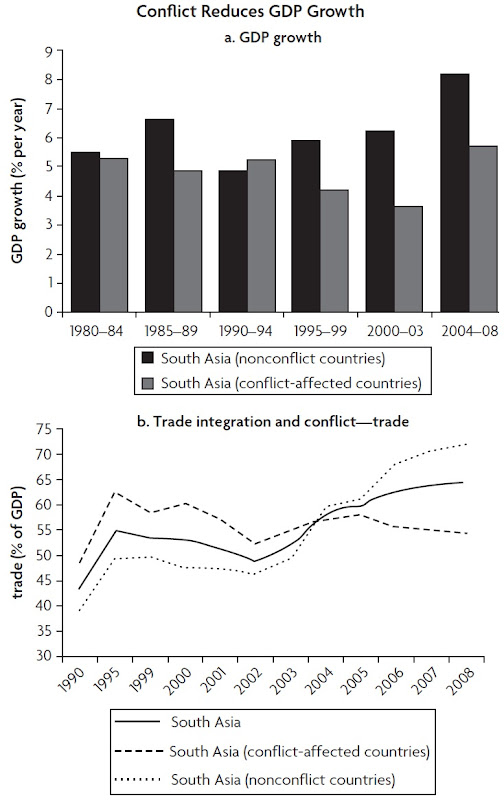
Conflict has severely impacted growth in South Asia. Given its income level, Nepal had the most fatalities between 1998 and 2004 as a result of conflict. Note that conflict-affected countries had lower GDP growth rate and trade.
 
Since 150 million people are entering the labor force in the next decade, without appropriate provision of providing them decent paying jobs, they could be a liability instead of providing demographic dividends. Workers are trapped in low-wage, low-productivity jobs. More jobs have to be created in the industrial sector. Skill enhancement and addressing high informality are also necessary.

[Here is a general summary of the book which argues that developing countries will come to the rescue of the world economy in the post-crisis period. Here is a summary of a chapter on economic crisis, migration and remittances/ )

Wednesday, October 20, 2010

Marx vs. Hicks: Technical change in India

“We use the real wage–profit rate schedule to examine the direction of technical change in India’s organized manufacturing sector during 1980–2007. We find that technical change was Marx biased (i.e., declining capital productivity with increasing labor productivity) through the 1980s and 1990s; and Hicks neutral (increasing both capital and labor productivity) post-2000. The historical experience suggests that Hicks-neutral technical change may only be a passing phase before we see a return to the long-term trend of Marx-biased technical change. We also find that the real profit rate has increased from about 30 percent to a very high 45 percent, that the real wage rate increased marginally, and that the share of capital in value added doubled. Overall, technical change in India’s organized manufacturing sector during 1980–2007 favored capital.”

More in this paper. Does this mean India will have increasing labor productivity and decreasing capital productivity in the long run? If so then, India might have low growth rate as in the “Marx biased” period. Now, what’s up with the growth projections that India will be the third largest economy by the next three decades?

Wednesday, October 13, 2010

The state of hunger in Nepal

It is no better even after two decades, according to latest Global Hunger Index 2010. Nepal’s ranking is 56. The hunger level in Nepal is ALARMING. But, Nepal fares better than India and Bangladesh in ranking. Sri Lanka is relatively better than all other South Asian countries.

The hunger situation in Nepal is still the same. Now, I wonder whats up with all the aid money in battling hunger and increasing agriculture production? What has it done to address their own primary objectives? We need some accountability here. Is our strategy to fight against hunger fundamentally wrong? Are we just wasting resources and giving band-aid solutions that require structural changes in the way we do farming and respond to emergencies? We seriously need to think. That said, lets not wholly blame the aid agencies working at the frontlines to combat hunger. But, how about questioning their strategy in combating hunger? Is it time to change that now? Now, lets see how much difference USAID’s “Feed the Future” initiative will make?

GHI is calculated based on three equally weighted indicators: (i) The proportion of undernourished as a percentage of the population; (ii) the prevalence of underweight in children under the age of five; (iii) and the mortality rate of children under the age of five. As a group, there has been a decrease in hunger in both South Asia and Sub-Saharan Africa. Globally, the countries that have made the most progress in the fight against hunger since 1990 are Kuwait, Malaysia, Turkey, Mexico, Tunisia, Nicaragua, Ghana, Iran, Saudi Arabia, and Peru. The losers are Congo DR, Comoros, Burundi, North Korea, Swaziland, Zimbabwe, Guinea Bissau, Liberia, The Gambia.

Monday, October 11, 2010

2010 Nobel prize in economics for unemployment!

This year’s Nobel prize craze finally ended with the announcement of the prize in economics to Peter Diamond, Dale Mortensen and Christopher Pissarides for “their analysis of markets with search frictions”. It is a prize for (structural) unemployment! I have heard and read some of Diamond’s stuff but not other’s. Here is an interview with Peter Diamond.

This blog post is largely derived from an extended note by the prize committee. Just to help me understand what’s up with the DMP model. It is pretty fascinating. Even though the main conclusion of their work looks obvious, they modeled it and systematically applied it in the real world. Their work has a Keynesian twist and slaps the classicists notion that markets clear itself. Tyler Cowen thinks of Pissarides “as the least Keynesian of the trio.” Here is Cowen on Diamond and Mortensen. Krugman is happy that the trio won the prize.

Diamond, Mortensen and Pissarides showed that an unregulated market does not clear by itself, as has been asserted by classical economics. The classical economists believe that markets always clear because prices are determined in such a way that demand matches supply as there are no transaction costs and there is perfect information. In reality, it ain’t so. Buyers and sellers face costs in their attempts to locate each other (“search”) and meet pairwise when they come into contact (“matching”). They explored how price formation works in a market with search frictions. How much price dispersion-- if the law of one price should be expected to hold in markets with frictions-- will be observed and how large are the deviations from competitive pricing?

Buyers are not able to find sellers, or vice versa, all the time. Even if they did, there might be disagreements in price of the product in question. This means that both will continue searching for the perfect deal. This process of finding the desired outcome is not frictionless. The trio clarified this by both using economic models and applying that to real life. They analyzed how (frictional) unemployment works and persists in an economy. Agents in an economy always look for cooperative patterns in order to meet their desired goal. For instance, in order to reach a settlement, there is always a search for cooperative deal between a buyer and a seller of a product, between employers and prospective employees, and between firms and their suppliers. When a producer produces an item, it does not sell automatically, unless it is pre-ordered, which usually does not happen all the time. This means that the seller will have to wait until he finds the right customer willing to pay the right price, and vice versa.

In 1971, Peter Diamond examined how prices are formed on a market where buyers look for the best possible price and sellers simultaneously set their best price while taking buyers’ search behavior into account. A small search cost would drastically change the outcome, which is not factored into the classical labor market model. He showed that the mere presence of costly search and matching frictions does not suffice to generate equilibrium price dispersion. He found that even a small search cost moves the equilibrium price away from the competitive price (typically exists under perfect competition). The only equilibrium outcome is the monopoly price. This is dubbed the “Diamond paradox”. This means that a small search friction can have a large effect on price outcomes, and it would not lead to any price dispersion at all.

Mortensen and Pissarides extended Diamond’s model to this notion to labor markets. Their work sheds light on how economic policy and regulation can affect unemployment, job vacancies, and wages. It relates to figuring out unemployment insurance or hiring and firing rules. Their work shows that a more generous unemployment benefits give rise to higher unemployment and longer search times.

Their research showed that an unregulated search market does not give rise to an efficient outcome. Aggregate welfare is not necessarily higher with more search since search itself is costly. Resource utilization could be either low or high as the search and matching process involves costs. There are external effects that an agent does not know of. For instance, intense search for jobs by an agent means more difficulty for other job seekers to find employment because it will be easy for companies to find desired personnel, and vice versa. Additionally, unlike in the unregulated classical models, when search costs exist, there could be several optimal points, but only one superior optimal point. This is where the role of the government comes in. It can find ways to ensure that the search process results in a superior outcome when the final deal is sealed. Unutilized resources can be put to good use by intervention from an external agent.

The search and matching environment can lead to macroeconomic unemployment problems as coordinating trade does not match one-to-one. This provides a rationale for “aggregate demand management” to steer the economy towards the best equilibrium. Diamond’s work is viewed as “a careful analysis, using microeconomic foundations, to analyze some of the central themes of Keynes’s business-cycle theory.” Coordination problems feature on both of their writings. An appropriate intervention by the government can address coordination problems.

Their work on the determinants of unemployment (DMP model) can be used to explain the position of the Beveridge curve and the location of the economy on the curve. A Beveridge curve shows that the labor market fluctuates between situations of either high unemployment and few vacancies or low unemployment and many vacancies. If unemployment increases when vacancies go down, then it is related to the demand for labor and is related to business cycle. But, if vacancies go up and unemployment also increases, then the labor market is not performing well, signaling that there could be weaker matching efficiency resulting in long-term unemployment. Understanding why this happens is important to reducing unemployment.

The DMP model addresses the following questions:

    1. How workers and firms jointly decide whether to match or to keep searching
    2. In case of a continued match, how the benefits from the match are split into a wage for the worker and a profit for the firm
    3. Firm entry, i.e., firms’ decision to “create jobs”
    4. How the match of a worker and a firm might develop over time, possibly leading to agreed-upon separation.

The model is used to examine the effects of policies concerning hiring costs, firing costs, minimum wage laws, taxes, and unemployment benefits on unemployment and economic welfare.It also used to analyze how aggregate shocks are transmitted to the labor market and lead to cyclical fluctuations in unemployment, vacancies, and employment flows.


As a side note, here is an abstract from a paper that uses search theory in marriage where older men appear to be attractive in the marriage market for younger women!

It is commonly observed that across societies and time, women tend to marry older men. The traditional explanation for this phenomenon is that wages increase with age and hence older men are more attractive in the marriage market. The explanation holds even where differences in fertility between men and women are taken in account. This explanation, however, involves an implicit assumption about female specialization in home production - an assumption that does not generally hold, especially in modern times. This paper shows that a marriage market equilibrium where women marry earlier in life than men can be achieved without making any assumptions about the wage process or gender roles. The only driving force in this two sided search model is the asymmetry in fertility horizons between men and women. When the model is calibrated with Census Data, the average age at first marriage and the pattern of the sex ratio of single men to single women over different age groups mimics the patterns observed in developed countries during the last decade (e.g. France, the U.S. and Sweden). However, the fit is less accurate for developing countries and for earlier decades in developed countries. This result may indicate a more important role of social norms and wages in the determination of marriage pattern in those cases.

2010 Nobel prize in economics

Peter Diamond, Dale Mortensen and Christopher Pissarides share 2010 Nobel prize in economics for “their analysis of markets with search frictions”.


Why are so many people unemployed at the same time that there are a large number of job openings? How can economic policy affect unemployment? This year's Laureates have developed a theory which can be used to answer these questions. This theory is also applicable to markets other than the labor market.

On many markets, buyers and sellers do not always make contact with one another immediately. This concerns, for example, employers who are looking for employees and workers who are trying to find jobs. Since the search process requires time and resources, it creates frictions in the market. On such search markets, the demands of some buyers will not be met, while some sellers cannot sell as much as they would wish. Simultaneously, there are both job vacancies and unemployment on the labor market.

This year's three Laureates have formulated a theoretical framework for search markets. Peter Diamond has analyzed the foundations of search markets. Dale Mortensen and Christopher Pissarides have expanded the theory and have applied it to the labor market. The Laureates' models help us understand the ways in which unemployment, job vacancies, and wages are affected by regulation and economic policy. This may refer to benefit levels in unemployment insurance or rules in regard to hiring and firing. One conclusion is that more generous unemployment benefits give rise to higher unemployment and longer search times.

Search theory has been applied to many other areas in addition to the labor market. This includes, in particular, the housing market. The number of homes for sale varies over time, as does the time it takes for a house to find a buyer and the parties to agree on the price. Search theory has also been used to study questions related to monetary theory, public economics, financial economics, regional economics, and family economics.


Saturday, October 9, 2010

Global economic crisis, migration & remittances

In a new book (here is a general summary of the book which argues that developing countries will come to the rescue of the world economy in the post-crisis period) published by the WB, Sanket Mohapatra and Dilip Ratha have a chapter on the impact of the global financial crisis on migration and remittances. They discuss recent trends in and the outlook for migration and remittance flows for 2010-11. Remittance to developing countries is estimated to decline by 6 percent in 2009. Remittances amounted to US$223 billion in 2008 (3x larger than ODA to developing countries). Remittances account for more than one-third of GDP in Lesotho, Moldova, Tajikistan, and Tonga.

Remittance inflows to South Asia is estimated to be US$82.8 billion in 2011 from  US$71.7 billion in 2008. Remittance inflow to developing countries is estimated to be US$359.1 billion in 2011.Total world remittance flows is estimated to be US$464.9 billion in 2011. East Asia and the Pacific is expected to see the highest growth of remittances in 2010 (9.8 percent) and 2011 (9.2 percent) following negative growth rate of 0.4 percent in 2009. Remittances is expected to amount US$102.7 billion in East Asia and Pacific in 2011.

The factors that affected migration and remittance flows in 2009 were:
  • effects of the economic crisis on migrant stock,
  • diversification of migration destinations,
  • currency effects, and
  • the link between barriers to labor mobility and the impact of economic cycles on remittances. If the barriers to labor mobility is low, then economy cycles and remittances are strongly related.

Existing migrants are unwilling to return back to their home countries, so remittances is expected to increase. Meanwhile, low demand for labor in the Gulf countries would reduce the stock of migrants from Nepal, Pakistan, India, and Bangladesh, among others.

The countries that have the most diverse migration destinations have better chances of remittances being more resilient. Additionally, the total value of remittance inflows to developing countries depends on the prevailing exchange rate, usually between US dollar and their domestic currency. The Indian rupee depreciated by almost 25 percent against the US dollar, leading to a surge in remittance flows and an increase in spending in housing sector, and in bank deposits and stocks.

Similar signs of investment-related remittance flows were seen in Nepal, Bangladesh, Pakistan, Tajikistan, Ethiopia, Moldova, and the Philippines.

One notable feature of remittances have been its impact on offsetting balance of trade deficit. It is particularly true in Nepal, the Philippines, Bangladesh, and Mexico.