Wednesday, October 29, 2008

Law of demand in action

It is a familiar story that economic agents respond to changes in price of a commodity by changing quantity demanded. This is the basic law of demand formally learnt in Econ 101—that is, price and quantity demanded are inversely related.

Here is the same principle applied in the real world:

The number of climbing expeditions to Himalayan mountains, including Mount Everest, has risen since Nepal reduced off season climbing fees three months ago, officials said on Wednesday.

Nepal announced a 50 percent cut in the climbing fees in August for the three-month autumn season starting in September as incentive to off-season climbers and boost tourism, hit by years of Maoist civil war and political unrest.

As a result the number of expeditions to different Himalayan peaks in Nepal during the Autumn season had increased to 145 this year, up from 84 in 2007, Tourism Ministry official Gyanendra Shrestha said.

Officials say tourist arrivals in 2007 also jumped 27.1 percent to 360,000 as visitors began to return to the scenic nation after the Maoists declared a ceasefire in 2006.

By the way, eight of the world’s 14 highest peaks above 8,000 meters, including Mount Everest, are located in Nepal, which is the poorest country in Asia with a GDP per capita income of $1,500 (PPP 2006 estimate).

Sachs and Green on the financial crisis

Jeff Sachs argues for expansionary, co-ordinated action from the US, EU, China, Japan, and the Middle East to prop up credit market and domestic demand in these countries and in the developing countries as well.

Any co-ordinated expansion should include the following actions. First, the US Federal Reserve, the European Central Bank and the Bank of Japan should extend swap lines to all main emerging markets, including Brazil, Hungary, Poland and Turkey, to prevent a drain of reserves. Second, the International Monetary Fund should extend low-conditionality loans to all countries that request it, starting with Pakistan. Third, the US and European central banks and bank regulators should work with their big banks to discourage them from abruptly withdrawing credit lines from overseas operations. Spain has a role to play with its banks in Latin America.

Fourth, China, Japan and South Korea should undertake a co-ordinated macroeconomic expansion. In China, this would mean raising spending on public housing and infrastructure. In Japan, this would mean a boost in infra- structure but also in loans to developing nations in Asia and Africa to finance projects built by Japanese and local companies. Development financing can be a powerful macro­econ­omic stabiliser. China, Japan and South Korea should work with other regional central banks to bolster expansionary policies backed by government-to-government loans.

Fifth, the Middle East, flush with cash, should fund investment projects in emerging markets and low-income countries. Moreover, it should keep up domestic spending despite a fall in oil prices. Indeed, the faster a global macro­economic expansion is in place the sooner oil prices will recover.

Sixth, the US and Europe should expand export credits for low and ­middle-income developing countries, not only to meet their unfulfilled aid promises but also as a counter-cyclical stimulus. It would be a tragedy for big infrastructure companies to suffer when the developing world is crying out for infrastructure investment.

Finally, there is scope for expansionary fiscal policy in the US and Europe, despite large budget deficits. The US expansion should focus on infrastructure and transfers to cash-strapped state governments, not tax cuts. This package will not stop a recession in the US and parts of Europe, but could stop a recession in Asia and the developing countries. At the least it would put a floor on the global contraction that is rapidly gaining strength.

Again, support for Keynesianism, which is the need of the hour (even Bernanke is falling into the lap of Keynes with all those talk about second round of stimulus package)…actually, it Keynesianism is always relevant in some scale! Also, a US sponsored global summit on Nov 15 will decide whether to overhaul key global institutions like the IMF and WB. It will most be in the regulatory side.

Meanwhile, Duncan Green fleshes out more on the financial crisis, Keynesianism and the climate change.

From the wreckage of the Depression emerged radical new approaches to running the world’s economies: Roosevelt’s New Deal, Keynesian beliefs in using government spending to manage slumps, and, in developing countries, a wholesale switch away from reliance on exporting raw materials such as coffee or copper to the pursuit of industrialisation.

A similar scale of tectonic shifts may be building below the surface of the current crisis. Some could resemble earlier transformations, others will have to break new ground – the world and its economy are now very different.

As in the previous crash, we are likely to see a retreat from the excesses and bubbles of laissez-faire capitalism as markets are re-regulated.

…Even before the current crisis, the world was facing new challenges. Since the Second World War, massive economic growth based on fossil fuels has brought material benefits to millions. Now we are entering an age of scarcity – of water, fertile soil and, above all, carbon.

Whether through the onset of “peak oil” or the response to climate change, the rationing of carbon will transform the nature and language of politics. Avoiding catastrophic climate change while still allowing poor countries to grow their way out of poverty will require the United States and Canada to reduce their per capita emissions from 20 tonnes to roughly two (some argue it should be nearer one tonne). The average starting point for Germany and France is ten tonnes per head. China stands at three tonnes.

…But that is not enough. Development requires effective states. The extraordinary transformation of countries such as South Korea, Vietnam and Botswana has invariably involved governments able to ensure their people are healthy and educated and that there are decent roads and power supplies, and which are willing to steer their economy through the dangerous, but ultimately rewarding rapids of globalisation.

The fight against poverty, inequality and the threat of environmental collapse will define the 21st century, as the fight against slavery and for universal suffrage defined earlier eras. It is hard to imagine a more worthwhile cause. Fail, and future generations will not forgive us. Succeed, and they will wonder how the world could have tolerated such needless injustice and suffering for so long.

Monday, October 27, 2008

Larry Summers argues for activist policy

Larry Summers argues that policy activism, especially in the fiscal side, spurs growth (well, at least it did after the WW II). He agrees that investment in interstate highway system, air travel and electronics led to such growth rate.

The most plausible explanation is that an array of transforming investments and technologies – the interstate highway system, widespread air travel and the expansion of electronics – were spurs to growth during the postwar period.

And, he also argues for selective policy intervention—identification of investments that stimulate demand in the short run and positively affect productivity in the long run. Does not this sound familiar, like industrial policy, to which Summers is so opposed to. See this as well.(This is exactly what Senator Obama has been arguing for in his campaign speeches).

So there is a need to ensure that the pressure to increase spending is directed at areas where it will have the most transformational impact. We need to identify those investments that stimulate demand in the short run and have a positive impact on productivity. These include renewable energy technologies and the infrastructure to support them, the broader application of biotechnologies and expanding broadband connectivity, an area where the US has fallen behind.

All of these considerations suggest that the pendulum will swing – and should swing – towards an enhanced role for government in saving the market system from its excesses and inadequacies. Policymakers need to be attentive to potential government flaws as well. For example, they need to recognise that, even as events compel larger deficits in the short run, they reinforce the need for longer-term measures to keep government finances on a sound footing. They must also be wary of measures that have a short-term superficial appeal, yet have adverse long-term consequences.

Nepal at a loss of $256 million due to financial crisis

$256.16 million is the amount of loss the Nepali manufacturing sector will have to incur because of the global financial crisis (and ensuing economic slowdown). This estimate comes from the Confederation of Nepalese Industries (CNI). Though not a huge sum in terms of the scale of bail out package in the West, this means a lot to an economy with GDP amounting to US$ 42 billion. Also, this number accounts for just the manufacturing sector. The main sectors to be hit hard will be tourism sector, and possible hydropower—the two most prioritized sectors that could lead to stimulation of economic growth in the short and medium term. Moreover, melting purchasing power of customers in the West mean less demand for exportable products from Nepal. This loss will be much more higher and severe than the number CNI came up with. In Nepal, the effect will be seen in full scale in late 2009/early 2010 if the financial meltdown in the West reaches its nadir by this end of this year.

The industries that are hit hard now are iron, plastic, edible oil, metals an other manufacturing industries. It is also expected to affect tourism sector, FDI, housing and financial transactions and remittance inflow. This will pose a challenge in meeting the expected revenue for the current fiscal years, as was outlined by the Finance Minister in his budget speech.

The recent decision by the central bank to increase reserve ratio from 10 to 20% has worried investors because of potential tightening of credit market. Due to series of collapse of banks in recent months in the US and EU, the Nepali government increased reserve ratio by 10 percentage point to avert bank failures in Nepal. However, it seems that it comes with high opportunity cost of high cost of borrowing/finance for the private sector, the engine of growth for the economy.

Sunday, October 26, 2008

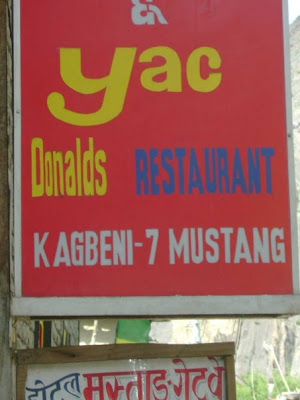
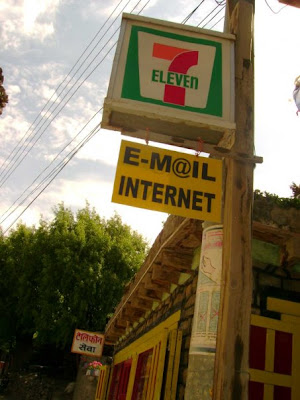
A mockery of copyrights


Big Mac...actually, its Yac Donalds!


7-Eleven up in the mountains...

These pictures are interesting. They were taken in Mustang, a trekking site in Nepal very popular among domestic and foreign tourists. I sourced the pics from Manoj Gajurel's facebook album.He is a popular comedian in Nepal.

And, a real pic of Kagbeni, Mustang:


Friday, October 24, 2008

The (insurmountable) level of crisis in the emerging countries

Dani Rodrik gives a feel about what the scale of the present financial crisis would be in the emerging countries. He thinks that the emerging countries would face much more severe crisis than the developed counterparts.

Emerging markets for the most part have weak and fragile fiscal systems, and the magnitude of the potential run is huge relative even to the large mountains of reserves that many of them have built up.  Socialization of private liabilities may enhance confidence in the rich countries; it will likely magnify the run in emerging markets.  So we are talking about economic collapses that could be significantly bigger than what the rich countries will experience.  And this time developing countries can legitimately say: it wasn't our fault!

It would be interesting to know what new ideas transpired/were floated when Rodrik, Rogoff, Stiglitz, Birdsall, and Sachs met with the UN Secretary-General Ban Ki-Moon recently. Rodrik sees a possible role for the IMF as a true global lender (massive) of last resort (without too many preconditions).

On a similar note, here is an interesting perspective: From capital flow bonanza to financial crash:

To examine the potential links with financial crises of various stripes, we constructed a family of country-specific probabilities. For each of the 64 countries, this implies four unconditional crisis probabilities, that of: default (or restructuring) on external sovereign debt, a currency crash, and a banking crisis. We also constructed the probability of each type of crisis within a window of three years before and after the bonanza year or years, this we refer to as the conditional probability of a crisis. If capital flow bonanzas make countries more crises prone, the conditional probability should be greater than the unconditional probability of a crisis.

For the full sample, the probability of any of the three varieties of crises conditional on a capital flow bonanza is significantly higher than the unconditional probability. Put differently, the incidence of a financial crisis is higher around a capital inflow bonanza. However, separating the high income countries from the rest qualifies the general result. As for the high income group, there are no systematic differences between the conditional and unconditional probabilities in the aggregate, although there are numerous country cases where the crisis probabilities increase markedly around a capital flow bonanza episode.

For sovereign defaults, less than half the countries (42%) record an increase in default probabilities around capital flow bonanzas. (Here, it is important to recall that about one-third of the countries in the sample are high income.) In two-thirds of the countries the likelihood of a currency crash is significantly higher around capital flow bonanzas in about 61% of the countries the probability of a banking crises is higher around capital flow bonanzas.

Most emerging market economies have thus far been relatively immune to the slowdown in the US. Many are basking in the economic warmth provided by high commodity prices and low borrowing costs. If the pattern of the past few decades holds true, however, those countries may be facing a darkening future.

Wasteful investment

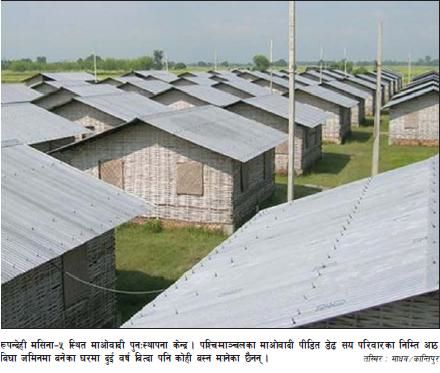
This picture shows what happens when supply is created irrespective of demand. Wasteful investment!

These houses were built two years ago under the Maoists resettlement program. Two training centers and 80 houses (one for two family) were built. Some form of wearing and tearing (depreciation) is already seen in these houses without a single family residing on it. This is a complete waste of resources by the government.

Without first assessing whether the displaced families want to resettle in this particular location (Rupendehi) the government went ahead with the project. Officials now concede that the choice of location was wrong in the first place. This is a typical waste of resource resulting from lack of careful diagnostic of incentives and constraints to resettlement.

Money wasted: NRs 1 crore 65 lakhs (do the maths in dollars, US$1=NRs 74). More here.