Friday, October 10, 2008

Aftermath of the financial mess: Redistribution of talent

Esther Duflo feels that the growth of financial sector until now has led to unproductive distribution of intelligence (talent). She argues that with stricter oversight and monitoring of CEO salary and bonus and disappearance of their exorbitant earning may encourage talents to seek job opportunities in other industries, thus leading to a more realistic allocation of talent.

If paying the bankers (a lot) less or taxing them (a lot) would certainly be more desirable from a moral point of view (not to mention considerations of equity), would it be harmful in terms of economic efficiency, as many economists suggest? Is there a risk of discouraging the most talented to work hard and innovate in finance? Probably. But it would almost certainly be a good thing. A study on Harvard graduates showed that those who work in finance earn almost 3 times more than others. The temptation for young talent to work in this sector is enormous – 15% of 1990 Harvard graduates are working in finance, compared with only 5% of the class of 1975. More generally, the massive deregulation of the financial sector, which began in the 1980s, and the opportunity to make extraordinary profits have been accompanied by an increase in the number and qualifications of employees in this sector. Again, according to Philippon and Resheff, one has to go back to 1929 to see such a gap between the average education of an employee in the financial sector and one in the rest of the economy. The complex financial products, but also the evolution of standards in the social sectors over the past 30 years, have made the financial sector particularly attractive to any graduate, intelligent as he or she may be.

What the crisis has made bluntly apparent is that all this intelligence is not employed in a particularly productive way. Admittedly, a financial sector is necessary to act as the intermediary between entrepreneurs and investors. But the sector seems to have taken a quasi-autonomous existence without close connection with the financing requirements of the real economy. Thomas Philippon calculates that the financial sector, which accounts for 8% of GDP in 2006, is probably at least 2% above the size required by this intermediation. Worse, the sub-prime crisis is almost certainly in part linked to the fact the needs of the financial markets (the insatiable demand from banks for the (in)famous “mortgage-backed securities”) led to excessive borrowing and a housing bubble. Watching the events of the last few days unfold does make us one want to send some of the finance CEOs back home. More pragmatically, the disappearance of their exorbitant earnings may encourage younger generations to join other industries, where their creative energies would be socially more useful. The financial crisis could plunge us into a severe and prolonged recession. The only silver lining is that it could cause a more realistic allocation of talents. One must hope that the bail-out packages in Wall Street and in Europe do not convince the best and brightest that the financial sector is still their best option.

Wednesday, October 8, 2008

The most competitive nations

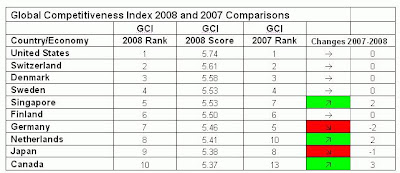
The World Economic Forum (WEF) has published The Global Competitiveness Report 2008-2009. Click here for highlights of the report. The US, followed by Switzerland, Denmark, Sweden, Singapore, and Finland are the top five competitiveness nations in the world, according to the report. Below are the top ten nations and their comparative movement along the list.

China is in 30th position (up by 4 positions from last year), India is in 50th position (down by 2 positions from last year), and Nepal is in 126th position (down by 12 positions from last year). From the Sub-Saharan Africa, Tunisia is in 36th position (up by 4 positions), South Africa is in 45th position (up by one position), Botswana is in 56th position (up by 20 positions), and Mauritius is in 57th position (up by 3 positions).

Among the 134 countries included in the report, the last ten, except for Nepal and Timor-Leste, are African nations. The bottom ten in the report are: Madagascar, Nepal, Burkina Faso, Uganda, Timor-Leste, Mozambique, Mauritania, Burundi, Zimbabwe, and Chad.

The co-author of the report states that amidst rising food and energy prices, international financial crisis, and slowdown in leading economies, the importance of a competitiveness-supporting economic environment is even higher as this helps to fend off these kinds of shocks in domestic economies.

“Rising food and energy prices, a major international financial crisis and the related slowdown in the world’s leading economies, are confronting policy-makers with new economic management challenges. Today’s volatility underscores the importance of a competitiveness-supporting economic environment that can help national economies to weather these types of shocks in order to ensure solid economic performance going into the future,” said Xavier Sala-i-Martin, Professor of Economics, Columbia University, USA, and co-author of the report.

Well, this needs a little bit of explaining to show how competitiveness-supporting economic environment actually help weather the financial and economic crisis, like the current one, emanating from the developed countries! Are the most competitive nations weathering the impact of the current financial crisis right now? Or, is there evidence that the least competitive nations not being able to weather the impact of the recent financial crisis? Put it another way: Is competitive environment helping weather the impact and risks inflicted by the current financial crisis and rise in commodity and fuel prices? Note that I am not doubting the power of markets!

Meanwhile, the director of WEF’s global competitiveness network said:

…despite the present turmoil the index was still relevant because it measured a wide range of factors important for long-term growth in productivity and living standards…Once the global economy emerges from the current financial crisis, which it will, the countries that do well on our index are those that are best prepared to bounce back and perform well in the longer term

The report looks at twelve “pillars of competitiveness” namely institutions, infrastructure, macroeconomic stability, health and primary education, higher education and training, goods market efficiency, labor market efficiency, financial market sophistication, technological readiness, market size, business sophistication, and innovation.

Finally, this one from the FT:

Like the rival index produced by the Swiss-based IMD business school, the WEF index relies heavily on the views of business executives as well as statistical data, and the rankings depend crucially on the weights given to the various factors.

This helps to explain some oddities in the WEF rankings. For instance, Qatar and Saudi Arabia are ranked above China (30), while now bankrupt Iceland (20) tops rich and solid Luxembourg (25).

Nice sentences

…developing nations will have to stop looking to financial markets and multilateral agencies for the recipes of economic growth. Perhaps most difficult of all, economists will have to learn to be more humble!

- Dani Rodrik, One Economics, Many Recipes, pp242

Links of Interest (10/07/08)

Zoellick argues for Modernizing Multilateralism and Markets and says the G-7 is not working. He calls for a new Steering Group including Brazil, Russia, India, China, Mexico, Saudi Arabia, South Africa, and the current G-7.

Why Nepal has to be at the heart of South Asian climate discussion initiatives: Regional initiatives, global strategies

Paul Collier on cracking down on Africa’s loot-seeking elites

Paul Romer’s take on the financial crisis: Fundamentalists versus Realists

Stiglitz, Hubbard, and Scholes throw The Dismal Questions at Obama and McCain ahead of the presidential debate!

Taking another look at land reform in Nepal

Perry gives the Good News From Africa (about improvement in governance indicators as shown by the Ibrahim Index)

The Ibrahim Index explained

List of formally educated African leaders

Geographic ignorance: ‘Nepal is Tibet’:The saga of gaffes continues

Pachauri on fighting climate change for the sake of the poor

Tuesday, October 7, 2008

Human Opportunity Index (HOI)

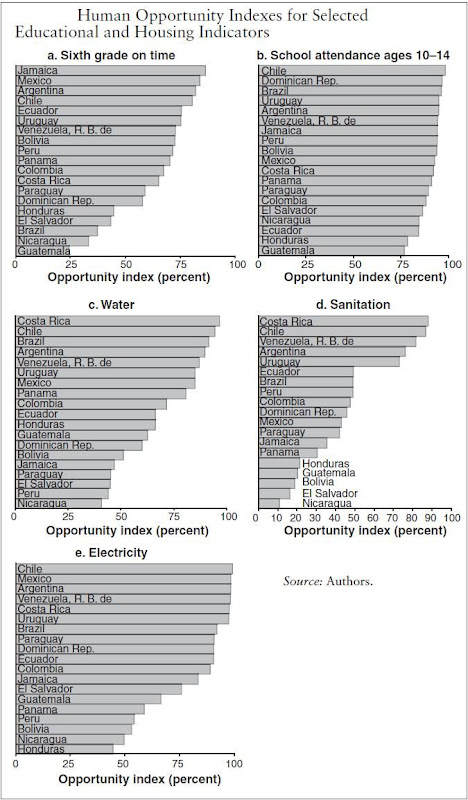
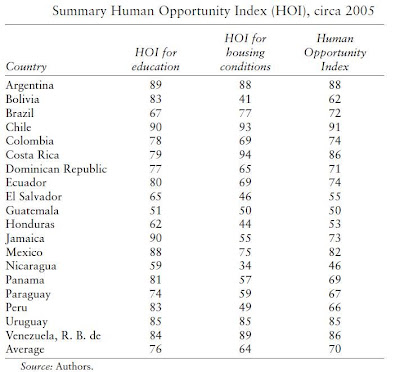
One more measure of inequality is out now. This one is said to be more broader than Gini coefficient index and tries to go well into the roots of inequality to figure out the role of lack of opportunities (that is inequality in opportunities) in human development. This new index called Human Opportunity Index (HOI) comes from the World Bank. Obviously, it focuses on Latin America, the most unequal region (going by the Gini coefficient) in the world. The HOI is calculated as  the average of HOI for education and the HOI for housing. The HOI measures the proportion of opportunities needed for children to attain universal access to basic services that are available and equitably distributed.

Between one fourth and one half of income inequality observed among Latin America and the Caribbean adults is due to personal circumstances endured during childhood that fell outside of their control or responsibility, such as race, gender, birthplace, parent’s educational level and their father’s occupation. These circumstances reveal the level of inequality of opportunity in the region.

The HOI shows how personal circumstances play in gaining or preventing access to those services needed for a productive life, such as running water, sanitation, electricity or basic education among children in the region. This opens up a whole new field of study dedicated to designing public policy focused on equity.

The composite index runs from 0 (total deprivation) to 100 (universality) and is calculated using potable water, sanitation, electricity and basic education services, which directly influence the chances that a child has to forge a decent future. The IOH improves when there are more opportunities and when they are more equitably distributed. It allows also to identify factors which determine a greater/lower access to these basic services.

HOI results also show that a person’s birthplace, and in second place, parents´ income, are a powerful determinant for access to running water, sanitation and electricity services. Both parental education and socioeconomic status are closely related to their children’s educational achievements.

Among 19 Latin American countries, Argentina (88 percent), Chile (91 percent), Costa Rica (86 percent), Uruguay (85 percent) and Venezuela (86 percent) are closer to achieving universality of opportunities. Guatemala (50 percent), Honduras (53 percent) and Nicaragua (46 percent) are farthest from that goal, due both to low coverage and unequal distribution.

Between 1995 and 2005, the average annual HOI growth in the region reached 1 percent. Paraguay and Peru grew at a higher rate of 1.4 percent annually.

On average, two thirds of improvements in the HOI are due to increasing the coverage rate, while one third is due to reducing inequity in the distribution of available educational and housing opportunities taken into account.

The study also finds that between one fourth (Colombia) and one half (Guatemala) of income inequality among Latin American adults is due to circumstances outside of their control, faced in the beginning of their lives. Race is a key factor to explain income differentials, especially for the most disadvantaged groups.

Sunday, October 5, 2008

HIV/AIDS: Boon or bane to Africa?

Going by the general logic, it might sound fine when some one argues that HIV/AIDS (which has already killed more than 32 million people worldwide) might increase per capita income in Africa because deaths caused by this deadly virus will reduce population and increase the size of economic pie for the surviving people. Obviously, this logic banks on the assumption that GDP growth either increases or remains equal while population growth is dragged down by HIV/AIDS.

Is there something wrong with this argument? It might seem perfectly okay if you just follow the way GDP per capita is computed in economics. However, in practice evidence points otherwise. A study found that HIV/AIDS does little to reduce fertility rates among non-infected women and it will very likely lower future per capita income in Africa because of devastation in human capital accumulation. An explanation by the authors of the paper is available here.

…Women who are HIV-positive have approximately 20% lower probability of giving birth in a given year compared to women who are HIV-negative. This result is fairly robust across countries and remains even after we control for condom use and other measures of risky sexual behaviour. Our investigation of births prior to 1986 (prior to the on-set of the HIV/AIDS) using women's fertility histories suggests that unobserved heterogeneity is not driving our results.

…In high HIV countries such as Kenya and Lesotho, the effect of community HIV prevalence on fertility of non-infected women is actually positive and statistically significant. However, when we pool all the countries we do not find a statistically significant effect.

…Will the fertility response to HIV reinforce or offset the declines in population due to mortality? Our results show that only fertility of infected women will decline and hence the total impact of HIV on the aggregate economy is much smaller than the effect implied by Young (2005). There is an extensive literature that documents substantial declines in human capital accumulation as a result of the disease. Complementary to these results, our evidence suggests that HIV/AIDS is likely to decrease rather than increase future per capita incomes in Africa.

Economics, India and Pakistan

Better trade relations (should) overshadow military might and enmity! India and Pakistan cannot afford to quibble around LOC and Kashmir issues forever. SAFTA is virtually dead just because of cold ties between these two nations. Every time there is a SAARC summit, the central focus is on bitter ties between these two countries rather than on regional trade, poverty, and cooperation.

...Not only does Mr. Zardari want better ties with Delhi, he notes that "there is no other economic survival for nations like us. We have to trade with our neighbors first." He imagines Pakistani cement factories being constructed to provide for India's huge infrastructure needs, Pakistani textile mills meeting Indian demand for blue jeans, Pakistani ports being used to relieve the congestion at Indian ones. For a country that spent most of its existence trying to show that it's the military equal of its neighbor, the agenda amounts to a remarkable recognition of the strides India has made in becoming a true world power.

...To his credit, Mr. Zardari's answer involves more than simply passing around the collection plate. When I ask whether he would consider a free-trade agreement with traditional archenemy India, Mr. Zardari responds with a string of welcome, perhaps even historic, surprises. "India has never been a threat to Pakistan," he says, adding that "I, for one, and our democratic government is not scared of Indian influence abroad." He speaks of the militant Islamic groups operating in Kashmir as "terrorists" -- former President Musharraf would more likely have called them "freedom fighters" -- and allows that he has no objection to the India-U.S. nuclear cooperation pact, so long as Pakistan is treated "at par." "Why would we begrudge the largest democracy in the world getting friendly with one of the oldest democracies in the world?"
More here.