Monday, September 8, 2008

How far to go with government intervention?

Here is an article about how to better utilize government involvement rather than clamoring for less government. Why? Because there is no evidence that higher taxes and bigger government spending on welfare slows down GDP growth rate. Compare the Nordic countries with the more liberal ones like the US!

...Contrary to the romantic claims about the nation's laissez-faire past, American history is a story of government intervening, time and again, to support growth.

...Rather than harm the economy, the evidence shows that government spending, when done well, contributes critically to economic growth. Americans rely on the government for the free primary and high schools that educate the workforce. The government subsidizes college education and has built the immense transportation infrastructure that moves goods across the country and gets people to work. Federal, state, and local government have been essential to the nation's health, building clean-water systems and developing vaccines that have eliminated or minimized diseases like diphtheria, tuberculosis, and polio. The government can waste money, too. But the national rhetoric about the economy needs to stop focusing on how to shrink the government, and start focusing on how best to use it.

...In 1992, President Bill Clinton succeeded in passing legislation to raise the income tax rate on higher income Americans. Harvard's Feldstein, who had served as Reagan's chief economic adviser, claimed that the tax increase would reduce the incentives to work and therefore the incomes of the wealthy. It turned out to do nothing of the kind: the top tier of Americans, in fact, made more money.

A look at tax history suggests that this should have been no surprise. Nancy L. Stokey, of the University of Chicago, and Sergio Rebelo, of Northwestern University, looked closely at the period between 1913 - when the United States first adopted an income tax - and 1942. In that period, the federal bite from income taxes rose from 2 to 15 percent of GDP. Discounting the data for business cycles, including the sharp downturns during the Great Depression, they found that the rate of growth remained consistently strong and positive over the years, despite ever-higher tax rates.

...But to a nation steeped in antigovernment economics, the idea that government cannot be of help - or that taxes are not worth paying - is now seriously jeopardizing its future. There is no rich nation in the world today, including America, that has grown wealthy without significant government involvement. And there will be no rich nation in the future that can stay wealthy without robust government, either

Urban Agriculture: A Cuban Success Story???

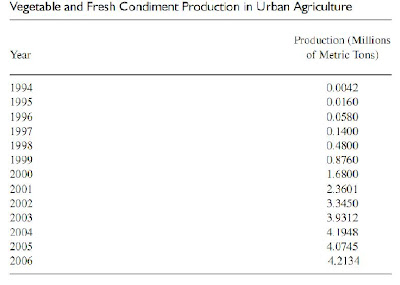
Sinan Koont, Professor of Economics in Dickinson College, in a paper about Cuban urban agriculture, terms the urban agricultural movement in Cuba "'a success story." (This reminds me of a similarly titled and very popular research paper by Acemoglu, Johnson, and Robinson: An African Success Story: Botswana ). While AJR's paper was about how strong institutions of property rights and complementary political leadership contributed Botswana to enjoy more than 7% GDP growth rate for more than three decades, Koont's paper is about how the Cuban government (something like the planners), alarmed by cut in aid by the Soviet Union during the 1990s for "industrial" agriculture development, spearheaded a program called "organoponicos" to increase agriculture productivity, mainly "agro-ecological" or "organic"  in urban areas.

This carefully planned policy, according to Koont's paper, led to roughly one-thousand fold increase in production: 4,000 tonnes to 4.2 million tonnes between 1994 and 2005 (annual growth rate of about 78 percent). Well, based on this increase in output, this exercise is termed as a "success story." It could be entirely possible that the increase in output was a result of farming in the usual idle land, which the government has complete control over. I would consider it a success story if productivity increases by multiple folds for more than a decade or so and the contribution from increase in productivity of factors of production is higher than that from increase in farming land (i.e. area). Also, most of the production boom occurred in vegetable and fresh condiment production, not in general staple food crops, multiple fold increase in productivity and production of which would have been an actual success story to celebrate on. Nevertheless, the achievements as of now is in fact awesome and could be modeled in crowded cities somewhere else, if possible.

In fact, it seems that increase in outcome was partially a result of land redistribution by the government:

...Before the crisis, land was either privately held and worked by owners, or it was state-owned and worked by employees. Now, land was also distributed in permanent usufruct to individuals (as parcelas, with the individuals being called parceleros) and cooperatives.

However, Koont also provides statistics of increase in yields per square meter:

...This kind of growth obviously implies an extensive increase in the surface area being cultivated but yields per square meter also went up impressively (in organoponicos, for example, from 1.5 kg/square meter in 1994 to 25.8 kg/square meter in 2001: a seventeen-fold increase).
Success behind the achievement:

...The most important principle underlying this spectacular success is organizational: strong, disciplined, coherent central direction and guidance are combined with decentralized action in input provision, marketing, and production.

How far this model differs from the Chinese land reform of 1970-80, which led to successful programs like household responsibility system and TVEs, leading to increase in productivity and spectacular economic growth for over three decades?

The author argues that four main policy responses from the part of the state played a critical role in the urban agriculture revolution: research and development, training and education, provisioning of inputs, and material and moral incentives.

One of the interesting arguments on the paper is that institutional reforms might not become a hit even if they are meticulously designed- it requires well-founded movement on the direction of institutional reform so that expectations are matched with reality and new policy reforms. If reforms are formulated without heeding underlying dynamics of the situation in concern, then however grand a policy may be, it won't produce expected results. Easterly, in his book The White Man's Burden, argues that movement towards individual farming was well underway in some provinces in China before the implementation of household responsibility system. The communist leaders learnt that farmers have more incentives to increase productivity when they practice individual farming. The Chinese reform post-1978 basically institutionalized this movement, leading to its success.

Koont also argues that preparation for this institutional reform was well underway before it became a policy.

The basic ingredients of such success were (and are) already present in Cuba: an educated population; a socially concerned and committed, people-oriented central government giving support and organizational backbone to the effort; and ample stimulation of decentralized initiative and decision making by producers at the base, encouraging the finding of local solutions to local problems.

Regarding institutions, reforms, and behavior of agents, Carolyn Lesorgol, in her new book Contesting the Commons: Privatizing Pastoral Lands in Kenya, also argues that for a reform program like privatization of pastoral lands to be successful, people for whom the program is being targeted need to participate to strengthen feedback mechanism, and power struggle between nay-sayers and yes-sayers should be expected. Yes-sayers may win the struggle not because the reform program is grand but because the ability to change in line with the reform program comes from the participating people itself (through a gradual process, often influenced by education and social interactions). This is an interesting book about the dynamics involved in institutions and in agent's behavior regarding privatization of pastoral lands in Kenya!

Anyway, this is a good, short paper on a topic we rarely hear about! Here is a piece about food security in Cuba by Koont.

Friday, September 5, 2008

RTAs and the Doha Round

Here are two articles about regional trade agreements (RTAs) and preferential trade agreements (PTAs). The more liberal The Economist magazine argues that RTAs is popular right now but it undermines full gains from global trade because they come at the expense of similar pact at the global level-- thus eroding potential global gains from global trade. Bhagwati calls preferential trade deals "termites in the trading system." See Rodrik's and Stiglitz's books and papers for a different perspectives on the benefits of globalization, the Doha Round, and free trade.

Regional Trade Agreements: A second-best choice

...Now Mr Nath has said “yes”. On August 28th India agreed a free-trade agreement with the ten fast-growing countries in the Association of South-East Asian Nations. ASEAN also announced a second big regional deal, with Australia and New Zealand. Coming so soon after Doha’s collapse, the two agreements sent a powerful message. The global trade talks may have stumbled, but regional pacts are pushing ahead, particularly in the fastest-growing part of the world economy. According to the World Trade Organisation (WTO), over 200 regional and bilateral agreements are in place with many more under negotiation. More than 100 came into force during Doha’s seven exasperating years.

...That is disturbing. Every trade deal should be measured on its own merits. But, for all their political appeal, bilateral and regional deals are never a substitute for progress at the WTO. Multilateral trade rounds are the foundation of the trading system because they are based on the “most favoured nation” principle—that any tariff cuts offered to one country must be offered to them all. Regional and bilateral deals are based on discrimination. They lower tariff barriers between their signatories, but not everyone else. Discrimination means that, although regional deals create new trade among their members, they may also divert it from lower-cost outsiders.

Should free traders applaud the rise of preferential trade deals?

...On August 28th they trundled through Singapore. The ten members of the Association of South-East Asian Nations (ASEAN) agreed on a trade deal with India and reached a separate accord with Australia and New Zealand. Together, the agreements cover trade worth about $70 billion in 2006.

...These preferential deals violate the principle of “most-favoured nation” (MFN), which holds that any favour offered to one member must be offered to all. But that principle now has few defenders in the world’s trade ministries. In his new book, “Termites in the Trading System”, Jagdish Bhagwati of Columbia University points out that negotiators see any deal as a “feather in your cap”. But economists know better. By playing favourites with its trading partners, a country can dupe itself into paying more for its imports. Its consumers may switch from a low-cost supplier to a more expensive one, only because the new supplier can sell its goods duty-free and the other cannot. The consumer pays less, but the Treasury is deprived of tariff revenue. Thus discriminatory trade deals do not just hurt those left out.

Surplus labor in China?

The Economist has a nice article about the debate surrounding the existence of surplus labor in China. Some say there is still surplus labor, others disagree. There is no definite answer. The one thing that can be said with certainty is that China has successfully absorbed surplus labor from the agriculture sector to the manufacturing sector. It needs to be seen when this flow of surplus labor would dry up and how much more can the increasing use of technology in agriculture (to increase productivity) can free up labor from the agriculture sector to the manufacturing sector. Shortage of labor would push up wages, which is not in the interest of manufacturing firms. MNCs would shift to other countries where wages are low in order to maintain low retail prices of final product and to maintain competitiveness in the global market. What would China do if its surplus labor vaporizes?

...A seemingly unlimited supply of cheap workers has been one of the main forces behind China’s rapid economic growth. But over the past couple of years, factory owners have complained of labour shortages and wages have risen more rapidly, leading some to conclude that China’s “surplus” labour has been used up. The country’s one-child policy, introduced in 1979, has caused the growth in its labour supply to slow sharply (see chart). After rising by 1.3% a year during the decade to 2005, the population of working age is expected to increase at an annual rate of 0.7% until 2015, and then shrink by 0.1% a year until 2025. At the same time, the shift of workers from agriculture to industry, which has been an important source of productivity gains, will also slow. Jonathan Anderson, an economist at UBS, reckons that these two trends will reduce China’s sustainable growth rate from 9-9.5% today to 7-7.5% by 2025.

...This acceleration of wages has prompted some to conclude that China’s surplus labour in the countryside has been used up. Last year Cai Fang, the director of the Institute of Population and Labour Economics at the Chinese Academy of Social Sciences, argued that China has reached the “Lewis turning point”. By 2009, he predicted, there would be a widespread shortage of workers, pushing up industrial wages. Does this mean the death of China’s growth model?

...Moreover, Mr Cai’s estimate of China’s labour surplus assumes that 180m workers, or 24% of total employment, are needed for farming. But that is based on today’s agriculture. Mechanisation and the consolidation of land plots will boost productivity, meaning that fewer farmers will be needed. That will in turn release more workers for industry. In developed countries only 3% of workers till the land.

Stiglitz (in Paraguay) is right, Friedman is wrong!

Here (the title of the article is catchy: Stiglitz is Right, Friedman is Wrong) is an interesting stuff about Stiglitz's visit to Paraguay and his policy prescriptions to the new formed government. He clearly sees a new role of the government in spurring economic growth and offers views far from the dictates of the Washington Consensus.

This is an interesting article. Most of the time I am very much convinced by Stiglitz's ideas. I love his books and papers!

...It must have been alarming for certain members of the audience to hear Stiglitz gloriously debunk, one by one, the conservative positions which development authorities and international institutions formerly embraced to bolster their positions and to which local elite groups and much of the media still cling. With great authority and occasional cheek, Stiglitz enumerated the flaws and misconceptions that have characterized the past decade of broken development thinking. He openly declared that bilateral free-trade agreements almost inevitably favor the U.S. and offer few advantages for poorer, agricultural economies such as Paraguay’s; that ‘trickle-down’ economics does not work and has never worked; that land reform was the basis of successful development experiences in East Asia; that privatization is not an automatic or necessarily the best answer to the woes of publicly-owned enterprises; that U.S. monetary policy, rather than Latin American industrial policy, was to blame for the region’s ‘lost decade’ in the 1980s; and that public investment forms the basis for private dynamism in developing countries as much as it does in developed countries like the U.S. Stiglitz summarized his position by pointing toward the current U.S. mortgage crisis, stating that markets alone produce neither efficient nor socially desirable outcomes. Instead, he insisted that dogmatic faith in markets provokes periodic crises that erase the gains achieved through growth and which hit the poor the hardest.

...After several decades during which free-market fundamentalism dominated development theory and policy, Stiglitz’s visit to Paraguay and the content of his advice demonstrated an important political and ideological shift. Aside from his positive influence on a younger generation of economists at the international lending agencies, Stiglitz is one of a number of economists whose ideas appear to be forming the foundation for a ‘post-Washington Consensus’ mentality. Stiglitz received his Ph.D. in economics from the Massachusetts Institute of Technology and, after his departure from there, continued to steep himself in an intellectual tradition with altogether different implications for the proper role of government in the economy than was the provenance offered by the Chicago School. The scholar went on to win the Nobel Prize in economics in 2001 for his work showing that markets fail to produce efficient outcomes whenever economic actors do not act on perfect information. This is a condition that is nearly universally true and that invites, if not requires, a wide set of government interventions into the market and an aggressive regulation of the private sector aimed at enhancing efficiency. Consequently, Stiglitz argues that the reason that Adam Smith’s “invisible hand” seems so invisible is because it is often not there to guide self-interested behavior in the direction of socially beneficial outcomes. Moreover, addressing his audience of elite Paraguayans, Stiglitz argued that, even with proper regulation, markets do not necessarily produce socially equitable outcomes and cannot alone effectively address entrenched inequalities in developing countries such as Paraguay. He thus opened wide the door toward social policy and redistributive spending that earlier development thinking had closed off as unnecessary, if not distortive, or at least counterproductive and vulgar.

...scholars like Stiglitz clearly see a much larger role for government in bringing about positive economic development and social justice than any leading development institution envisioned a decade ago.

See this one as well: Stiglitz goes to Paraguay: Move over Chicago, A Cambridge boy's in town

Links of Interest (9/5/08)

Friedman's misplaced monument

...It is accurate to say Friedman was an early pioneer in reaction to post-Keynesianism, but it is not accurate to label post-Keynesianism one-sided. In fact "only money matters" sounded definitively one-sided to most listeners. Friedman's reaction to Keynesianism is hardly well-founded, though it is admittedly reactionary. As the press report noted, Friedman's emphasis of money is important to the analysis of the business cycle and inflation. But business cycles are not the economy, only one aspect of it. In fact, Friedman's fundamental flaw is his fixation on the business cycle as expressed by the stock market, rather than looking at the whole economy with a wide range of meta-finance concerns such as agricultural economics, labor economics, population economics, the economics of war, pollution, development, and so forth. The list is long and interlinked and any economist ignoring any of part of the list runs the risk of being one-sided.

...The target of Friedman's evangelical crusade was John Maynard Keynes and the Keynesians who dominated government policy since the New Deal. Actually, both Keynes and Friedman were pro-market economists. Their difference was that while Keynes proposed to save the market from its self-destruct tendencies, Friedman asserted that the market could self-correct with a simple governmental monetary policy of focusing on the money supply. Federal Reserve chairman Paul Volcker tried Friedman's formula in 1980 with his "new operating method" of controlling the money supply with sharp interest rate volatility and almost caused the Fed to loose control of the Fed funds rate, the most effective instrument for controlling the money supply without calling on the heavy artillery of the discount rate and bank reserve requirements.

...The collapse of market fundamentalism in economies everywhere is putting the Chicago School theology on trial. Its big lie has been exposed by facts on two levels. The Chicago Boys' claim that helping the rich will also help the poor is not only exposed as not true, it turns out that market fundamentalism hurts not only the poor and the powerless; it hurts everyone, rich and poor, albeit in different ways. When wages are kept low to fight inflation, the low-wage regime causes overcapacity through over investment from excess profit. And monetary easing under such conditions produces hyperinflation that hurts also the rich. The fruits of Friedman test are in - and they are all rotten.

Angola's oil fields fuel economic growth

Slowdown 'to hit poor countries'

Double-digit growth: Tourism needs a boost

In Nepal, tourism has always been centre-stage when it comes to foreign exchange earning and job creation. It is said that a tourist visiting Nepal supports around a doz-en people. The World Tourism Council estimates that tour-ism in Nepal has created half a million jobs. Direct foreign exchange earnings are close to $20 billion annually, approximately 2.5% of the country’s gross domestic product.
It is imperative that the government and political leaders seriously begin discussing ways to help tourism bounce back. If ever there was a time not to let ideology dictate economy, it is now. Tourism should be guided by five principles — attracting maximum investment through both domestic and foreign sources, flexible labour laws, cutting red tape and establishing effective and efficient management in tourism related areas, and setting up infrastructure and positioning Nepal as a hub of South Asian tourism.

From Shangri-La to hell in ten years

Video: RETURNED: Child Soldier's of Nepal's Maoists Army