Friday, November 18, 2011

Corruption (rate) at Raxual custom

Corruption at custom check points between Nepal and India border is an accepted practice now—just ask the traders how much they have to pay extra money per truck. Now, it looks like the cost of import of goods has increased because the commission rate on 71 products entering Nepal via Raxual custom has been increased. It is reported that almost 60 percent of goods imported from India come through this custom point. Almost 1000 truck enter through this point each day.

According to this media report, Indian agents revealrf that commission (corruption) money is added to the normal fare for truck/vehicle service. It is reported that around 50 lakhs Indian rupee per day is collected as commission by Indian officials, who then let trucks enter the Nepal side of the border. This means Nepalese consumers will have to pay even for the amount illegally raked in by Indian border officials because the final retail price of imported goods includes all formal and informal costs incurred by importer.

Here are the rates:

  • Corruption rate for import using cart, truck and rail is different.
  • For small quantities, the corruption rate is IRs 800 per cart.
  • For each truck full of potatoes, the corruption rate is IRs 2000, onion IRs 3000, and maize IRs 3500. For coal it is IRs 3000.
  • Commission equivalent to one percent of total cost of machinery.

These are institutional non tariff barriers to trade!

Return to investment in education

Using Indonesia Family Life Survey, this WB policy research working paper shows that return to upper secondary schooling in Indonesia is as high as 50 percent per year of schooling for those very likely to enroll in upper secondary schooling, or as low as -10 percent for those unlikely to do so. Furthermore, returns to the marginal student (14 percent) are well below those for the average student attending upper secondary schooling (27 percent).

Meanwhile, the chart below shows returns to investment in education by level in few countries. The estimation for Nepal is that of 1999. More on why education is not a binding constraint to growth in Nepal is explained here.

Thursday, November 17, 2011

Labor growth and finance


This paper combines firm-level data from 89 countries with updated country-level data on financial structure, and uses two estimation approaches. It finds that in low-income countries, labor growth is swifter in countries with a higher level of private credit/gross domestic product; the positive effect of bank credit is especially pronounced in industries that depend heavily on external finance; and banking development is positively associated with more physical and human capital investment. These findings are consistent with predictions from new structural economics. In high-income countries, labor growth rates are increasing in the level of stock market capitalization, which is also consistent with predictions from new structural economics, although the analysis is unable to provide evidence that the association is causal. It finds no evidence that small-scale firms in low-income countries benefit most from private credit market development. Rather, the labor growth rates of larger, capital-intensive firms increase more with the level of private credit market development, a finding consistent with the history-based political economy view that banking systems in low-income countries serve the interests of the elite, rather than providing broad-based access to financial services.


Read the full paper by Cull and Xu (2011).

Monday, November 14, 2011

The sources of food and nonfood inflation in Nepal

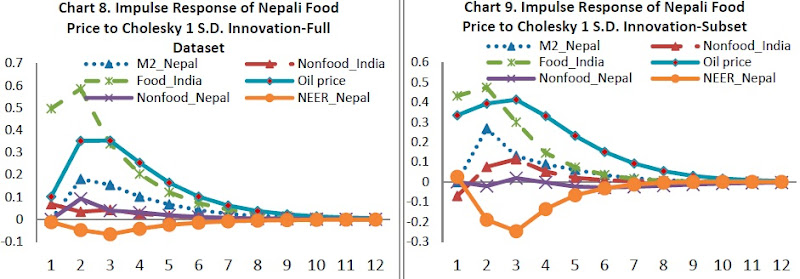
Inflation rate in Nepal reached double-digit for three consecutive years now and is now just above 9 percent. What are sources of inflation in Nepal? Is it following Indian price level? Is it being affected by demand side or supply side or both? How much is it affected by food prices? How much traction M2 (money supply) has on inflation in Nepal? In order to bring down the persistently high and sticky price level, policymakers need to first know the sources of inflation and then devise policies accordingly. The IMF recently published a study that looks into the sources of inflation in Nepal.

Using a VAR model to estimate the impact of external spillovers from India, international oil prices, nominal effective exchange rate, and domestic monetary factors, the study finds that inflation (both food and non-food) in Nepal is mainly driven by inflation in India and movements of international oil prices. These two factors account for more than one-third of the variability in domestic inflation. Since inflation in Nepal have been historically following inflation in India but not after 2007/08, the analysis uses two datasets: full dataset ranging from 2001 to 2011 and a sub dataset ranging from 2007 to 2011. The latter dataset shows that inflation in Nepal is deviating from India’s inflation and is becoming more responsive to oil prices. Note that Nepal has open border and pegged its currency with India.

Overall inflation

  • Monetary factors matter more for nonfood price inflation than for food price inflation. But, its effects fade out quickly. (Earlier I wrote that M2 does not have traction on inflation). Monetary tools have not been used to manage inflation.
  • The appreciating nominal effective exchange rate has a negative and lagged impact on inflation only between 2007 and 2011 dataset. [It might be due to rising imports in recent years.]
  • Responsiveness to international oil prices and exchange rate has increased lately. That is why international oil prices show a stronger effect in the 2007-2011 dataset.
  • Food price increases have contributed about three-fourths of overall CPI inflation, while nonfood prices contributed the remaining one-fourth. Food price inflation has been more volatile than nonfood price inflation.

Food price inflation

  • The responsiveness of food price inflation is significant and quick to spillovers from India’s food inflation and oil price movements. Furthermore, the impact of oil prices is more persistent than India’s food inflation. It intensified in recent years. It might be because the price of petroleum products gets reflected faster in the price of chemicals and fertilizers used in agriculture production, transportation cost of agriculture products and use of energy in irrigation, says the report.
  • Nominal effective exchange rate has a negative effect on food inflation with a lag of about three months in 2007-2011 dataset only.
  • Monetary responsiveness to food price inflation is significant in 2007-2011 dataset, but the effect fades out quickly.

Nonfood price inflation

  • Monetary responsiveness to nonfood price inflation is strong in both full and subset dataset series (with largest impact on the full dataset). But, the effects are short.
  • Nonfood price inflation responds to Indian food and nonfood inflation as well as international oil prices (strongly since 2007).
  • Nominal effective exchange rate has a negative effect on nonfood price inflation between 2007-2011 dataset only.


In a study of similar nature in 2007, Edimon Ginting shows that inflation in India and inflation in Nepal tend to converge in the long run, but the pass through of inflation from India to Nepal take about seven months. Now, this seems to have been violated especially after 2007 due to the strong impact of petroleum prices.

Here is how there is disconnect between Indian and Nepalese inflation rates. I wrote this one last year and is still valid. 

  • In the long term, inflation is primarily affected by money supply. In the short term, it is affected by demand and supply pressures, which in turn are dictated by relative elasticity of wages, prices and interest rates. The inflationary pressure in the short term could drag into medium term and long term, leading to high inflation for an extended period of time. It happens if prices and wages are too sticky at high level, i.e. once prices and wages rise either due to demand or supply pressure, or both, even if pressures subside, they continue to remain at high levels. This is happening in the economy since 2007.
  • One of the reasons why prices remain sticky at high levels (i.e. domestic prices do not come down even when market conditions normalize) is because of various non-economic factors constraining the functioning of markets.
  • The global economy was struck by a rapid rise in commodity and food prices in 2007, severely affecting net food importing developing countries like Nepal. Several countries, including India, banned export of key agricultural items imported by Nepal. The shortage of agricultural goods led to rapid rise in domestic prices. Then came a sudden rise in global fuel prices in 2008, leading to a drastic increase in petroleum prices in the domestic market. This directly reduced real disposable income because a substantial portion of the population banks on petroleum products for daily need. It also shot up cost of production of domestic producers, resulting in rising prices of consumer goods and services. The combined effect of the rise in food, commodity, and fuel prices led to spiraling prices starting 2007.
  • Unfortunately, when fuel, commodity and food prices cooled down in the international market, the hangover persisted in our economy. Prices stubbornly remained sticky at high levels. Exogenous factors such as supply bottlenecks due to extended periods of bandas and strikes led to shortage of essential items. Additionally, hoarding, black marketeering, deliberate withholding of supplies and inventory, and agricultural trade hurdles imposed by our neighbors contributed to keeping prices higher even after the normalization of market forces.
  • These series of events contributed to higher inflationary expectations, leading to a situation where workers, employers, producers, wholesalers and retailers started inflating wages and prices on expectation that inflation will go up. The final outcome was a permanently higher inflation. It might go even higher if the supply side constraints and inflationary expectations are not timely and adequately addressed.

Here is another piece I wrote in 2009 and the arguments still hold true.

Sunday, November 13, 2011

Policy implementation paralysis in Nepal

[This was published in Republica, November 12, 2011, p.6]


Policy implementation paralysis

Here is a snapshot of the current state of our economy: Economic growth is stagnant at under 4 percent, well short of fiscal budgetary targets and the Three Year Interim Plan. A lack of job opportunities in the domestic economy is compelling over 20,000 workers to seek employment abroad every month. General prices of goods and services have been stubbornly sticky at near double-digit level. The fragile financial sector and real estate activities have not recovered yet. The manufacturing sector is shrinking, productivity is declining, competitiveness of Nepali products is eroding in the international market and imports are ever-surging, which has resulted in widening of the trade deficit. Expenditure growth is higher than revenue growth and the growing saving-investment gap has led to inflow of foreign aid worth 25 percent of budget. High inflow of remittances has precariously balanced the economy right now.

All of these have occurred not because we lack good policies, but because there is laxity in implementing existing policies and enacting new ones that will directly stimulate economic activities.

Anyone trying their hands at innovative and entrepreneurial stuff, those who are actively looking for job opportunities and those frequenting local retail stores might have realized that the current state of economic affairs is simply unsustainable. Unfortunately, most of our political leaders and policymakers, far removed from the concerns of the regular folks, are unaware of the fact that the status quo is unsustainable. It is high time they acknowledged that new reforms and effective implementation of the already enacted ones are vital to break the economic impasse.

Thus the government should focus on effectively implementing the enacted economic and trade reforms and formulate new ones that directly address the constraints to growth of key sectors. Equally importantly, it should also ensure that the implementation of reforms is overseen by qualified and informed policymakers and political leaders.

Our economy will remain competitive only if we align production and employ resources in such a way that output base gradually shifts from production of low value added goods to high value added goods. It will lead to an increase in growth rate, job opportunities, revenue, production level, and foreign reserves as our export items gain deeper foothold in the international market. For this to happen, the economy needs to undergo structural transformation along with the enhancement of productivity.

In its latest Article IV Consultation with Nepal, the IMF also argued that Nepal needs to enact structural reforms to raise productivity and growth. It maintains that macroeconomic stability and managing financial sector risks are the two most challenging tasks right now. Given the current state of our economy, it expects real economic growth of 3.8 percent in 2011/12, which is revised downward from its preliminary estimate released in August. It means that economic activities are expected to slow down even more than what was projected few months back.

Now, to check further slowdown in growth (which is expected to remain below 4 percent till 2015 with the current state of affairs) and maintain macroeconomic stability, we need meaningful implementation of structural and policy reforms. It means controlling unproductive expenditure, raising revenue, increasing exports and decreasing trade deficit, maintaining sound balance of payment, controlling high inflation, addressing supply-side constraints, and ensuring soundness of the financial sector, among others. Without effectively implementing the already enacted reforms and adopting new ones that will generate high growth and employment, all of these economic challenges will remain unaddressed. Sadly, the existing laxity shown by policymakers and political leaders on this front is costing us dearly in terms of lost industrial output and eroding competitiveness of our exports.

For instance, as outlined in the Industrial Policy 2010, the government has been unable to implement ‘no-pay-for-no-work’ policy and one-window facility to all industrial woes. Similarly, the same policy document promises easy exit from business for promoters, freeing them from long-term labor and other liabilities. Unfortunately, all of these also remain unrealized as is evidenced by the difficulty in exiting the market by the labor strike stricken Surya Nepal’s garment manufacturing unit in Biratnagar. The policy implementation paralysis is leading to protracted industrial disputes, high cost of production resulting from power cuts and high labor costs, and numerous supply-side impediments. These are eroding investors’ confidence In our economy. Worse, labor cost in Nepal is already the highest in South Asia. The total annual labor cost is US$ 1889 per year in Nepal while the figures for Bangladesh, India, Pakistan and Sri Lanka are US$ 789, US$ 943, US$ 1052 and US$ 1619, respectively. Additionally, the parliament has not yet passed the Special Economic Zones (SEZs) Act at a time when the construction of first SEZ in Bhairawa is nearing completion. Without this bill to operationalize SEZs, approximately Rs 1 billion worth of investment will go down the drain. Moreover, the government has not also been to implement various export promotion and industrial policies that have been enacted since 2009.

It is no surprise that the eroding competitiveness of our economy is vividly reflected in recent comparative studies. First, the global competitiveness report shows that Nepal is one of the most uncompetitive economies in South Asia, ranking 125 out of 142 countries. Nepal’s labor market efficiency is ranked below that of other factor-driven economies. Worse, Nepal’s infrastructure ranking is the second worst out of the 142 economies. The business community thinks that government instability—followed by inefficient government bureaucracy, policy instability, corruption, and lack of infrastructure among others— is the most problematic factor for doing business. Second, according to the latest Doing Business report, the cost of starting business (37.4% of income per capita) in Nepal is far higher than the average for South Asia (21.6% of income per capita). In terms of export facilitation, there has not been any improvement in the last couple of years. It still takes 9 documents, 41 days, and US$ 1960 to export a container.

Third, according to the latest Gallup poll, the Nepalese people feel that a lack of political leadership and corruption are the main factors preventing economic growth. In the survey, 64% of respondents who were dissatisfied with the current economic conditions said that a lack of political leadership was the main factor behind poor economic performance. Almost the same percentage of respondents felt that corruption is impeding our potential economic growth path. It shows that a lack of political will to project economic agendas before political agendas, misinformed political leaders at the helm of decision making bodies, and corruption are the main reasons for the policy implementation paralysis.

To address the macroeconomic problems and economic hardships faced by households, there is no option other than to increase productivity and competitiveness of our economy by seriously implementing the already enacted reforms and introducing new ones aimed at boosting growth and employment. The laxity in implementing agreed policies and half-hearted commitment to enact needed reforms is not helping to resolve our economic woes.


Friday, November 11, 2011

Cash incentives for export promotion in Nepal

My presentation on policy study on cash incentives for export promotion in Nepal. The event was organized by the FAO. Here is my earlier take on cash incentives issue.

Cash Incentives for Export Promotion in Nepal

Tuesday, November 8, 2011

Determinants of financial flows from BRICs to LICs

Turns out BRICs lend more to low income countries with weaker institutions. Interestingly, interests on loans are higher for countries that have weak institutional indicators (i.e. higher the risks, higher the interest rates). And, land-locked, resource-scarce low income countries receive less financing than resource-rich countries. Below is the abstract from a working paper by Nkunde Mwase of the IMF.


BRICs development financing flows have increased significantly and are expected to become more prominent in the post-crisis era. We investigate the potential implications on the country-allocation of loan commitments and the degree of concessionality using a panel vector autoregression model and single equation dynamic panel estimation.We find that BRICs lend more to LICs with weaker institutions. Land-locked, resource-scarce LICs receive significantly less financing than other resource-rich LICs. The degree of concessionality is negatively correlated with the amount of loans and positively correlated with better institutional indicators suggesting that the higher the risks, the higher the required returns that BRICs expect.