Crusader Sees Wealth as Cure for India Caste Bias
Economics is not a value-free science
Hey, Big Number, Make Room for the Rest of US

Journalism and science: Hepatitis B and missing women
The growth future- India and China
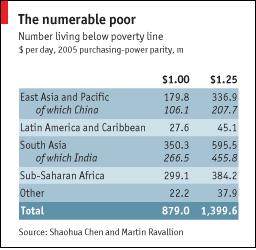
The World Bank recently revised its poverty estimate and upped the number of poor people living with less amount than standard basic requirements required to live a life. According to new estimate computed by considering the rising cost of living and using updated poverty data from countries, the WB researchers have set an international poverty line equal to $1.25 a day (at 2005 PPP). Now, over one billion people (1,399.6 to be exact) are living under extreme poverty, according to a recent updated estimate by WB researchers Ravallion and Chen. The Asian Development Bank recently came up with its own Asian Poverty Line of $1.35, according to which 800 million people live in poverty in Asia alone.
More on this from The Economist:
The researchers now prefer a yardstick more typical of the 15 poorest countries that have credible poverty lines. By this definition, people are poor if they cannot match the standard of living of someone living on $1.25 a day in America in 2005. Such people would be recognised as poor even in Nepal, Tajikistan and hard-pressed African countries such as Uganda. But for those who still think a “dollar a day” has a better ring to it, the authors also calculate the number of people living on less than that at 2005 prices (see table).
The discovery of another 400m poor people will not satisfy some of the bank’s critics, who think it still undercounts poverty. Its cost-of-living estimates are based on the prices faced by a “representative household”, whose consumption mirrors national spending. But the poor are not representative. In particular, they buy in smaller quantities—a cupful of rice, not a 10-kilogram bag; a single cigarette, not a packet. As a result, the “poor pay more”.
Such concerns prompted the Asian Development Bank (ADB) to carry out its own study of the prices faced by the poor in 16 of its member countries (not including China). Its results, released on August 27th, found that in nine of those countries the poor in fact pay less. Even though they buy in smaller quantities, they save money by buying cut-price goods from cheaper outlets: kerbside haircuts not salons; open-air stalls not supermarkets; toddy not wine.
Here is the paper (The developing world is poorer than we thought, but no less successful in the fight against poverty) by Chen and Ravallion. Below is a summary of the paper:
The paper presents a major overhaul to the World Bank's past estimates of global poverty, incorporating new and better data. Extreme poverty-as judged by what "poverty" means in the world's poorest countries-is found to be more pervasive than we thought. Yet the data also provide robust evidence of continually declining poverty incidence and depth since the early 1980s. For 2005 we estimate that 1.4 billion people, or one quarter of the population of the developing world, lived below our international line of $1.25 a day in 2005 prices; 25 years earlier there were 1.9 billion poor, or one half of the population. Progress was uneven across regions. The poverty rate in East Asia fell from 80% to under 20 percent over this period. By contrast it stayed at around 50 percent in Sub-Saharan Africa, though with signs of progress since the mid 1990s. Because of lags in survey data availability, these estimates do not yet reflect the sharp rise in food prices since 2005.


Here are some interesting stuff from Michael Spence's and El-Erian's paper titled "Growth Strategies and Dynamics: Insights from Country Experiences." I read the paper way back in April when it was first released during a panel discussion in DC. I went over the paper once again yesterday, reviewed it for my reference, and found these useful paragraphs.
...There is a certain amount of confusion in the literature with respect to informational gaps in the context of development. There are informational gaps and asymmetries (and related phenomena such as signaling, screening, and reputation building) throughout advanced economies in financial, labor, and other markets. These informational gaps are structural and do not disappear over time, absent regulation that alters the incentive structure with respect to disclosure. They also exist in developing economies, but they are fundamentally different from transitory informational gaps that tend to characterize new entrants to the global economy. The latter are not structural in the same sense, and they do decline over time with experience and normal informational spillovers. Domestic investors learn over time about the global economy and foreign investors learn about the domestic investment environment and institutions. The exception of course is when there is a blockage and relatively little interaction with the global economy. Under these conditions, incentives to jumpstart the process are appropriate.
Lessons from China's experience with growth:
China’s experience (and with variations India’s) sheds light on how to approach specific challenges that are inherent to a successful growth process. These include the pace and sequencing for liberalizing internal and external markets for goods and services, how and when and in what order to liberalize the capital account, management of the exchange rate, the role of industrial policy, overcoming the constraints imposed by a banking system riddled with NPLs and noncommercial operations, dealing with surges in capital inflows, and management of national financial wealth.
And, the ingredients in recipes that generate growth:
More on this topic here.
The Asian Development Bank (ADB) has come up with its own benchmark to measure poverty in Asia. The new Asian Poverty Line defines poverty as living on $1.35 a day. The total number of poor people in Asia with this estimate is about 800 million. Last month, the World Bank economists revised poverty estimate and set the international poverty line as $1.25 a day in 2005 prices.
The ADB has set Asian Poverty Line by calculating the median of the national poverty lines of 15 of the poorest countries in Asia. In case of the WB estimate, the international poverty line was calculated using the same technique but there was just one country from Asia, i.e. Nepal in the list, which was dominated by African nations.
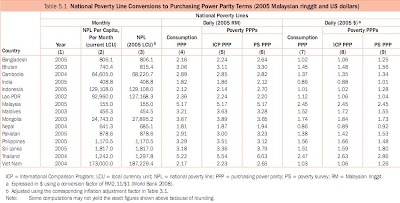
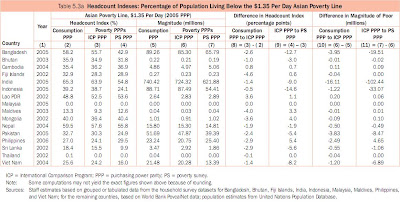
This is what percentage of population (headcount) living below the $1.35 poverty line look like:
And, this is what percentage of population living below the Asian Poverty Line looks like as against the $1 and $2 a day estimate:
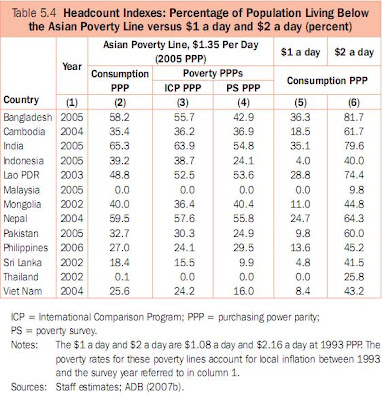
Clearly, for Nepal with the new ADB estimate the percentage of population living in poverty is higher than under $1 a day. Under $1.35 a day estimate 59.5% of the population live in poverty, while under $1 a day 24.7% and under $2 a day 64.3% of the population live in poverty.
Here is nice, valuable paragraph from Easterly's book:
Put the focus back where it belongs: get the poorest people in the world such obvious goods as the vaccines, the antibiotics, the food supplements, the improved seeds, the fertilizer, the roads, the boreholes, the water pipes, the textbooks, and the nurses. This is not making the poor dependent on handouts: it is giving the poorest people the health, nutrition, education, and other inputs that raise the payoff to their own efforts to better their lives. (p369)
Here an interview with Norman Borlaug, the father of the Green Revolution and winner of the 1970 Nobel Peace Price. He sees bio-technology as a promising field in helping Africa increase production and productivity, and sees roads as one of the growth constraints in Africa.
...Biotech has a big potential in Africa, not immediately, but down the road. Five to eight years from now, parts of it will play a role there. Take the case of maize with the gene that controls the tolerance level for the weed killer Roundup. Roundup kills all the weeds, but it's short-lived, so it doesn't have any residual effect, and from that standpoint it's safe for people and the environment. The gene for herbicide tolerance is built into the crop variety, so that when a farmer sprays he kills only weeds but not the crops. Roundup Ready soybeans and corn are being very widely used in the U.S. and Argentina. At this stage, we haven't used varieties with the tolerance for Roundup or any other weed killer [in Africa], but it will have a role to play.
Roundup Ready crops could be used in zero-tillage cultivation in African countries. In zero tillage, you leave the straw, the rice, the wheat if it's at high elevation, or most of the corn stock, remove only what's needed for animal feed, and plant directly [without plowing], because this will cut down erosion. Central African farmers don't have any animal power, because sleeping sickness kills all the animals--cattle, the horses, the burros and the mules. So draft animals don't exist, and farming is all by hand and the hand tools are hoes and machetes. Such hand tools are not very effective against the aggressive tropical grasses that typically invade farm fields. Some of those grasses have sharp spines on them, and they're not very edible. They invade the cornfields, and it gets so bad that farmers must abandon the fields for a while, move on, and clear some more forest. That's the way it's been going on for centuries, slash-and-burn farming. But with this kind of weed killer, Roundup, you can clear the fields of these invasive grasses and plant directly if you have the herbicide-tolerance gene in the crop plants.
...Supplying food to sub-Saharan African countries is made very complex because of a lack of infrastructure. For example, you bring fertilizer into a country like Ethiopia, and the cost of transporting the fertilizer up the mountain a few hundred miles to Addis Ababa doubles its cost. All through sub-Saharan Africa, the lack of roads is one of the biggest obstacles to development--and not just from the standpoint of moving agricultural inputs in and moving increased grain production to the cities. That's part of it, but I think roads also have great indirect value. If a road is built going across tribal groups and some beat-up old bus starts moving, in seven or eight years you'll hear people say, "You know, that tribe over there, they aren't so different from us after all, are they?"
And once there's a road and some vehicles moving along it, then you can build schools near a road. You go into the bush and you can get parents to build a school from local materials, but you can't get a teacher to come in because she or he will say, "Look, I spent six, eight years preparing myself to be a teacher. Now you want me to go back there in the bush? I won't be able to come out and see my family or friends for eight, nine months. No, I'm not going." The lack of roads in Africa greatly hinders agriculture, education, and development.
Read the full interview here. A related post about biography of Norman Borlaug is here.
So, the newly elected Finance Minister Dr. Baburam Bhattarai, Maoist party's second-in-command, has outlined highlights of the upcoming budget. Here are some:
The budget is due mid-September. Does not these few highlights sound inflationary? Note that at present the inflation level is hovering around 9 percent.