Monday, November 14, 2011

The sources of food and nonfood inflation in Nepal

Inflation rate in Nepal reached double-digit for three consecutive years now and is now just above 9 percent. What are sources of inflation in Nepal? Is it following Indian price level? Is it being affected by demand side or supply side or both? How much is it affected by food prices? How much traction M2 (money supply) has on inflation in Nepal? In order to bring down the persistently high and sticky price level, policymakers need to first know the sources of inflation and then devise policies accordingly. The IMF recently published a study that looks into the sources of inflation in Nepal.

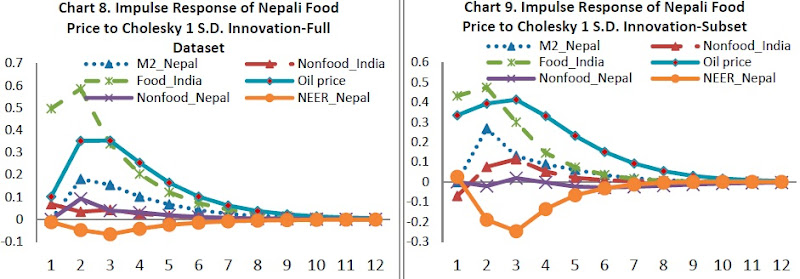
Using a VAR model to estimate the impact of external spillovers from India, international oil prices, nominal effective exchange rate, and domestic monetary factors, the study finds that inflation (both food and non-food) in Nepal is mainly driven by inflation in India and movements of international oil prices. These two factors account for more than one-third of the variability in domestic inflation. Since inflation in Nepal have been historically following inflation in India but not after 2007/08, the analysis uses two datasets: full dataset ranging from 2001 to 2011 and a sub dataset ranging from 2007 to 2011. The latter dataset shows that inflation in Nepal is deviating from India’s inflation and is becoming more responsive to oil prices. Note that Nepal has open border and pegged its currency with India.

Overall inflation

  • Monetary factors matter more for nonfood price inflation than for food price inflation. But, its effects fade out quickly. (Earlier I wrote that M2 does not have traction on inflation). Monetary tools have not been used to manage inflation.
  • The appreciating nominal effective exchange rate has a negative and lagged impact on inflation only between 2007 and 2011 dataset. [It might be due to rising imports in recent years.]
  • Responsiveness to international oil prices and exchange rate has increased lately. That is why international oil prices show a stronger effect in the 2007-2011 dataset.
  • Food price increases have contributed about three-fourths of overall CPI inflation, while nonfood prices contributed the remaining one-fourth. Food price inflation has been more volatile than nonfood price inflation.

Food price inflation

  • The responsiveness of food price inflation is significant and quick to spillovers from India’s food inflation and oil price movements. Furthermore, the impact of oil prices is more persistent than India’s food inflation. It intensified in recent years. It might be because the price of petroleum products gets reflected faster in the price of chemicals and fertilizers used in agriculture production, transportation cost of agriculture products and use of energy in irrigation, says the report.
  • Nominal effective exchange rate has a negative effect on food inflation with a lag of about three months in 2007-2011 dataset only.
  • Monetary responsiveness to food price inflation is significant in 2007-2011 dataset, but the effect fades out quickly.
Nonfood price inflation

  • Monetary responsiveness to nonfood price inflation is strong in both full and subset dataset series (with largest impact on the full dataset). But, the effects are short.
  • Nonfood price inflation responds to Indian food and nonfood inflation as well as international oil prices (strongly since 2007).
  • Nominal effective exchange rate has a negative effect on nonfood price inflation between 2007-2011 dataset only.


In a study of similar nature in 2007, Edimon Ginting shows that inflation in India and inflation in Nepal tend to converge in the long run, but the pass through of inflation from India to Nepal take about seven months. Now, this seems to have been violated especially after 2007 due to the strong impact of petroleum prices.

Here is how there is disconnect between Indian and Nepalese inflation rates. I wrote this one last year and is still valid. 

  • In the long term, inflation is primarily affected by money supply. In the short term, it is affected by demand and supply pressures, which in turn are dictated by relative elasticity of wages, prices and interest rates. The inflationary pressure in the short term could drag into medium term and long term, leading to high inflation for an extended period of time. It happens if prices and wages are too sticky at high level, i.e. once prices and wages rise either due to demand or supply pressure, or both, even if pressures subside, they continue to remain at high levels. This is happening in the economy since 2007.
  • One of the reasons why prices remain sticky at high levels (i.e. domestic prices do not come down even when market conditions normalize) is because of various non-economic factors constraining the functioning of markets.
  • The global economy was struck by a rapid rise in commodity and food prices in 2007, severely affecting net food importing developing countries like Nepal. Several countries, including India, banned export of key agricultural items imported by Nepal. The shortage of agricultural goods led to rapid rise in domestic prices. Then came a sudden rise in global fuel prices in 2008, leading to a drastic increase in petroleum prices in the domestic market. This directly reduced real disposable income because a substantial portion of the population banks on petroleum products for daily need. It also shot up cost of production of domestic producers, resulting in rising prices of consumer goods and services. The combined effect of the rise in food, commodity, and fuel prices led to spiraling prices starting 2007.
  • Unfortunately, when fuel, commodity and food prices cooled down in the international market, the hangover persisted in our economy. Prices stubbornly remained sticky at high levels. Exogenous factors such as supply bottlenecks due to extended periods of bandas and strikes led to shortage of essential items. Additionally, hoarding, black marketeering, deliberate withholding of supplies and inventory, and agricultural trade hurdles imposed by our neighbors contributed to keeping prices higher even after the normalization of market forces.
  • These series of events contributed to higher inflationary expectations, leading to a situation where workers, employers, producers, wholesalers and retailers started inflating wages and prices on expectation that inflation will go up. The final outcome was a permanently higher inflation. It might go even higher if the supply side constraints and inflationary expectations are not timely and adequately addressed.

Here is another piece I wrote in 2009 and the arguments still hold true.

Sunday, November 13, 2011

Policy implementation paralysis in Nepal

[This was published in Republica, November 12, 2011, p.6]


Policy implementation paralysis

Here is a snapshot of the current state of our economy: Economic growth is stagnant at under 4 percent, well short of fiscal budgetary targets and the Three Year Interim Plan. A lack of job opportunities in the domestic economy is compelling over 20,000 workers to seek employment abroad every month. General prices of goods and services have been stubbornly sticky at near double-digit level. The fragile financial sector and real estate activities have not recovered yet. The manufacturing sector is shrinking, productivity is declining, competitiveness of Nepali products is eroding in the international market and imports are ever-surging, which has resulted in widening of the trade deficit. Expenditure growth is higher than revenue growth and the growing saving-investment gap has led to inflow of foreign aid worth 25 percent of budget. High inflow of remittances has precariously balanced the economy right now.

All of these have occurred not because we lack good policies, but because there is laxity in implementing existing policies and enacting new ones that will directly stimulate economic activities.

Anyone trying their hands at innovative and entrepreneurial stuff, those who are actively looking for job opportunities and those frequenting local retail stores might have realized that the current state of economic affairs is simply unsustainable. Unfortunately, most of our political leaders and policymakers, far removed from the concerns of the regular folks, are unaware of the fact that the status quo is unsustainable. It is high time they acknowledged that new reforms and effective implementation of the already enacted ones are vital to break the economic impasse.

Thus the government should focus on effectively implementing the enacted economic and trade reforms and formulate new ones that directly address the constraints to growth of key sectors. Equally importantly, it should also ensure that the implementation of reforms is overseen by qualified and informed policymakers and political leaders.

Our economy will remain competitive only if we align production and employ resources in such a way that output base gradually shifts from production of low value added goods to high value added goods. It will lead to an increase in growth rate, job opportunities, revenue, production level, and foreign reserves as our export items gain deeper foothold in the international market. For this to happen, the economy needs to undergo structural transformation along with the enhancement of productivity.

In its latest Article IV Consultation with Nepal, the IMF also argued that Nepal needs to enact structural reforms to raise productivity and growth. It maintains that macroeconomic stability and managing financial sector risks are the two most challenging tasks right now. Given the current state of our economy, it expects real economic growth of 3.8 percent in 2011/12, which is revised downward from its preliminary estimate released in August. It means that economic activities are expected to slow down even more than what was projected few months back.

Now, to check further slowdown in growth (which is expected to remain below 4 percent till 2015 with the current state of affairs) and maintain macroeconomic stability, we need meaningful implementation of structural and policy reforms. It means controlling unproductive expenditure, raising revenue, increasing exports and decreasing trade deficit, maintaining sound balance of payment, controlling high inflation, addressing supply-side constraints, and ensuring soundness of the financial sector, among others. Without effectively implementing the already enacted reforms and adopting new ones that will generate high growth and employment, all of these economic challenges will remain unaddressed. Sadly, the existing laxity shown by policymakers and political leaders on this front is costing us dearly in terms of lost industrial output and eroding competitiveness of our exports.

For instance, as outlined in the Industrial Policy 2010, the government has been unable to implement ‘no-pay-for-no-work’ policy and one-window facility to all industrial woes. Similarly, the same policy document promises easy exit from business for promoters, freeing them from long-term labor and other liabilities. Unfortunately, all of these also remain unrealized as is evidenced by the difficulty in exiting the market by the labor strike stricken Surya Nepal’s garment manufacturing unit in Biratnagar. The policy implementation paralysis is leading to protracted industrial disputes, high cost of production resulting from power cuts and high labor costs, and numerous supply-side impediments. These are eroding investors’ confidence In our economy. Worse, labor cost in Nepal is already the highest in South Asia. The total annual labor cost is US$ 1889 per year in Nepal while the figures for Bangladesh, India, Pakistan and Sri Lanka are US$ 789, US$ 943, US$ 1052 and US$ 1619, respectively. Additionally, the parliament has not yet passed the Special Economic Zones (SEZs) Act at a time when the construction of first SEZ in Bhairawa is nearing completion. Without this bill to operationalize SEZs, approximately Rs 1 billion worth of investment will go down the drain. Moreover, the government has not also been to implement various export promotion and industrial policies that have been enacted since 2009.

It is no surprise that the eroding competitiveness of our economy is vividly reflected in recent comparative studies. First, the global competitiveness report shows that Nepal is one of the most uncompetitive economies in South Asia, ranking 125 out of 142 countries. Nepal’s labor market efficiency is ranked below that of other factor-driven economies. Worse, Nepal’s infrastructure ranking is the second worst out of the 142 economies. The business community thinks that government instability—followed by inefficient government bureaucracy, policy instability, corruption, and lack of infrastructure among others— is the most problematic factor for doing business. Second, according to the latest Doing Business report, the cost of starting business (37.4% of income per capita) in Nepal is far higher than the average for South Asia (21.6% of income per capita). In terms of export facilitation, there has not been any improvement in the last couple of years. It still takes 9 documents, 41 days, and US$ 1960 to export a container.

Third, according to the latest Gallup poll, the Nepalese people feel that a lack of political leadership and corruption are the main factors preventing economic growth. In the survey, 64% of respondents who were dissatisfied with the current economic conditions said that a lack of political leadership was the main factor behind poor economic performance. Almost the same percentage of respondents felt that corruption is impeding our potential economic growth path. It shows that a lack of political will to project economic agendas before political agendas, misinformed political leaders at the helm of decision making bodies, and corruption are the main reasons for the policy implementation paralysis.

To address the macroeconomic problems and economic hardships faced by households, there is no option other than to increase productivity and competitiveness of our economy by seriously implementing the already enacted reforms and introducing new ones aimed at boosting growth and employment. The laxity in implementing agreed policies and half-hearted commitment to enact needed reforms is not helping to resolve our economic woes.


Friday, November 11, 2011

Cash incentives for export promotion in Nepal

My presentation on policy study on cash incentives for export promotion in Nepal. The event was organized by the FAO. Here is my earlier take on cash incentives issue.

Cash Incentives for Export Promotion in Nepal

Tuesday, November 8, 2011

Determinants of financial flows from BRICs to LICs

Turns out BRICs lend more to low income countries with weaker institutions. Interestingly, interests on loans are higher for countries that have weak institutional indicators (i.e. higher the risks, higher the interest rates). And, land-locked, resource-scarce low income countries receive less financing than resource-rich countries. Below is the abstract from a working paper by Nkunde Mwase of the IMF.


BRICs development financing flows have increased significantly and are expected to become more prominent in the post-crisis era. We investigate the potential implications on the country-allocation of loan commitments and the degree of concessionality using a panel vector autoregression model and single equation dynamic panel estimation.We find that BRICs lend more to LICs with weaker institutions. Land-locked, resource-scarce LICs receive significantly less financing than other resource-rich LICs. The degree of concessionality is negatively correlated with the amount of loans and positively correlated with better institutional indicators suggesting that the higher the risks, the higher the required returns that BRICs expect.


Monday, November 7, 2011

Links of Interest (2011-11-07)

Europe Sneezes, India Catches a Cold (Europe was the target for 18 percent of India’s exports, compared with 10 percent headed for the US. Collapse of the euro could instigate a host of protectionist measures that would disrupt global trade.)

The Contribution of Chinese FDI to Africa's Pre Crisis Growth Surge


In the 3 years before the 2008 Financial Crisis, GDP growth in sub Saharan Africa (averaged over individual economies) was around 6%, or 2 percentage points above mean growth rates for the preceding 10 years. This period also coincided with significant Chinese FDI flows into these countries, accounting for up to 10% of total inward FDI flows for certain countries in these years. [...]Our individual results vary by year and country, but there are several year/country combinations where Chinese FDI contributed to an additional one half of a percentage point or above to GDP growth. These results suggest that a significant, even if in some cases small, portion of the elevated growth in sub Saharan Africa in the three years before the Financial Crisis and also in the two years afterwards (2008-2009) can be attributed to Chinese inward investment.


Unconditional Convergence by Dani Rodrik (Here is another one by Rodrik)


Unlike economies as a whole, manufacturing industries exhibit unconditional convergence in labor productivity. The paper documents this finding for 4-digit manufacturing sectors for a large group of developed and developing countries over the period since 1990. The coefficient of unconditional convergence is estimated quite precisely and is large, at 3.0-5.6 percent per year depending on the estimation horizon. The result is robust to a large number of specification tests, and statistically highly significant. Because of data coverage, these findings should be as viewed as applying to the organized, formal parts of manufacturing.


On aid and growth: Reflections ahead of Busan (The links below show that aid has positive impact on growth. Beware of the fact that there are studies that also show aid does not buy growth. Meanwhile, Raghuram Rajan and Arvind Subramanian argue that aid inflows have systematic adverse effects on a country's competitiveness, as reflected in a decline in the share of labor intensive and tradable industries in the manufacturing sector, but private-to-private flows like remittances do not seem to create these adverse effects.They argue that these effects stem from the real exchange rate overvaluation caused by aid inflows.)

  • Arndt, Channing; Jones, Sam; and Tarp, Finn (2010) argue that aid has a positive and statistically significant causal effect on growth over the long run, with confidence intervals conforming to levels suggested by growth theory. Aid remains a key tool for enhancing the development prospects of poor countries.
  • Tseday Jemaneh Mekasha and Finn Tarp argue that meta-analysis show that effect of aid on growth is positive and statistically significant.
  • Katarina Juselius, Niels Framroze Møller, and Finn Tarp argue that their study provides “broad support for a positive long-run impact of ODA flows on the macroeconomy. For example, we find a positive effect of ODA on investment in 33 of the 36 included countries, but hardly any evidence supporting the view that aid has been harmful. From a methodological point of view our study documents the importance of transparency in results reporting in particular when the statistical null does not correspond to a natural economic null hypothesis. Our study identifies three reasons for econometrically unsatisfactory results in the literature: failure to adequately account for unit roots and breaks; imposing seemingly innocuous but invalid data transformations; and imposing aid endogeneity/exogeneity without testing.”
  • Channing Arndt, Sam Jones, and Finn Tarp argue that aid stimulates growth and reduces poverty through physical capital investment and improvements in health.

Nepal government is making employment database to match workers with employers

Nepal’s IT industry attracts US’s IT firm’s attention (“The number of IT companies in the country working for American companies has significantly gone up. In recent months, some of the local companies have been acquired by the US-based companies and also the number of new companies with tie-ups with American companies is on the rise.”)

Inequality drags down Nepal’s HDI ranking


Even though Nepal´s performance improved on human development, the country ranked 157th out of 187 countries in Global Human Development Index (HDI), down from last year´s ranking at 138th position.

The drop in position, however, was recorded not because Nepal performed badly on income, education and health -- three key areas that Human Development Repot (HDR) focuses on, but because this year´s ranking was done after adjusting inequality in all those areas, according to officials.


Justin Lin explains Development Thinking 3.0 (Here is a link to the full paper on Lin’s rejoinder to Kruger, Stiglitz, and Rodrik’s comment on his paper on New Structural Economics.)

Sources of electricity in Asia

Mountainous countries generally depend on hydropower to generate electricity. Fast growing economies depend more on fossil fuels to generate most of their electricity. Nepal derives all of its electricity from hydropower. The figure in the left is adapted from this ADB 2010 report (p.38). Burenei Darussalam depends entirely on carbon fuels. Check out the Asian countries’ dependence on carbon fuels, hydropower, and other fuels for their power needs.

The curious case of Nepali electricity supply is noteworthy here. Despite having one of the highest hydropower potentials, Nepal is facing acute shortage of electricity. Load-shedding is a normal phenomena year round (blackouts could be as long as 18 hours a day during dry season). There is huge demand for electricity in the market—meaning high returns to investment, albeit with high gestation period—but still supply cannot remotely match up the demand.

Sunday, November 6, 2011

World Hunger Report 2011: High & volatile prices in the future as well

The World Hunger Report 2011 argues that high and volatile prices are set to continue in the coming days. Key message from the FAO report are copied below:


  • Some large countries were able to insulate themselves from the crisis through restrictive trade policies and functioning safety nets, but trade restrictions increased prices and volatility on international markets.
  • Demand from consumers in rapidly growing economies will increase, population will continue to grow, and further growth in biofuels will place additional demands on the food system. On the supply side, there are challenges due to increasingly scarce natural resources in some regions, as well as declining rates of yield growth for some commodities. Food price volatility may increase due to stronger linkages between agricultural and energy markets, as well as an increased frequency of weather shocks.
  • Because food represents a large share of farmer income and the budget of poor consumers, large price changes have large effects on real incomes. Thus, even short episodes of high prices for consumers or low prices for farmers can cause productive assets – land and livestock, for example – to be sold at low prices, leading to potential poverty traps. In addition, smallholder farmers are less likely to invest in measures to raise productivity when price changes are unpredictable.
  • Changes in income due to price swings can reduce children’s consumption of key nutrients during the first 1 000 days of life from conception, leading to a permanent reduction of their future earning capacity, increasing the likelihood of future poverty and thus slowing the economic development process.
  • The benefits go primarily to farmers with access to sufficient land and other resources, while the poorest of the poor buy more food than they produce. In addition to harming the urban poor, high food prices also hurt many of the rural poor, who are typically net food buyers. The diversity of impacts within countries also points to a need for improved data and policy analysis.
  • Domestic food prices increased substantially in most countries during the 2006–08 world food crisis at both retail and farmgate levels. Despite higher fertilizer prices, this led to a strong supply response in many countries. It is essential to build upon this short-term supply response with increased investment in agriculture, including initiatives that target smallholder farmers and help them to access markets, such as Purchase for Progress (P4P).
  • In order to be effective at reducing the negative consequences of price volatility, targeted safety-net mechanisms must be designed in advance and in consultation with the most vulnerable people.
  • Restrictive trade policies can protect domestic prices from world market volatility, but these policies can also result in increased domestic price volatility as a result of domestic supply shocks, especially if government policies are unpredictable and erratic. Government policies that are more predictable and that promote participation by the private sector in trade will generally decrease price volatility.
  • Investment in agriculture remains critical to sustainable long-term food security. For example, cost-effective irrigation and improved practices and seeds developed through agricultural research can reduce the production risks facing farmers, especially smallholders, and reduce price volatility. Private investment will form the bulk of the needed investment, but public investment has a catalytic role to play in supplying public goods that the private sector will not provide. These investments should consider the rights of existing users of land and related natural resources.