Sunday, August 17, 2008

Links of Interest

A very Canadian way to solve a world problem

Together they form the basis of what is often called "hidden hunger," the deforming element of malnutrition that stunts children's growth and can dramatically shorten the lives of youngsters and pregnant women throughout much of Africa and southeast Asia.

The other surprise was that the person advocating the investment is a Canadian: Susan Horton, an economics professor at Wilfrid Laurier University in Waterloo, Ont., who has been involved with Third World nutrition issues since a graduate-student stint at Bangladesh's International Centre for Diarrheal Disease Research about 30 years ago.

Her plan: An investment of $347 million a year over five years to scale up the delivery of vitamin A, iron and iodine, and to add zinc and folic acid to the majority of diets in sub-Saharan Africa and much of Asia. She believes the result would be an estimated $5 billion in health-care savings and future earnings — and saving something in the order of 3.5 million lives.

The Copenhagen Consensus for 2008 lists that micronutrient supplements for children (vitamin A and zinc) as the top most solvable (based on what produces the biggest bang for a buck) problem for this year. Every dollar spent on micronutrients would generate a $17 return in health and productivity costs, which is far greater than investments in global warming or counterterrorism, which require enormous amounts of public money to make even a modest amount of headway. The top ten problems in the list are micronutrient supplements for children (vitamin A and zince), the Doha development agenda, micronutrient fortification (iron and salt iodization), expanded immunization coverage for children, biofortification, deworming and other nutrition programs at school, lowering the price of schooling, increase and improve girls' schooling, community-based nutrition promotion, and provide support for women's reproductive role.

Why doesn't aid work in sub-Saharan Africa?

Unsolved problems in economics

  1. What caused the Industrial Revolution?
  2. What is the proper size and scope of government
  3. How can heterogeneous production goods be included in a mathematically tractable intertemporal equilibrium constrution?
  4. What caused The Great Depression?
  5. The Equity premium puzzle
  6. How is it possible to provide causal explanations using the purely logical constructions of mathematical economics?
  7. Futures contract model
  8. What is the microeconomic foundation of inflation?
  9. Is the money supply endogenous?
  10. How does price formation occur?
  11. What causes the variation of income among ethnic groups?

A fiasco named NOC (a good article about sorry state of state-run Nepal Oil Corporation and the perennial short supply of oil, even when subsidies are scrapped and prices upped multiple times. What's the secret: corruption, political infringement in management decision, poor governance, and poor accountability)
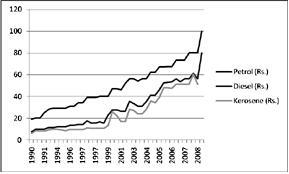


See my take on the Nepali fuel crisis and the troubled NOC here (written in Sept 2007, but for some reason it was not published in the newspaper I usually publish Op-Ed and Commentary).


Large cardamom export touches new record (Nepal is the largest exporter of large cardamom. This product has been identified as having the highest export potential. I don't understand why the policymakers are neglecting this particular product rather than actively promoting its production in the country. Nepal has already squandered decades promoting garment and textile sector. Sadly, the same sector is now reeling under sustained recession (I say the Great Garment Depression of 2005/06 in Nepal) chiefly because of slacking competitiveness of Nepali products and production efficiencies fostered by subsidies and duty free access in the West until the end of MFA in 2005)

Friday, August 15, 2008

Former guerrilla becomes Prime Minister

Finally after two years of political bickering, the political parties have chosen Pushpa Kamal Dahal aka Prachanda, the head of the Maoist guerrillas (former) who waged a bloody decade long war against the monarchy and state, as the first prime minister of the Federal Democratic Republic of Nepal. More here.

Prachanda as PM

It needs to be seen how Prachanda tames his belligerent guerrillas currently stationed at different cantonments supervised by the UN. Also, it needs to be seen what form of political and economic system Nepal would follow under his leadership. My concern about too many potential red tapes here. There will be more questions raised about the Maoists' bullying nature and their ability to lead the nation through the path of peace, which Nepal has barely witnessed in the past two years.

Keynes got it right but ...

Krugman recalls Keynes while explaining why nationalism, militarism and imperialism might overturn the gains from and prospects of globalization:

...Writing in 1919, the great British economist John Maynard Keynes described the world economy as it was on the eve of World War I. “The inhabitant of London could order by telephone, sipping his morning tea in bed, the various products of the whole earth ... he could at the same moment and by the same means adventure his wealth in the natural resources and new enterprises of any quarter of the world.”

And Keynes’s Londoner “regarded this state of affairs as normal, certain, and permanent, except in the direction of further improvement ... The projects and politics of militarism and imperialism, of racial and cultural rivalries, of monopolies, restrictions, and exclusion ... appeared to exercise almost no influence at all on the ordinary course of social and economic life, the internationalization of which was nearly complete in practice.”

But then came three decades of war, revolution, political instability, depression and more war. By the end of World War II, the world was fragmented economically as well as politically. And it took a couple of generations to put it back together.

So, can things fall apart again? Yes, they can.

Consider how things have played out in the current food crisis. For years we were told that self-sufficiency was an outmoded concept, and that it was safe to rely on world markets for food supplies. But when the prices of wheat, rice and corn soared, Keynes’s “projects and politics” of “restrictions and exclusion” made a comeback: many governments rushed to protect domestic consumers by banning or limiting exports, leaving food-importing countries in dire straits.

And now comes “militarism and imperialism.” By itself, as I said, the war in Georgia isn’t that big a deal economically. But it does mark the end of the Pax Americana — the era in which the United States more or less maintained a monopoly on the use of military force. And that raises some real questions about the future of globalization.

...the belief that economic rationality always prevents war is an equally great illusion. And today’s high degree of global economic interdependence, which can be sustained only if all major governments act sensibly, is more fragile than we imagine.

Marriage between markets and regulation

The head of the UNDP says we need more regulation that does not stifle individual/market incentives:

Even very strong supporters of “capitalist globalization” believe that greater and more effective regulation is needed to make what some call “financial capitalism” sustainable...What we need to invent and develop are regulatory mechanisms that, on the one hand, don’t stifle private initiative and the creative energy of a market economy, but on the other hand, are very effective in their correction of the market failures that lead to excesses and misallocation of resources. We must also remember that democratic societies can only function well if the results achieved by the market economy are politically acceptable. The current global financial crisis provides a stark example of the consequences of missing and misguided regulation in the market economy.

Read the Q&A with Kemal Dervis, head of the UNDP here.

Thursday, August 14, 2008

Top universities in the world

Here is the full list of the academic ranking of world universities 2008. Obviously, the US education institutions occupy the top spots on the list.

academic ranking


Monday, August 11, 2008

Time to focus on tourism and hydro sectors

Finally, the Nepali businessmen have realized (after decades of inefficient investment in the garment and apparel sector) that Nepal should focus on what it inherently is best at exploiting comparative advantage. The President of Nepal Chamber of Commerce (NCC) argues that for economic development the government should focus on four main areas:

(i) Development of hydropower (ii) Promotion of tourism and special incentives for its development (iii) Strengthening of economic diplomacy and (iv) Human resource development.

Is it a self-discovery of the best sectors needed for economic development? If it is, then thank God, it has been acknowledged now, though late. Enough of focus on the uncompetitive garment, apparel, and carpet sector, which have led the economy nowhere! Now, it is time to change direction and focus on what Nepal is best at harnessing its comparative advantage.

Nepal has notorious transportation system, which has always created supply bottlenecks (contributing to longer delivery time and increase in cost of production). Focusing on tourism and hydro sector would be relevant because these sectors do not require well paved roads. Tourism relies very less on road transportation, as tourists usually either take airway or hike up the hills. Hydro sector also does not require roads as much as the export/trade sector does. So, in the short run Nepal is better off focusing on these sectors. Meanwhile, in the long run it should construct well paved roads/transport networks along with the development in the trading sector.

More like self-discovery, agian:

We have always urged the government to provide incentives to farmers, focus on agro and herb processing industries and link farms with the market - both domestic and overseas - in order to develop rural Nepal and help people enjoy the fruits of development. We have also focused on capacity building of commodity associations so that they can better serve the markets.

Very sticky labor laws are a big, big problem in Nepal:

...our long-running demands like "no work no pay" and a "hire and fire" provision in the labor law continue to fall on deaf ears. Labor law reform has been shelved for now.